

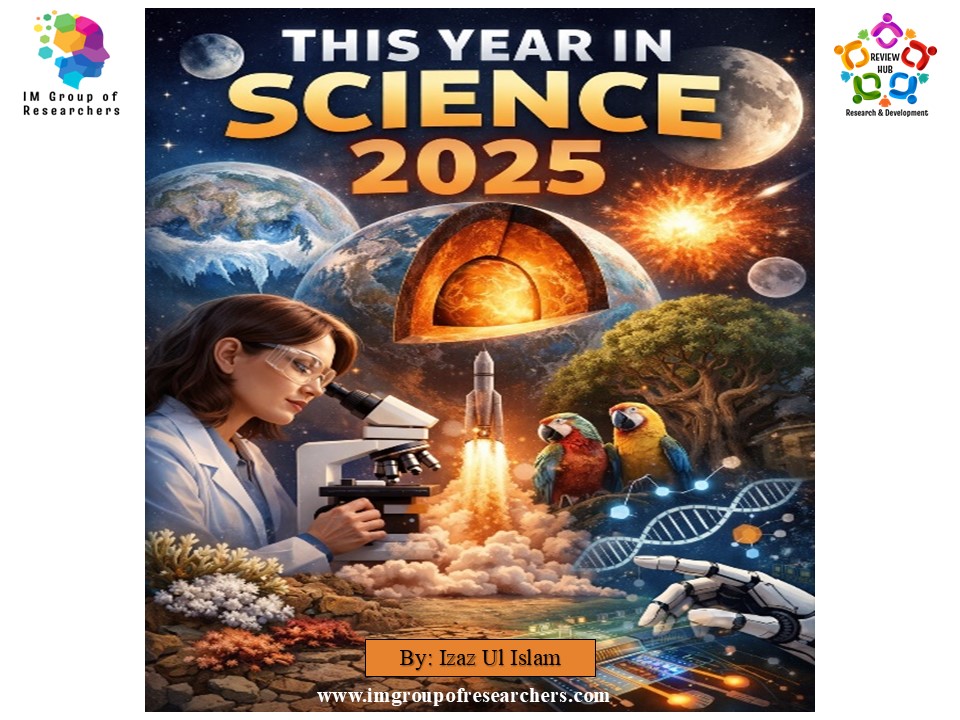
Author: Izaz Ul Islam
Science in 2025 was less about sudden “eureka” moments and more about revealing hidden layers — inside our planet, inside living systems, and across scientific disciplines. Month by month, researchers peeled back complexity, showing that the natural world is far more dynamic, interconnected, and surprising than we once believed.
January – Looking Inward
The year opened with a discovery from deep beneath our feet. Seismologists analyzing earthquake waves reported that Earth’s inner core may be layered like an onion, rather than a smooth, uniform sphere. These subtle layers hint at different stages of Earth’s formation and provide clues about how the planet’s magnetic field is generated and maintained. January set the tone for 2025: re-examining foundations long assumed to be settled science.
February – Mapping the Mind
February focused on the brain and its vulnerabilities. Neuroscientists identified early biological patterns associated with Alzheimer’s disease, some appearing years before memory loss begins. These findings suggested a future where neurodegenerative diseases could be detected — and possibly treated — much earlier. At the same time, psychologists explored how brain structure, personality, and environment interact, emphasizing that mental health is both biological and deeply social.
March – Ancient Life, Living Earth
In March, biology stretched across deep time. Researchers described giant ancient trees, potentially new species, that may have survived for millennia, quietly recording Earth’s climate history in their rings. Elsewhere, studies of microbes and early life forms revealed how resilient and adaptable life can be, reinforcing the idea that Earth’s biosphere is far older — and stranger — than it appears.
April – A Sharper Universe
Space science dominated April. New telescope observations delivered clearer views of supernovae, galaxies, and cosmic debris, helping scientists better understand how stars are born, live, and die. Lunar studies also gained attention, with improved models of the Moon’s interior refining our understanding of its formation — knowledge that will be crucial for future human exploration beyond Earth.
May – Climate Signals Grow Louder
By May, climate science took center stage. Researchers reported accelerating coral reef loss, record-breaking temperatures, and compounding ecosystem stress. Scientists emphasized that climate change is not a collection of isolated disasters but a network of interconnected effects — where warming oceans, biodiversity loss, and extreme weather amplify one another.
June – Intelligence Beyond Humans
June brought surprising insights into animal behavior. Studies documented complex communication, learning, and even rhythmic dance behaviors in birds, challenging assumptions that advanced cognition is uniquely human. These findings blurred the line between instinct and intelligence, suggesting that many species possess richer inner lives than previously recognized.
July – Rethinking Aging and Health
Health science in July turned toward aging. Researchers questioned popular longevity myths and examined how organs, immune systems, and cells age at different rates. Rather than searching for a single “anti-aging switch,” scientists emphasized aging as a complex biological process shaped by genetics, lifestyle, and environment.
August – Smaller Tools, Bigger Science
August highlighted a quiet technological revolution. Physicists proposed tabletop particle accelerators, shrinking machines once the size of buildings into devices that could fit inside university labs. Meanwhile, new imaging technologies allowed scientists to watch viruses invading cells in real time, transforming how diseases are studied and treated.
September – AI Joins the Lab
In September, artificial intelligence moved from support tool to scientific partner. AI systems helped design new materials, analyze massive datasets, and model complex physical systems. Across disciplines, researchers found that AI didn’t replace human insight — it amplified it, accelerating discovery and revealing patterns too complex for humans alone.
October – Revisiting Old Mysteries
October revisited mysteries that have lingered for centuries. Scientists proposed physical explanations for ghostly atmospheric lights once attributed to folklore, blending physics with historical observation. At the same time, physicists and cosmologists re-examined long-standing assumptions about matter, energy, and the structure of the universe.
November – Science Meets Society
As discoveries accumulated, November focused on how science is communicated. Researchers and educators confronted misinformation and emphasized transparency, uncertainty, and trust. A growing generation of science communicators played a key role in making complex research accessible, reminding the public that science is a process, not a fixed set of answers.
December – Drawing the Connections
December was a month of reflection. End-of-year analyses revealed clear patterns: science in 2025 was interdisciplinary, tool-driven, and deeply connected to global challenges. From Earth’s core to artificial intelligence, the year showed that understanding our world requires collaboration, better tools, and the courage to question long-held assumptions.
2025 Conclusive Remarks
Science in 2025 did not just uncover new facts — it revealed deeper connections. Between Earth and space, biology and technology, humans and nature, the year demonstrated that progress comes not from isolated breakthroughs, but from seeing how everything fits together.
Read More: The Mystery Of Highly Reactive Oxygen Has Finally Been Solved
Follow Us on