

Author: Izaz Ul Islam
Imagine a future where carbon is no longer the enemy!!
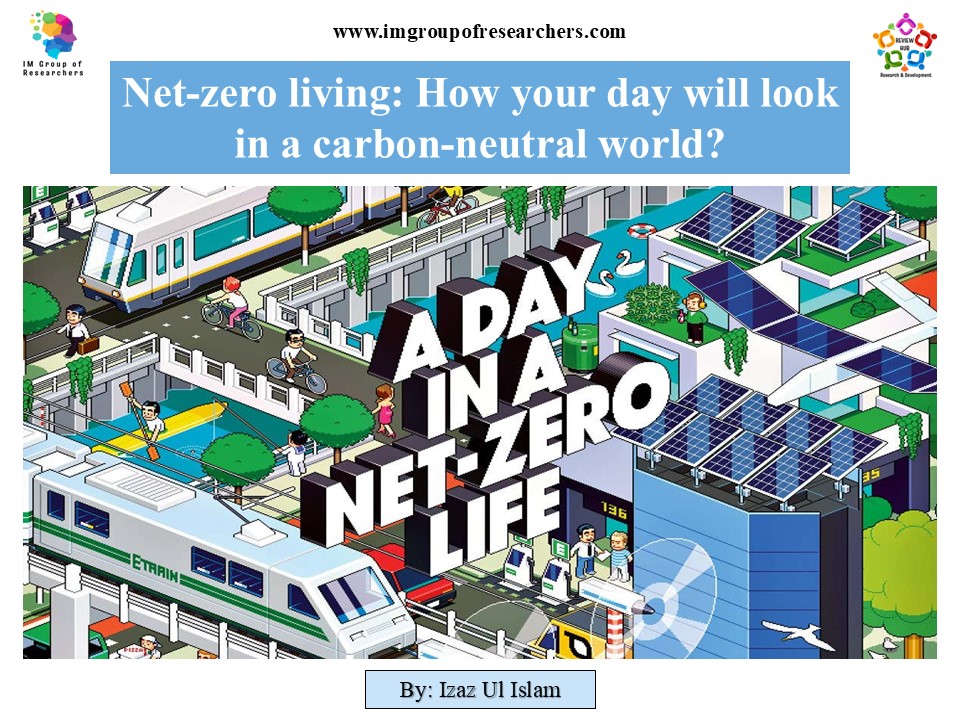
We fast-forward to 2050 and imagine what an average day will be like when we have slashed our carbon emissions – a picture informed by the latest research, ongoing trials and expert opinion
Not extracted from deep geological reservoirs, combusted, and released into the atmosphere—but cultivated, engineered, recycled, and intentionally redeployed. A future in which carbon is recovered from waste streams, refined at the molecular level, and applied to regenerate soils, store energy, purify water, construct resilient cities, protect human health, and even support life beyond Earth. This future already has a name: biochar.
As a researcher working at the intersection of carbon science and environmental systems, I often find myself reflecting on what such a future might realistically entail. Not because biochar represents a singular solution to the challenges ahead—it does not—but because decades of empirical research demonstrate that, when applied thoughtfully and contextually, it can address multiple interconnected pressures shaping our planet. Biochar is best understood not as a cure-all, but as a flexible material platform whose effectiveness depends on design, governance, and systems-level integration.
What began as charcoal incorporated into soil has matured into a scientifically validated carbon architecture. Its long-term stability, customizable porosity, and adaptable surface chemistry have already proven valuable across agriculture, water treatment, remediation, construction, energy storage, and emerging biomedical fields. Each successful application—whether in croplands, filtration systems, electrochemical devices, or experimental laboratories—strengthens a vision that is no longer speculative, but increasingly evidence-based.
This article explores a near-term future grounded in scientific plausibility rather than optimism alone. It imagines a world in which biochar does not replace existing solutions, but complements them—quietly integrating into systems designed for resilience, regeneration, and long-term equilibrium. If carbon has long been framed as the core problem, biochar may help redefine how humanity coexists with it—intelligently and responsibly.
From Soil Amendment to Carbon Platform
Once viewed narrowly as a soil additive, biochar is rapidly emerging as one of the most versatile material platforms of the twenty-first century. Accelerating research has transformed it from a residual black carbon into a tunable, functionalized, and application-specific material capable of operating across agriculture, infrastructure, energy systems, environmental remediation, medicine, and even space science. The cities and technologies of tomorrow may well be carbon-negative, porous, conductive, biologically interactive—and biochar-enabled.
Regenerative Agriculture Begins Belowground
In a biochar-enabled future, agriculture shifts from managing nature to collaborating with it.
Soils enriched with next-generation biochars become dynamic biochemical environments rather than passive substrates. Engineered pore networks support microbial communities that regulate nutrient cycling, stabilize nitrogen, immobilize toxic metals, and moderate soil moisture. Crops grow in soils that retain water during drought, resist nutrient loss during heavy rainfall, and sequester atmospheric carbon for centuries.
Advanced biochars—produced through precisely controlled pyrolysis, activation, and surface modification—function as nutrient reservoirs, releasing ions in synchrony with plant demand. Farming evolves from extractive practices toward regenerative systems, with biochar forming the structural carbon backbone of long-term soil health and food security. Existing research already confirms biochar’s ability to improve soil structure, enhance microbial resilience, and deliver persistent carbon sequestration, making large-scale deployment a matter of implementation rather than scientific uncertainty.
Carbon as the Skeleton of Future Cities
Where concrete once symbolized durability, carbon-based composites begin to redefine it.
Biochar-reinforced cementitious materials and asphalt blends yield lighter, stronger, and more durable infrastructure. Their internal carbon porosity improves thermal regulation, reduces material fatigue, and extends service lifetimes. Buildings require less energy, pavements resist cracking, and urban heat island effects are mitigated.
In this vision, cities quietly transition from carbon emitters to carbon reservoirs. Building envelopes incorporate biochar-based materials that adsorb indoor pollutants and regulate humidity. Conductive biochar layers provide electromagnetic shielding and decentralized energy storage. Architecture becomes interactive rather than inert—structures respond dynamically to energy flows, air quality, and climate.
Decentralized and Resilient Water Systems
In the biochar future, water treatment becomes robust, adaptable, and locally scalable.
Activated and functionalized biochar membranes remove heavy metals, pharmaceuticals, organic contaminants, and pathogens in a single treatment step. Rural communities deploy filtration systems fabricated from local agricultural residues, closing loops between farming, waste management, and clean water access. In disaster response, compact biochar filters restore potable water rapidly. Urban wastewater facilities evolve into resource recovery hubs, capturing nutrients, carbon, and energy instead of discarding them.
Advanced biochars already rival conventional activated carbons in adsorption performance, while offering significantly lower environmental costs and greater adaptability.
From Remediation to Ecological Repair
Landscapes once deemed irreversibly damaged are progressively restored.
Biochar barriers stabilize arsenic-contaminated aquifers, immobilize petroleum residues, and detoxify industrial soils. Surface-modified biochars selectively capture persistent organic pollutants while supporting microbial degradation pathways. Instead of relocating contamination, ecosystems are stabilized in situ and guided toward recovery.
Post-mining and chemically degraded landscapes regenerate atop carbon frameworks that anchor soil, retain moisture, and promote biological succession. Environmental remediation shifts from containment to long-term ecological renewal.
Carbon That Stores and Moves Energy
One of the most transformative applications of biochar emerges within energy systems.
Engineered biochars become key electrode materials for supercapacitors and hybrid energy storage devices. With surface areas exceeding 3000 m² g⁻¹, heteroatom doping, and hierarchical pore structures, these materials enable rapid charge–discharge cycles, long operational lifetimes, and carbon-negative energy storage.
Residential buildings store solar energy within biochar-integrated walls. Electric vehicles utilize electrodes derived from agricultural waste. Renewable grids stabilize intermittency using waste-to-carbon storage systems. Experimental studies already demonstrate high capacitance, strong cycling stability, and competitive energy densities—clear indicators that biochar-based energy technologies are transitioning from laboratory to application.
Carbon at the Interface of Human Health
As biochar matures as a material platform, its relevance extends into biomedical science.
Carbon has long been used clinically in the form of activated charcoal for toxin adsorption. The next phase builds on this foundation. Precisely engineered biochar-derived carbons are under investigation for drug delivery, detoxification, antimicrobial systems, biosensing, and therapeutic scaffolding.
In this future, porous carbon particles selectively bind harmful compounds, transport pharmaceuticals, and enhance diagnostic sensitivity. Biochar-based sensors detect disease biomarkers, while carbon scaffolds support antimicrobial and anticancer strategies currently under active research. Carbon that once regenerated soils increasingly supports the chemistry of healing—reinforcing the inseparability of environmental and human health.
Carbon Beyond Earth
Perhaps the most ambitious application of biochar unfolds off-planet.
Martian regolith is chemically hostile, biologically inert, and structurally unstable. When blended with biochar—transported from Earth or produced from early biomass systems—it gains porosity, water retention, chemical buffering, and microbial habitat potential. Biochar binds toxic perchlorates and creates root-compatible microenvironments. The first extraterrestrial crops grow not in imported soil, but in engineered carbon–regolith composites.
Terraforming begins not with atmosphere, but with soil.
Toward Carbon Intelligence
As artificial intelligence converges with materials science, biochar enters a predictive era.
Machine-learning models forecast pore architectures, surface chemistries, and functional performance before synthesis. Biochars become purpose-designed materials—optimized for nutrient exchange, pollutant capture, ion transport, structural reinforcement, or energy storage. Carbon transitions from by-product to programmable resource.
Early demonstrations of AI-guided prediction of electrochemical and environmental performance signal the emergence of carbon intelligence systems.
Designing Carbon, Not Eliminating It
The biochar future is not a return to primitive charcoal—it is a commitment to intelligent carbon cycling.
It is about directing carbon through food systems, water infrastructure, energy storage, urban design, ecosystem repair, and healthcare. It transforms waste into stability, emissions into materials, and liabilities into regenerative assets.
Biochar does not impose itself.
It integrates.
It adapts.
It persists.
In doing so, it reshapes humanity’s relationship with carbon—not as an adversary to eliminate, but as a material partner deliberately designed for resilience and balance.
Built on Evidence, Not Fantasy
Every credible future rests on the work of scientists who refused to treat materials as static and carbon as inherently problematic.
The vision outlined here emerges not from speculation alone, but from decades of rigorous experimentation, skepticism, and interdisciplinary innovation. From early demonstrations of soil remediation to advanced carbon composites for energy and infrastructure, researchers have steadily expanded what biochar can achieve.
The studies referenced below form the empirical backbone of this perspective. They show that ideas once bordering on science fiction are increasingly supported by reproducible data across fields, ecosystems, and scales. These works did not promise miracles—they provided evidence strong enough to make imagination responsible.
Without rigorous science, visions collapse.
With it, they become roadmaps.
Follow Us on