

How Chemistry Is Powering the Circular Economy
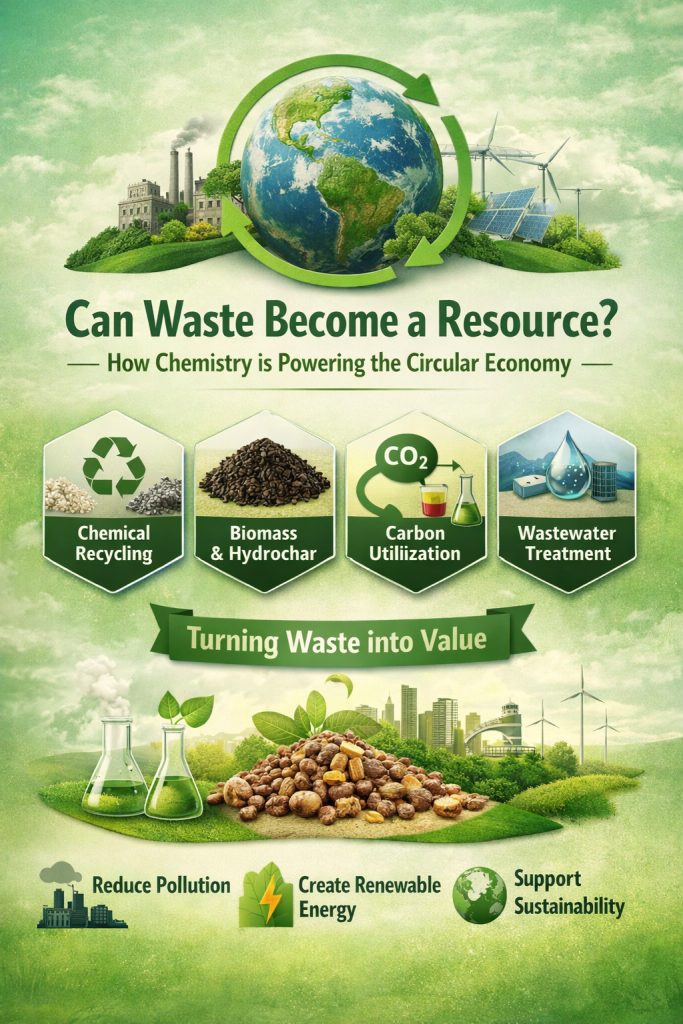
What if Waste Wasn’t the End, but the Beginning?
Every year, billions of tons of waste are generated worldwide. Traditionally, this waste ends up in landfills, oceans, or incineration systems, causing severe environmental damage.
But a powerful shift is underway.
Scientists and industries are now asking a transformative question: Can waste become a valuable resource?
This idea is reshaping how we think about materials, production, and sustainability. Instead of discarding waste, modern chemistry is helping us turn it into fuel, materials, and new products.
This transformation is closely linked to innovations in future focused chemistry and sustainability.
For a global perspective on waste generation and its impact, refer to the World Bank report
https://www.worldbank.org/en/topic/urbandevelopment/brief/solid-waste-management
What Is a Circular Economy?
A circular economy is a system designed to eliminate waste and maximize resource efficiency.
Unlike the traditional linear model
Take → Use → Dispose
The circular model focuses on
Reduce → Reuse → Recycle
At its core, the circular economy treats waste as a resource, keeping materials in use for as long as possible.
Learn more from the Ellen MacArthur Foundation
https://ellenmacarthurfoundation.org/topics/circular-economy-introduction/overview
The Chemistry Behind Turning Waste into Value
Modern chemistry plays a central role in converting waste into useful products. Instead of treating waste as a problem, scientists now see it as a valuable chemical resource.
Chemical Recycling
Traditional recycling often reduces material quality. However, chemical recycling breaks materials down into their molecular components, allowing them to be rebuilt into high quality products.
This is especially important for plastics and complex materials.
Further reading on advanced recycling from the American Chemical Society
https://www.acs.org/greenchemistry/research-innovation/end-of-use/plastics-recycling.html
Biomass Conversion and Hydrothermal Processes
Organic waste from agriculture, food systems, and sewage can be transformed into valuable products.
One of the most promising innovations is hydrochar, produced through hydrothermal carbonization.
Hydrochar is a carbon rich material created by heating wet biomass under moderate temperature and pressure. It works efficiently with high moisture waste such as food waste, agricultural residues, and sewage sludge.
Hydrochar can be used for soil improvement and carbon sequestration, clean solid fuel alternatives, and water purification through adsorption systems.
In fact, hydrochar is increasingly being used in wastewater treatment due to its porous structure and ability to remove contaminants efficiently.
Carbon Capture and Utilization
Carbon dioxide is often seen as a harmful emission. However, modern chemistry enables it to be captured and converted into fuels, chemicals, and construction materials.
This connects directly to emerging carbon transformation technologies.
Explore carbon utilization research from the International Energy Agency
https://www.iea.org/reports/carbon-capture-utilisation-and-storage
Advanced Materials and Adsorption
New materials are being engineered to capture pollutants and convert them into usable substances.
For example, porous materials can trap gases and toxins with remarkable efficiency.
Real World Applications From Waste to Wealth
The transformation of waste into valuable resources is already happening across industries.
Plastic waste is converted into new polymers and fuels
Agricultural waste is transformed into hydrochar and bioenergy
Industrial emissions are converted into useful chemicals
These innovations are helping industries move toward closed loop systems where waste is minimized and resources are continuously reused.
This also supports efforts to tackle persistent environmental pollutants.
Why This Matters for the Future
The transition to a circular economy offers significant benefits.
- Reduced environmental pollution
- Lower reliance on raw materials
- Improved energy efficiency
- Economic value creation from waste
Technologies like hydrochar production also contribute to carbon negative solutions by locking carbon into stable forms.
These innovations strongly align with the United Nations Sustainable Development Goals including Responsible Consumption and Production, Climate Action, and Clean Water and Sanitation.
Explore the SDGs
https://sdgs.un.org/goals
Challenges and Limitations
Despite its promise, the circular economy faces several challenges.
- High costs of advanced recycling technologies
- Scaling hydrothermal technologies for hydrochar production
- Limited infrastructure in many regions
- Need for policy support and global coordination
However, ongoing research continues to improve efficiency and scalability.
The Future of Waste A Resource Driven World
Looking ahead, the concept of waste may disappear entirely.
Instead, materials will continuously circulate through systems, creating value at every stage. This vision aligns with innovations in carbon capture and sustainable materials.
Conclusion
The idea that waste can become a resource is no longer theoretical. It is a growing reality powered by modern chemistry.
Through innovations like chemical recycling, carbon capture, and hydrochar production, waste is being transformed into valuable materials and energy.
In a circular economy, waste is not the end. It is the beginning of something new.
Editor: Ayesha Noor