

Introduction
For thousands of years, agriculture has been the foundation of human civilization. From growing crops to raising livestock, traditional farming has provided the food needed to sustain a growing population. However, climate change, land degradation, water scarcity, and increasing food demand are placing unprecedented pressure on global food systems.
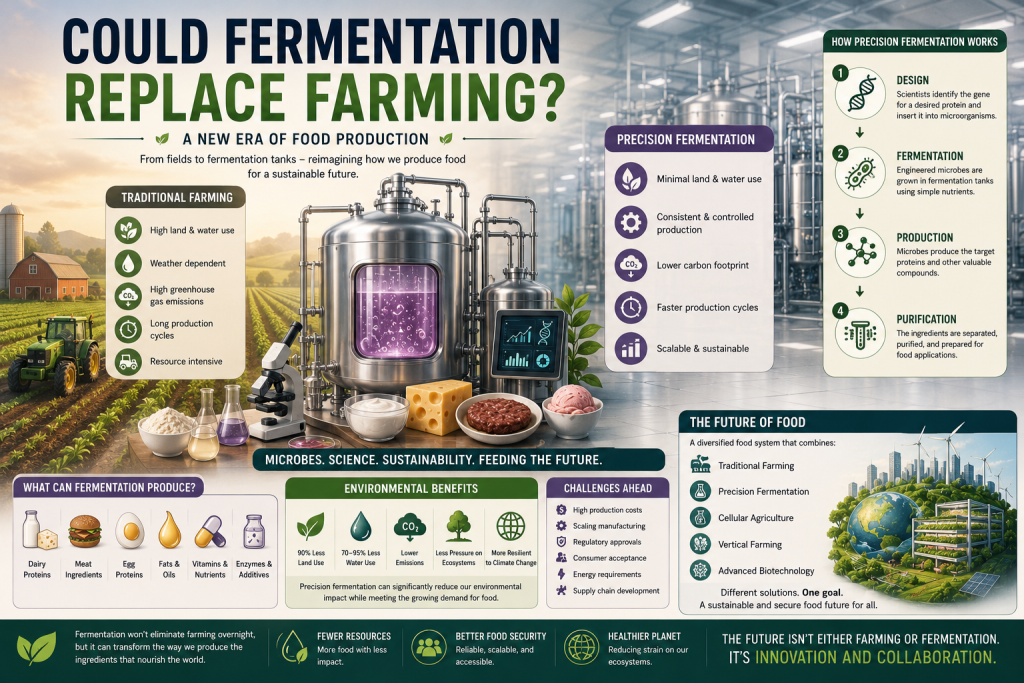
A revolutionary technology known as precision fermentation is now challenging the conventional model of food production. Instead of relying on vast agricultural land or animal farming, scientists are using microorganisms to produce proteins, fats, and other food ingredients in controlled environments.
This raises an intriguing question: Could fermentation replace farming and usher in a new era of food production?
What Is Precision Fermentation?
Precision fermentation is a biotechnology process that uses engineered microorganisms such as yeast, fungi, or bacteria to produce specific food compounds.
The process begins by programming microorganisms with genetic instructions that enable them to manufacture desired ingredients. These microbes are then grown in fermentation tanks where they convert simple nutrients into valuable proteins, enzymes, fats, vitamins, and flavor compounds.
Unlike traditional fermentation used to make bread, yogurt, or cheese, precision fermentation allows scientists to create highly specific molecules that are identical to those found in plants or animals.
Why Food Production Needs Innovation
The global food system faces significant challenges.
According to international estimates, agriculture occupies nearly half of the world’s habitable land and consumes around seventy percent of freshwater resources. At the same time, livestock production contributes substantially to greenhouse gas emissions.
As the global population continues to grow, food demand is expected to increase significantly over the coming decades.
Researchers are exploring alternative food production systems that can:
Reduce environmental impact
Use less land and water
Improve food security
Lower greenhouse gas emissions
Provide sustainable protein sources
Precision fermentation is emerging as one of the most promising solutions.
How Fermentation Produces Food Without Traditional Farming
In fermentation based production systems, microorganisms act as microscopic factories.
Instead of growing crops or raising animals, companies cultivate microbes inside stainless steel bioreactors. These microbes produce proteins and other nutrients that can be harvested and incorporated into food products.
Examples include:
Animal free dairy proteins
Alternative meat ingredients
Egg proteins without chickens
Specialized fats and oils
Nutritional supplements
Food enzymes
The resulting ingredients can be used to create foods that closely resemble conventional products while requiring significantly fewer natural resources.
Environmental Benefits of Precision Fermentation
One of the primary reasons precision fermentation is attracting global attention is its potential environmental impact.
Research suggests that fermentation based food production can dramatically reduce:
Land use
Water consumption
Carbon emissions
Agricultural runoff
Deforestation pressure
Because production occurs in controlled facilities, it is also less vulnerable to droughts, floods, and changing weather patterns.
As countries pursue sustainability goals, these advantages make fermentation an attractive component of future food systems.
Can Fermentation Replace Animal Agriculture?
One of the most exciting applications of precision fermentation involves producing animal proteins without animals.
Scientists can now create proteins that are molecularly identical to those found in milk, eggs, and other animal derived products.
This technology allows manufacturers to produce dairy alternatives with the same taste, texture, and nutritional properties as conventional dairy products.
Rather than replacing all animal agriculture immediately, experts envision a gradual transition where fermentation supplements traditional food production and reduces dependence on resource intensive farming practices.
Current Challenges and Limitations
Despite its enormous potential, precision fermentation faces several challenges.
Scaling production to meet global demand remains a significant hurdle.
Other challenges include:
High production costs
Infrastructure requirements
Regulatory approval processes
Consumer acceptance
Energy consumption concerns
Supply chain development
Researchers and companies are actively working to overcome these barriers through technological innovation and industrial optimization.
The Future of Food Production
Many experts believe the future food system will combine multiple approaches rather than rely on a single solution.
Traditional agriculture will continue to play a crucial role, particularly for fruits, vegetables, grains, and many staple crops.
However, precision fermentation could transform the production of proteins, specialty ingredients, and functional foods.
Future food systems may integrate:
Conventional farming
Precision fermentation
Cellular agriculture
Vertical farming
Advanced biotechnology
This diversified approach could improve sustainability, resilience, and food security worldwide.
Conclusion
The question is no longer whether fermentation can produce food. It already does. The real question is how large a role it will play in feeding future generations.
Precision fermentation offers a compelling vision of food production that requires fewer natural resources while maintaining nutritional quality and scalability. Although it is unlikely to completely replace traditional farming in the near future, it has the potential to fundamentally reshape how many foods are produced.
As biotechnology continues to advance, fermentation may become one of the defining innovations of twenty first century agriculture, helping create a more sustainable and resilient global food system.
Editor: Ayesha Noor