

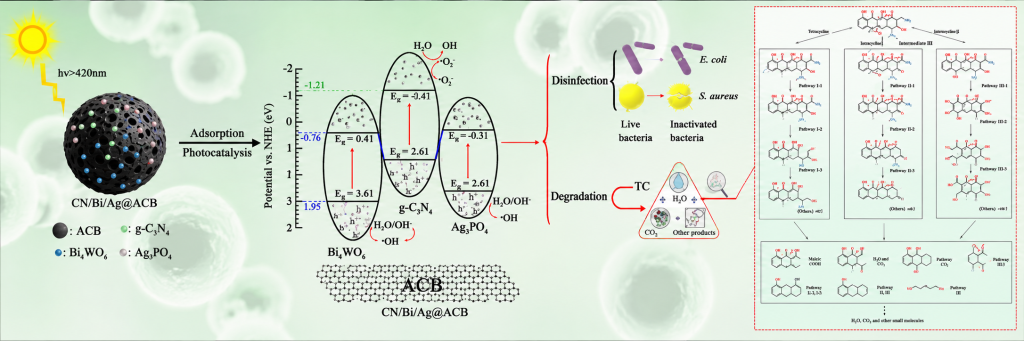
Author: Shi Hui et al. Source; Communication Chemistry
How to remove antibiotics and other new pollutants efficiently and cost-effectively from water is a major challenge in current environmental governance. On February 27, the restoration ecology team at Xi’an University of Architecture and Technology made significant progress in the field of low-carbon, efficient treatment of new pollution, successfully constructing a dual-Z-Scheme biochar-based nanocomposite photocatalyst, providing a new technical solution to address the problem of antibiotic pollution in water bodies. The related research results were published in Nature Communication Chemistry.
Residual antibiotics, as a new pollutant, not only disrupt ecological balance but may also induce the emergence of superbugs, posing potential health risks to humans. Photocatalytic technology, due to its green nature, energy efficiency, and no secondary pollution, is regarded as a powerful tool for controlling new pollutants. However, although this technology has potential, it is limited by issues such as high photoactive carrier recombination rate, insufficient utilization of visible light, and poor material stability, making it difficult to meet practical wastewater treatment needs.
To address these challenges, the team took a different approach by using common agricultural and forestry waste to prepare porous biochar with high specific surface area. Using ultrasonic-ball milling, hydrothermal synthesis, and chemical co-precipitation green synthesis strategies, they pioneered the construction of a biochar-based graphite-phase carbon nitride/bismuth tungstate/silver phosphate composite photocatalyst (CN/Bi/Ag@ACB) with double Z-Scheme heterojunction.
This unique structural design cleverly utilizes biochar as both the electronic medium and carrier, and through the dual Z-Scheme carrier transport channels, not only significantly expands the visible light response range but also fundamentally improves the separation efficiency of photogenerated carriers. Wang Tongtong, the first author and corresponding author of the paper and a young teacher at Xi’an University of Architecture and Technology, introduced this article.
Experimental data show that under visible light irradiation, this new catalyst has significant degradation efficiency for high-concentration (50 mg/L) tetracycline, achieving almost complete removal within 120 minutes, with a degradation rate 8.56 to 13.50 times that of pure semiconductor materials. When treating actual wastewater, this catalyst also demonstrated excellent synergistic removal and anti-interference capabilities against multiple antibiotics such as norfloxacin and chloramphenicol. It is worth mentioning that this catalyst also has a continuous sterilization function. Within 48 hours, it achieves a sterilization rate of up to 99% against E. coli and Staphylococcus aureus in the water, achieving both decontamination and sterilization. This novel photocatalyst efficiently removes new pollutants through a synergistic mechanism. Photo provided by Xi’an University of Architecture and Technology
This research not only successfully developed a new low-cost, efficient, and stable photocatalyst but, more importantly, revealed the dual role of biochar as a ‘carrier-functional component’ in composite systems, elucidating the synergistic enhancement mechanism of its surface properties on catalytic performance. This discovery provides an important theoretical basis for designing highly efficient and stable double Z-type photocatalysts, and lays a scientific foundation for promoting the application of photocatalytic technology in deep water treatment and environmental remediation, said Professor Shi Hui, corresponding author of the paper and professor at Xi’an University of Architecture and Technology. (Source: China Science Daily, Li Yuan, Xiao Wenwen)
Reference Paper: https://doi.org/10.1038/s42004-026-01923-w
Editor: Ayesha Noor