

Introduction
For decades, scientists have worked to understand life by studying DNA, proteins, cells, and evolution. Recent advances in synthetic biology have raised an extraordinary possibility: Could scientists create a mirror version of life? While this idea may sound like science fiction, it has become the subject of serious scientific debate.
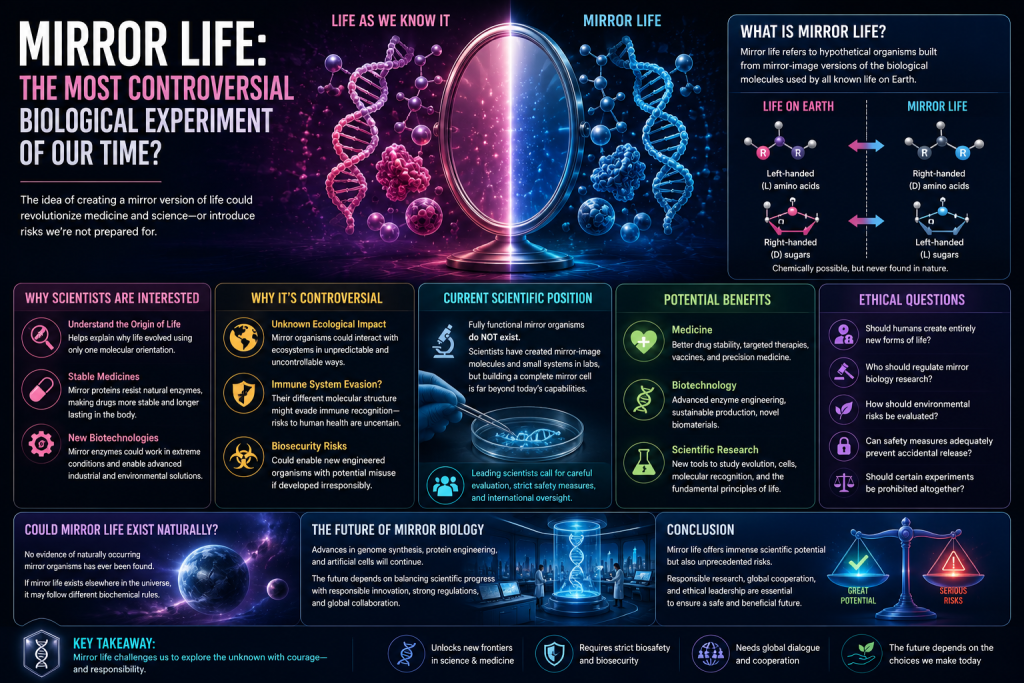
Mirror life refers to hypothetical organisms built entirely from the mirror-image versions of the biological molecules found in all known living organisms. Such organisms would operate using reversed molecular structures that do not naturally exist on Earth. Researchers believe mirror life could advance biotechnology, medicine, and our understanding of biology. However, many scientists also argue that creating mirror organisms could introduce unprecedented biosafety and biosecurity risks.
The debate has become one of the most important ethical and scientific discussions in modern biology. Should humanity attempt to create mirror life, or are the potential risks too great?
What Is Mirror Life?
Life on Earth follows a remarkable pattern known as molecular chirality. Many biological molecules exist in two mirror-image forms, similar to how the left and right hands appear identical but cannot perfectly overlap.
All known organisms consistently use:
- Left-handed (L) amino acids to build proteins
- Right-handed (D) sugars to construct DNA and RNA
This molecular preference is one of the defining characteristics of life on Earth.
Mirror life would reverse this arrangement. A mirror organism would use:
- Right-handed amino acids
- Left-handed sugars
Although chemically possible, such organisms have never been found in nature.
Why Are Scientists Interested in Mirror Life?
Mirror life is not being studied simply out of curiosity. Researchers believe it could unlock entirely new scientific and technological possibilities.
Understanding the Origin of Life
One of biology’s greatest mysteries is why life evolved using only one molecular orientation.
Building mirror biological systems could help scientists understand:
- How the first living cells emerged
- Whether molecular chirality was accidental or essential
- Whether life elsewhere in the universe might follow different biochemical rules
Creating Highly Stable Medicines
Many biological drugs break down quickly because enzymes recognize and digest natural proteins.
Mirror proteins would be largely invisible to these enzymes, potentially making medicines:
- More stable
- Longer lasting
- More resistant to degradation
This could improve treatments for cancer, infectious diseases, and rare genetic disorders.
Developing New Industrial Biotechnologies
Mirror enzymes could function under conditions that damage ordinary biological systems.
Possible applications include:
- Industrial catalysis
- Chemical manufacturing
- Environmental cleanup
- Advanced biosensors
These systems may perform reactions that conventional enzymes cannot efficiently accomplish.
Why Is Mirror Life So Controversial?
Although the scientific benefits appear exciting, many experts believe the risks deserve even greater attention.
Unlike most synthetic biology research, mirror organisms could interact with Earth’s ecosystems in unpredictable ways.
Unknown Ecological Consequences
Natural microbes have evolved alongside one another for billions of years.
Mirror organisms would represent an entirely separate biological system.
Scientists cannot confidently predict:
- Whether natural predators could control them
- How they would interact with existing ecosystems
- Whether they could spread beyond laboratory environments
Even if mirror organisms grew more slowly than natural microbes, unexpected ecological effects cannot currently be ruled out.
Challenges for the Immune System
The human immune system has evolved to recognize naturally occurring biological molecules.
Mirror microorganisms could potentially evade normal immune recognition because their molecular structures would be fundamentally different.
Although scientists do not know whether mirror pathogens could infect humans, this uncertainty has become one of the central concerns in ongoing discussions.
Biosecurity Risks
Mirror biology could eventually enable entirely new classes of engineered organisms.
While such technologies might benefit medicine and industry, they could also introduce risks if developed irresponsibly.
Many experts believe careful international oversight is essential before research progresses toward creating complete mirror organisms.
Current Scientific Position
Importantly, fully functional mirror organisms do not currently exist.
Scientists have successfully synthesized some mirror-image biological molecules and small molecular systems in laboratories. However, creating an entire mirror cell remains far beyond current technological capabilities.
In recent years, leading researchers in synthetic biology have called for careful evaluation of the scientific, ethical, and safety implications before pursuing mirror life research further.
Many experts argue that society should establish clear international governance frameworks before attempting to create self-replicating mirror organisms.
Potential Benefits of Mirror Biology
If developed safely under strict oversight, mirror biology could contribute to numerous fields.
Medicine
Mirror biomolecules may improve:
- Drug stability
- Targeted therapies
- Vaccine development
- Precision medicine
Biotechnology
Mirror biological systems could support:
- Advanced enzyme engineering
- Sustainable chemical production
- Industrial biocatalysis
- Novel biomaterials
Scientific Research
Mirror life could provide entirely new ways to investigate:
- Evolution
- Cell biology
- Molecular recognition
- The fundamental principles governing life itself
Ethical Questions
Mirror life raises questions that extend beyond science.
Researchers, policymakers, and ethicists continue debating issues such as:
- Should humans create entirely new forms of life?
- Who should regulate mirror biology research?
- How should potential environmental risks be evaluated?
- Can safety measures adequately prevent accidental release?
- Should certain experiments be prohibited altogether?
These questions highlight the importance of balancing scientific innovation with responsible governance.
Could Mirror Life Exist Naturally?
Scientists have searched extensively for naturally occurring mirror organisms but have found no evidence that they exist.
If mirror life exists elsewhere in the universe, it may have evolved under entirely different environmental conditions.
Studying mirror biology may therefore also contribute to astrobiology by helping researchers understand what forms life beyond Earth could take.
The Future of Mirror Biology
Research in synthetic biology continues to advance rapidly.
Although complete mirror organisms remain a distant possibility, progress in genome synthesis, protein engineering, and artificial cells suggests that capabilities will continue to grow.
Many scientists emphasize that technological progress should be accompanied by equally strong advances in biosafety regulations, international cooperation, and ethical oversight.
The future of mirror biology will likely depend not only on scientific capability but also on global consensus regarding responsible research.
Conclusion
Mirror life represents one of the most fascinating and controversial ideas in modern science. By reversing the fundamental molecular architecture of living systems, scientists may gain unprecedented insights into the origin of life, develop more durable medicines, and create powerful new biotechnologies.
At the same time, the possibility of introducing entirely new forms of biology raises profound biosafety, biosecurity, and ethical concerns. Because the ecological and health consequences remain uncertain, many researchers believe caution should guide future research.
Whether mirror life is eventually created or not, the debate surrounding it demonstrates that scientific progress must always be accompanied by responsible innovation, rigorous safety standards, and thoughtful global collaboration.
Editor: Ayesha Noor