

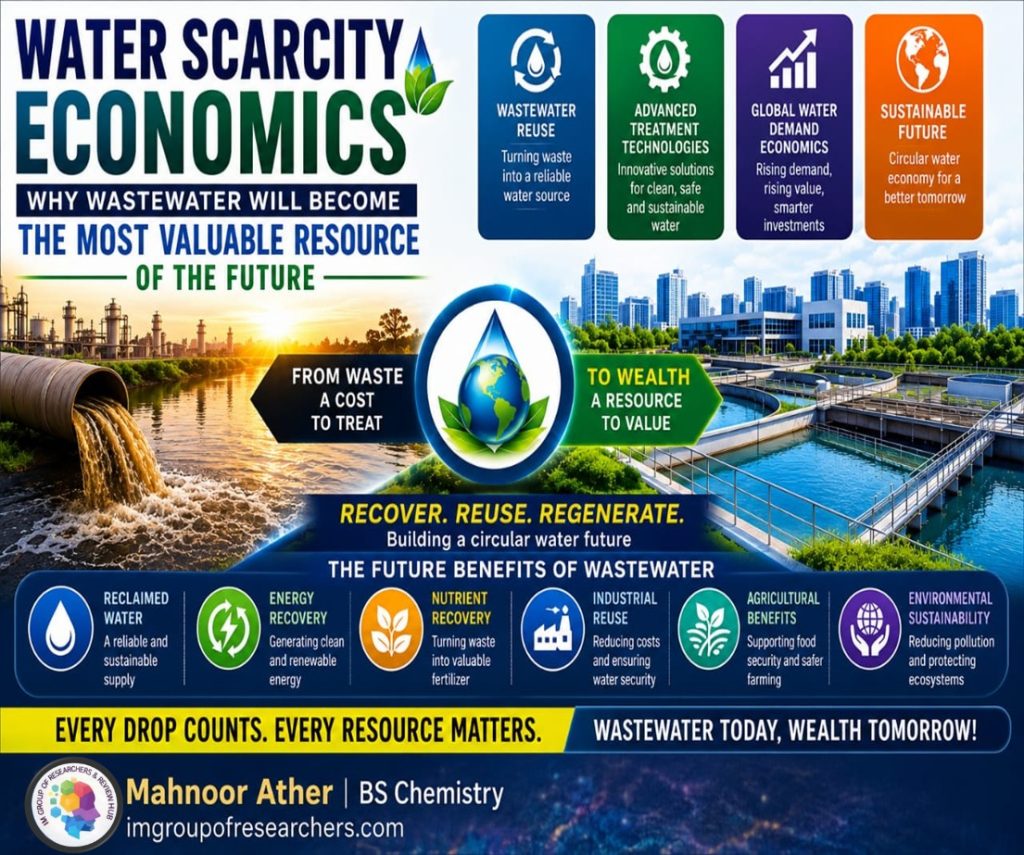
Focus: Wastewater Reuse, Advanced Treatment Technologies, and Global Water Demand Economics
Introduction
Water is the foundation of human civilization, economic growth, industrial development, food production, and environmental sustainability. Although nearly 71% of the Earth’s surface is covered by water, less than 3% is freshwater, and only a small fraction is readily accessible for human use.
For decades, wastewater was viewed as an unwanted byproduct that required disposal. Today, this perspective is rapidly changing. Governments, industries, researchers, and policymakers increasingly recognize wastewater as a strategic resource capable of addressing water scarcity, generating renewable energy, recovering valuable nutrients, and supporting sustainable development.
As climate change, population growth, urbanization, and industrial expansion continue to intensify pressure on freshwater supplies, wastewater is emerging as one of the most valuable resources of the twenty-first century.
The Growing Global Water Crisis
Global water demand is rising at an unprecedented rate. According to international projections, nearly two-thirds of the world’s population could face water stress or water scarcity conditions in the coming decades.
Several factors are driving this challenge:
- Population growth
- Climate change and prolonged droughts
- Rapid urbanization
- Industrial expansion
- Increasing agricultural water demand
To feed a global population expected to exceed 9 billion people by 2050, food production must increase significantly. Agriculture already accounts for approximately 70% of global freshwater withdrawals, creating immense pressure on limited water resources.
In many regions, untreated or poorly treated wastewater is already being used for irrigation. While this practice helps alleviate water shortages, it can introduce pathogens, heavy metals, and excess salts into agricultural systems, creating risks for human health and environmental quality.
These challenges highlight the urgent need for advanced wastewater treatment and safe water reuse strategies.
Why Wastewater Is Becoming a Valuable Resource
Unlike rainfall, rivers, and groundwater reserves, wastewater production is highly predictable.
Wastewater is continuously generated through:
- Household activities
- Commercial operations
- Industrial processes
- Municipal services
This consistent generation makes wastewater one of the most reliable alternative water sources available.
Countries such as Israel, Singapore, Australia, and the United Arab Emirates have successfully demonstrated that treated wastewater can provide a dependable water supply regardless of seasonal rainfall variations.
As freshwater resources become increasingly scarce, wastewater is transitioning from a waste stream to a strategic economic asset.
The Economics of Wastewater Reuse
The value of wastewater increases as freshwater becomes more expensive and difficult to obtain.
Infrastructure Costs
Freshwater often needs to be transported over long distances, requiring extensive pipelines, reservoirs, and distribution networks.
Energy Costs
Pumping, desalination, and purification processes consume significant amounts of energy, increasing operational expenses.
Environmental Costs
Overextraction of freshwater resources can damage ecosystems, reduce biodiversity, and degrade natural habitats.
Opportunity Costs
Water shortages can limit agricultural productivity, industrial output, and economic growth.
As these costs continue to rise, wastewater reuse becomes an increasingly attractive and cost-effective solution. In many regions, reclaimed water is already less expensive than importing freshwater or operating large-scale desalination facilities.
Advanced Technologies Driving Wastewater Reuse
Technological advancements are transforming wastewater into a safe, reliable, and economically valuable resource.
Membrane Filtration for Wastewater Reuse
Membrane filtration is one of the most effective wastewater treatment approaches available today. It uses semi-permeable membranes to separate contaminants based on size and molecular characteristics.
Common membrane technologies include:
Microfiltration
Removes suspended solids, sediments, and microorganisms.
Ultrafiltration
Removes bacteria, viruses, and larger organic particles.
Nanofiltration
Removes dissolved organic compounds and specific contaminants.
Reverse Osmosis
Produces extremely high-purity water by removing salts, pathogens, heavy metals, and dissolved contaminants.
Reverse osmosis is widely used in potable water reuse systems and advanced water purification facilities worldwide.
Advanced Oxidation Processes
Advanced oxidation technologies use powerful oxidizing agents such as hydrogen peroxide to eliminate contaminants.
These systems effectively remove:
- Pharmaceutical residues
- Personal care products
- Industrial chemicals
- Emerging contaminants
Such technologies significantly improve water quality and safety.
Biological Treatment Systems
Biological wastewater treatment utilizes microorganisms to break down organic pollutants naturally.
Common biological treatment technologies include:
- Activated sludge systems
- Membrane bioreactors (MBRs)
- Moving bed biofilm reactors (MBBRs)
These systems provide high treatment efficiency while maintaining relatively low operational costs.
Artificial Intelligence and Smart Monitoring
Artificial intelligence is transforming wastewater management through:
- Real-time process monitoring
- Predictive maintenance
- Energy optimization
- Contamination detection
- Operational efficiency improvements
Smart sensors combined with AI-driven analytics allow treatment facilities to operate more efficiently while reducing costs and environmental risks.
Resource Recovery Through Wastewater Reuse
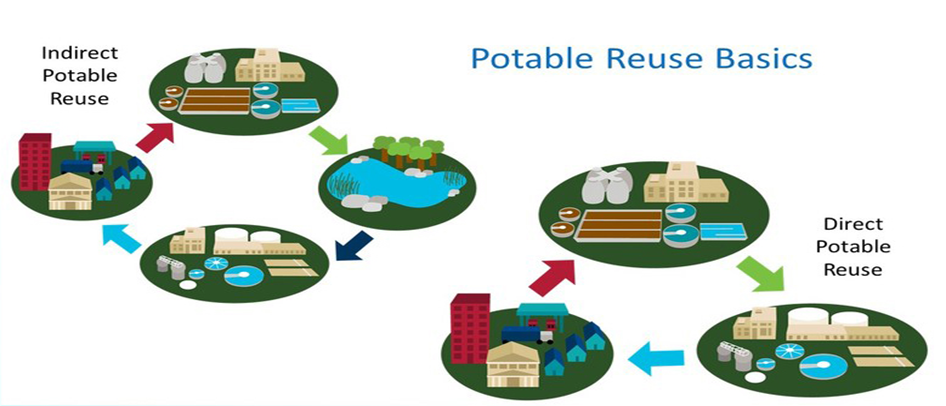
One of the most important developments in modern water management is the production of drinking water from treated wastewater.
Indirect Potable Reuse
In indirect potable reuse systems, highly treated wastewater is first introduced into environmental buffers such as reservoirs, rivers, or aquifers before being reused as drinking water.
Direct Potable Reuse
Direct potable reuse involves introducing highly purified wastewater directly into drinking water systems after advanced treatment.
Modern treatment technologies can produce water that meets or exceeds drinking water standards, making potable reuse an increasingly important strategy for water security in water-stressed regions.
Resource Recovery Through Wastewater Reuse
Wastewater contains valuable resources that can be recovered and reused.
Energy Recovery
Organic matter present in wastewater can be converted into biogas through anaerobic digestion, producing renewable energy.
Nutrient Recovery
Nitrogen and phosphorus can be recovered and reused as agricultural fertilizers.
Industrial Resource Recovery
Advanced treatment systems can recover valuable materials, including:
- Metals
- Salts
- Chemicals
- Industrial byproducts
These opportunities support the development of circular economy models where waste streams become sources of economic value.
The Future of Wastewater Reuse and Circular Water Economies
The future water economy will likely be built around resource recovery and water circularity.
Key trends include:
- Decentralized water reuse systems
- Smart wastewater treatment facilities
- Energy-positive treatment plants
- Circular water economies
- Climate-resilient water infrastructure
- Large-scale potable water reuse programs
As freshwater resources become increasingly constrained, wastewater will no longer be viewed as a disposal challenge but as a critical component of sustainable economic development.
Conclusion
Water scarcity is rapidly becoming one of the defining challenges of the modern era. As freshwater supplies face growing pressure from climate change, population growth, and industrial demand, wastewater is emerging as a strategic resource with enormous economic and environmental value.
Advanced treatment technologies, artificial intelligence, membrane filtration systems, and potable water reuse programs are transforming wastewater into a dependable source of clean water, renewable energy, and recoverable nutrients.
The future of sustainable water management will depend not only on conserving freshwater resources but also on maximizing the value of wastewater. In a world facing increasing water stress, wastewater may become one of the most valuable resources of the future, supporting economic growth, environmental protection, and long-term water security.
References
- United Nations World Water Development Reports.
- World Health Organization (WHO) Guidelines on Wastewater Reuse.
- Food and Agriculture Organization (FAO) Water Reports.
- International Water Association (IWA) Publications.
- European Commission Water Reuse Regulation Reports.
- Global Water Intelligence Market Assessments.
- Recent Advances in Membrane Technologies for Wastewater Treatment and Reuse.
- Artificial Intelligence Applications in Water and Wastewater Management Studies.
- Circular Economy Approaches for Resource Recovery from Wastewater.
- Sustainable Water Reuse and Potable Reuse Research
Editor: Ayesha Noor