

The Next Big Food Revolution
Introduction
The global food industry is undergoing a major transformation. As the world population continues to grow, concerns surrounding climate change, food security, animal welfare, and resource consumption are pushing scientists and food innovators to rethink how protein is produced.
One of the most promising developments is the rise of alternative proteins. These emerging protein sources are designed to provide sustainable, nutritious, and scalable alternatives to conventional animal based foods.
From plant based meat to lab cultivated protein and precision fermentation, alternative proteins are rapidly becoming one of the most important innovations in modern food science.
What Are Alternative Proteins
Alternative Proteins are protein sources developed as alternatives to traditional meat, dairy, eggs, and seafood.
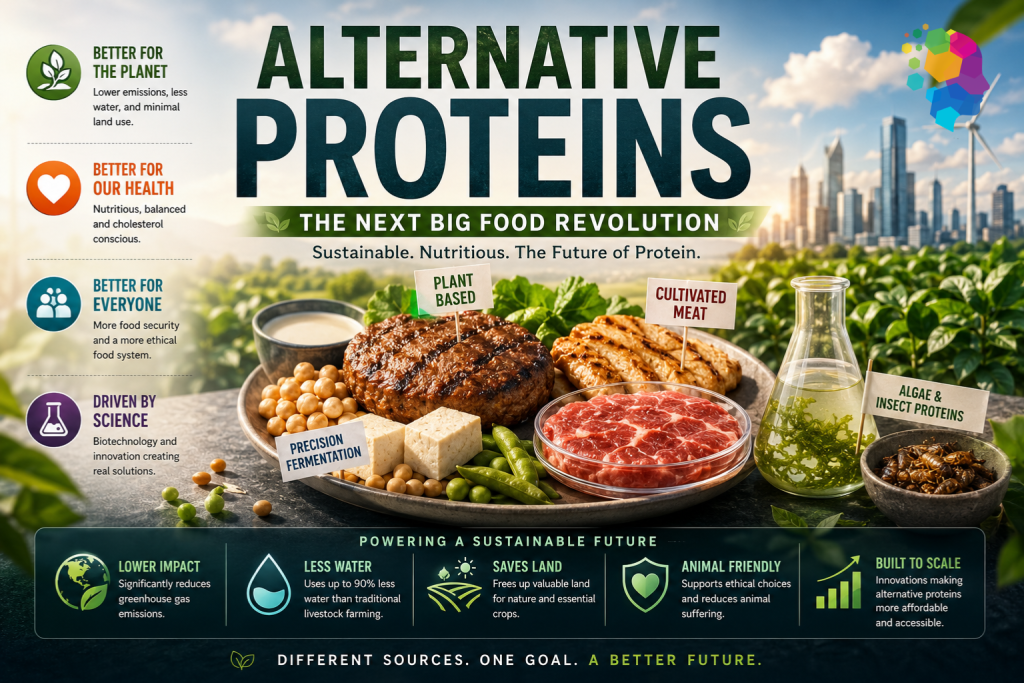
These proteins can come from several sources including
Plant based proteins
Cultivated or lab grown meat
Fermentation derived proteins
Algae and insect proteins
The goal is to create food systems that are more sustainable, efficient, and environmentally responsible while still meeting global nutritional demands.
Why the Food Industry Is Changing
Traditional livestock farming requires enormous amounts of land, water, and energy. It also contributes significantly to greenhouse gas emissions and environmental degradation.
As demand for protein increases globally, scientists and companies are searching for more sustainable solutions.
Alternative proteins offer several potential advantages
Lower environmental impact
Reduced greenhouse gas emissions
Less land and water consumption
Improved food security
Reduced dependence on intensive animal farming
These benefits are driving major investment and research in the field.
Plant Based Proteins
Plant based proteins are currently the most commercially advanced category of alternative proteins. These products use ingredients such as soy, peas, wheat, and legumes to mimic the taste and texture of meat.
Advances in food chemistry and biotechnology have significantly improved the flavor, texture, and nutritional quality of plant based foods.
Many consumers are adopting plant based diets for health, ethical, and environmental reasons, accelerating market growth worldwide.
Cultivated Meat and Cellular Agriculture
One of the most revolutionary developments is cultivated meat, also known as lab grown meat.
Instead of raising and slaughtering animals, scientists grow animal cells in controlled laboratory environments to produce real meat tissue.
This process, often referred to as cellular agriculture, has the potential to dramatically reduce environmental impact while maintaining the taste and nutritional profile of conventional meat.
Although large scale commercialization still faces challenges, cultivated meat represents a major scientific breakthrough in food production.
Precision Fermentation and Engineered Proteins
Another rapidly growing field is precision fermentation. This technology uses microorganisms such as yeast or bacteria to produce specific proteins through biotechnology.
Scientists can engineer microbes to create dairy proteins, enzymes, and other food ingredients without relying on animals.
Precision fermentation is already being used to develop sustainable alternatives for milk, cheese, and egg products.
The Science Behind Alternative Proteins
The development of alternative proteins depends heavily on chemistry, biotechnology, food engineering, and molecular science.
Researchers study how proteins interact, fold, and behave during cooking and processing to replicate the sensory properties of traditional foods.
Advances in synthetic biology, tissue engineering, and fermentation science are accelerating the development of more realistic and affordable protein alternatives.
Challenges Facing Alternative Proteins
Despite rapid growth, the industry still faces important challenges
High production costs for cultivated meat
Consumer acceptance and perception
Regulatory approval processes
Nutritional optimization
Scaling production for global demand
Addressing these challenges will be essential for widespread adoption.
Could Alternative Proteins Transform the Future of Food
Many experts believe alternative proteins could become a defining feature of future food systems.
As technology advances, these products may become more affordable, accessible, and nutritionally competitive with traditional animal products.
Alternative proteins could help create more sustainable agriculture systems while supporting a growing global population with fewer environmental pressures.
The transition may not completely replace conventional farming, but it could significantly reshape how protein is produced and consumed worldwide.
Conclusion
Alternative proteins represent far more than a temporary food trend. They are part of a broader scientific and technological shift aimed at redefining the future of food production.
Through innovations in biotechnology, cellular agriculture, and food chemistry, scientists are developing sustainable protein sources capable of reducing environmental impact while meeting rising nutritional demands.
As research and innovation continue, alternative proteins may become one of the most transformative developments in the global food industry.