

Introduction
The demand for electricity is increasing as populations grow, industries expand, transportation becomes more electrified, and artificial intelligence requires increasingly powerful computing infrastructure. At the same time, the world is under pressure to reduce greenhouse gas emissions and move away from fossil fuels.
Solar energy is one of the most promising solutions, but conventional solar power has an important limitation: it depends on conditions on Earth. Clouds, nighttime, seasonal changes, and limited land availability can reduce electricity generation.
Scientists are therefore exploring a remarkable alternative: space based solar power.
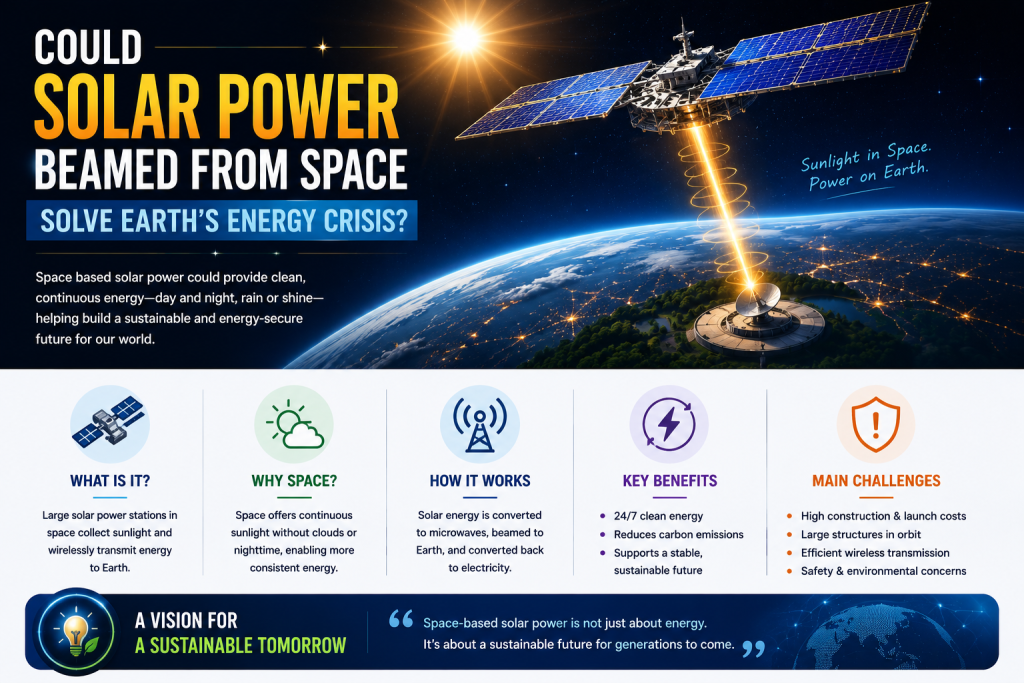
The concept is simple but ambitious. Solar power stations would be placed in space, where they could collect sunlight almost continuously and transmit the energy to Earth using wireless technologies.
Could this futuristic technology become a practical solution to Earth’s energy crisis?
What Is Space Based Solar Power?
Space based solar power is a concept in which large solar energy systems are placed outside Earth’s atmosphere to collect sunlight and transmit the generated energy to receiving stations on the ground.
Unlike conventional solar farms, space based solar power would not be affected by clouds or nighttime in the same way.
A typical system would involve three major components:
- Solar panels or solar collectors in space
- A system for converting electricity into an energy beam
- Ground based receiving stations that convert the transmitted energy back into usable electricity
The basic energy pathway can be described as:
Sunlight → Space Solar Power Station → Wireless Energy Transmission → Ground Receiver → Electricity Grid
Why Collect Solar Energy in Space?
The biggest advantage of space based solar power comes from the environment beyond Earth’s atmosphere.
Space offers continuous exposure to sunlight without atmospheric clouds blocking solar radiation.
On Earth, solar panels generate electricity only when sufficient sunlight reaches them. A space based system could potentially provide a much more continuous energy supply.
This could make space based solar power particularly attractive for supporting electricity grids that increasingly depend on intermittent renewable sources.
How Would Solar Power Be Beamed to Earth?
One of the most important technological challenges is transferring electricity from space to Earth.
Scientists are primarily investigating wireless power transmission using electromagnetic radiation, particularly microwaves and, in some concepts, lasers.
The solar panels would first convert sunlight into electricity. That electricity would then be converted into an energy beam directed toward a receiving station on Earth.
At the receiving station, specialized equipment would convert the transmitted energy into electricity for use by the grid.
Microwave transmission is particularly interesting because it can potentially operate through clouds and atmospheric conditions with relatively low energy loss compared with some alternatives.
Could Space Solar Power Provide Electricity 24 Hours a Day?
One of the most attractive features of space based solar power is the possibility of generating electricity for much longer periods than conventional solar farms.
A carefully positioned space solar power station could receive sunlight for most of its orbital period.
This could help address one of renewable energy’s biggest challenges: intermittency.
Solar and wind power are variable resources. Solar generation falls at night, while wind generation changes according to weather conditions.
Space based solar power could potentially complement these technologies by providing a more continuous renewable energy source.
The Role of Wireless Energy Transmission
Wireless energy transmission is at the heart of the concept.
A space based solar power system would need to transmit enormous amounts of energy over distances of hundreds or thousands of kilometers.
The system would therefore require extremely accurate beam control and highly efficient energy conversion.
The receiving station would also need to cover a substantial area to safely capture the transmitted energy.
This means that the technology is not simply about putting solar panels into orbit. It requires advances in power electronics, antennas, robotics, materials science, orbital engineering, and energy conversion.
What Are the Main Challenges?
Despite its enormous potential, space based solar power faces major technological and economic obstacles.
Extremely High Construction Costs
Building and launching massive solar power stations into orbit would be expensive.
Traditional satellites are already costly to manufacture and launch. A commercial space solar power station could be vastly larger than most existing spacecraft.
Reducing launch costs and developing reusable space transportation systems could therefore play an important role in making the concept economically realistic.
Large Structures in Orbit
A space based solar power station would need an enormous collection area to capture sufficient sunlight.
Constructing and maintaining such a structure in space would be a major engineering challenge.
Robotic assembly systems could become essential because manually constructing extremely large structures in orbit would be impractical.
Energy Conversion Losses
Energy would pass through several stages:
Sunlight → Electricity → Microwave or Laser Beam → Electricity
Every conversion step produces some energy loss.
For space based solar power to compete with terrestrial renewable energy, engineers would need to achieve very high overall system efficiency.
Wireless Transmission
Transmitting energy over extremely long distances requires precise beam control.
The system must ensure that energy reaches the intended receiving station while maintaining appropriate safety limits.
Developing efficient and reliable transmission systems remains one of the central challenges.
Is Space Solar Power Safe?
Safety is another major consideration.
A large energy beam traveling from space to Earth sounds alarming, but proposed systems would be designed with controlled transmission and designated receiving areas.
The energy intensity would need to remain within carefully established safety limits.
The receiving stations, often called rectennas, would convert microwave energy into electricity.
Extensive testing would be required to understand environmental and biological effects before large scale deployment.
What Are Rectennas?
A rectenna is a specialized antenna system capable of receiving electromagnetic energy and converting it into direct current electricity.
In a space based solar power system, the rectenna would act as the receiving infrastructure on Earth.
Because the system would need to collect large amounts of energy, rectennas could occupy significant areas.
However, unlike conventional solar farms, the receiving area itself would not necessarily need to be covered with photovoltaic panels.
Could Space Solar Power Reduce Carbon Emissions?
If space based solar power can eventually be produced and operated economically using low carbon technologies, it could provide electricity without directly burning fossil fuels.
This could support the electrification of transportation, industrial processes, heating, and other sectors.
However, the total environmental impact would depend on the materials, manufacturing processes, launch systems, orbital infrastructure, and end of life management involved in constructing the system.
Therefore, space based solar power should be evaluated through its entire life cycle rather than simply considering the emissions produced during electricity generation.
Space Solar Power and Energy Storage
One major advantage of space based solar power is its potential to reduce dependence on large scale energy storage.
Conventional solar energy requires batteries or other storage systems when electricity is needed after sunset.
Space based solar power could potentially provide electricity during periods when terrestrial solar generation is unavailable.
However, energy storage would still be useful for managing demand fluctuations, transmission interruptions, and periods when the space based system is unavailable.
Could Space Solar Power Support Developing Countries?
If the technology becomes economically viable, space based solar power could eventually provide renewable electricity to regions with limited access to large land areas or reliable energy infrastructure.
However, large scale deployment would require international cooperation, significant investment, ground infrastructure, and appropriate regulatory systems.
The technology alone would not solve energy inequality.
Access to electricity also depends on transmission networks, affordability, infrastructure, political stability, and local energy policies.
The Role of Robotics and Artificial Intelligence
Artificial intelligence and robotics could play a major role in the future development of space based solar power.
Robotic systems could potentially assemble large structures in orbit, inspect solar panels, repair damaged components, and manage complex operations.
Artificial intelligence could help optimize energy collection, orbital positioning, beam control, maintenance schedules, and energy transmission.
The combination of space engineering, robotics, AI, materials science, and renewable energy could therefore become an important part of future space power systems.
Who Is Researching Space Based Solar Power?
Space agencies, universities, research institutions, and private companies around the world are investigating different aspects of space based solar power.
Research programs have explored technologies including wireless power transmission, lightweight solar materials, orbital assembly, autonomous robotics, and large scale space structures.
The European Space Agency, Japan’s space research community, China, the United States, and other countries have investigated concepts related to space based solar energy.
These programs are helping determine whether the technology can move from theoretical proposals toward practical demonstrations.
Could Space Solar Power Really Solve Earth’s Energy Crisis?
Space based solar power could become an important future energy technology, but describing it as a complete solution to Earth’s energy crisis would be premature.
The world will likely need a combination of technologies, including:
- Solar energy
- Wind power
- Hydropower
- Nuclear energy
- Energy storage
- Hydrogen
- Advanced transmission networks
- Energy efficiency
- Carbon management technologies
- Potentially space based solar power
The strength of space solar power is not that it could replace every other energy source.
Its potential value lies in providing another source of continuous, low carbon electricity that could complement renewable energy systems on Earth.
The Future of Space Solar Power
The concept that humanity could collect sunlight in space and transmit it to Earth once seemed purely futuristic.
Today, advances in reusable launch vehicles, lightweight materials, robotics, power electronics, and wireless energy transmission are making the idea increasingly realistic.
The biggest question is no longer whether the basic physics is possible. The real challenge is whether engineers can develop a system that is safe, affordable, efficient, scalable, and environmentally responsible.
If these challenges can be overcome, space based solar power could become one of the most ambitious energy technologies ever developed.
Conclusion
Space based solar power represents a remarkable vision for the future of energy. Instead of relying entirely on solar panels located on Earth, humanity could potentially collect sunlight in space and transmit clean electricity to the planet.
The concept offers several potential advantages, including more consistent sunlight exposure, reduced dependence on terrestrial weather conditions, and the possibility of providing renewable electricity when conventional solar generation is unavailable.
However, enormous challenges remain. Launch costs, orbital construction, energy conversion efficiency, wireless transmission, safety, environmental impacts, and economic feasibility must all be addressed.
Space solar power is therefore unlikely to solve Earth’s energy crisis by itself. But if technological progress continues, it could become an important component of a diversified global clean energy system.
The idea is extraordinary: harvest the Sun’s energy in space and send it back to Earth.
The question now is whether humanity can turn that extraordinary idea into an economically and environmentally sustainable reality.
Editor: Ayesha Noor