

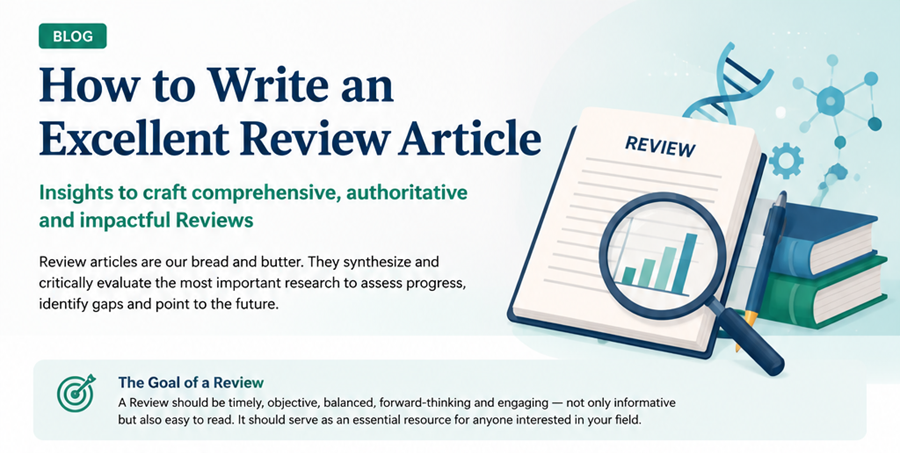
Turning complex scientific literature into a compelling, insightful, and influential review
By: Izaz Ul Islam
Why Review Articles Matter More Than Ever
Scientific progress does not happen in isolation. Every major discovery builds upon years of experiments, debates, failures, and breakthroughs. In this process, review articles play a critical role by helping researchers understand the current state of a field and identify future research directions.
A strong scientific review article does more than summarize published studies. It connects ideas, identifies research gaps, evaluates methodologies, highlights controversies, and inspires future innovation.
According to an editorial published in Nature Reviews Bioengineering in 2024, impactful review articles should be:
Timely
Objective
Balanced
Forward thinking
Scientifically authoritative
Easy to read
If you are learning how to write a review article, this practical guide outlines the essential strategies researchers can use to create insightful and influential scientific reviews.
1. Choose a Timely and Relevant Research Topic
The first step in writing a scientific review article is selecting a topic that is actively evolving.
Before starting, ask yourself:
Is the field developing rapidly enough to justify a review article right now?
Strong review topics usually include:
Significant recent research activity
Emerging technologies or methodologies
Unresolved controversies
Clinical or translational relevance
New scientific breakthroughs
A Useful Benchmark
Try to identify at least 30 high quality primary research papers published within the last two to three years.
If the literature is growing rapidly, the topic is likely suitable for a valuable review article.
2. Conduct a Comprehensive Literature Search
A review article is only as strong as its references. Conducting a deep literature review is essential for scientific credibility and completeness.
Use Multiple Scientific Databases
Researchers should explore:
PubMed
Google Scholar
Scopus
Web of Science
Conference proceedings
Specialized repositories
Improve Your Search Strategy
Use:
Different keyword combinations
Synonyms and related concepts
Emerging terminology
Author based searches
Citation tracking
Following researchers from different institutions and geographic regions also improves citation diversity and provides a broader perspective on the field.
3. Build a Strong Narrative Instead of Listing Studies
One of the most common mistakes in scientific review writing is treating the article like a simple collection of summaries.
A high quality review article should develop a clear scientific narrative.
Ask important questions such as:
What major shift is happening in the field?
What challenges remain unresolved?
Are new technologies changing previous assumptions?
What bottlenecks are slowing progress?
Is the field moving toward clinical or industrial applications?
A memorable review article tells the story of scientific progress rather than merely organizing information.
4. Create a Clear Structure Before Writing
Strong scientific reviews are carefully structured before drafting begins.
Creating a detailed outline improves clarity, readability, and logical flow.
Essential Sections of a Review Article
Introduction
Explain the topic and its importance.
Major Sections
Divide the review into major scientific themes.
Subsections
Improve readability and organization.
Comparative Discussions
Analyze strengths, weaknesses, and conflicting findings.
Future Outlook
Discuss future opportunities and unresolved questions.
A well planned structure acts as the foundation of the entire article.
5. Write an Accessible and Readable Introduction
Not every reader will be an expert in your specific research area.
A strong introduction should:
Explain concepts clearly
Provide sufficient background information
Avoid unnecessary jargon
Define important mechanisms
Use concise sentences
Avoid Excessive Acronyms
Too many acronyms reduce readability, especially for interdisciplinary audiences. Simpler scientific writing often creates greater impact.
6. Critically Analyze the Literature
The difference between an average and exceptional review article lies in critical analysis.
Weak reviews summarize studies chronologically. Strong reviews evaluate and interpret the literature.
A Strong Review Article Should:
Compare studies
Evaluate methodologies
Discuss limitations
Identify contradictions
Highlight research bottlenecks
Explain why certain approaches succeeded or failed
Ask Critical Scientific Questions
Which experimental models performed best?
What assumptions remain untested?
Are findings reproducible?
Where do studies disagree?
What methodologies contain limitations?
Readers value insight and interpretation more than information overload.
7. Use Figures and Visuals to Simplify Complex Ideas
Scientific visuals significantly improve comprehension and engagement.
Well designed figures can:
Summarize biological mechanisms
Compare methodologies
Illustrate workflows
Highlight limitations
Explain translational pathways
Useful Visual Elements
Comparative Tables
Useful for comparing studies, devices, clinical trials, or methodologies.
Conceptual Diagrams
Ideal for pathways, workflows, and system architecture.
Technical Text Boxes
Helpful for equations, specialized terminology, and computational methods.
Readers often remember figures longer than paragraphs.
8. Maintain Precision and Scientific Transparency
A high quality review article clearly distinguishes between:
Established evidence
Emerging hypotheses
Speculative interpretations
Personal perspectives
Whenever possible:
Cite evidence directly
Discuss methodological context
Acknowledge limitations
Avoid exaggerated claims
Balanced scientific discussions increase the credibility and authority of the review article.
9. End With a Strong Future Outlook
A powerful conclusion should inspire future research rather than simply summarize existing literature.
An Effective Outlook Section Should:
Reinforce major takeaways
Identify unresolved scientific challenges
Suggest future research directions
Discuss translational barriers
Highlight emerging opportunities
By the end of the article, readers should clearly understand:
Where the field currently stands
What major obstacles remain
What future progress is needed
The best review articles inspire new experiments, collaborations, and scientific ideas.
10. Craft an SEO Friendly Title and Abstract
Your title is the first thing readers and search engines see.
Avoid vague titles such as:
Recent advances
Emerging trends
Novel insights
Instead, use:
Specific scientific terminology
Clear scope
Search optimized keywords
A Strong Abstract Should:
Introduce the field
Explain the article focus
Highlight major themes
Summarize key insights
The abstract should function as a concise overview of the entire review article.
The Real Goal of a Great Review Article
An excellent review article teaches even experienced researchers something new.
Writing a review article is not simply an academic exercise. It is an opportunity to:
Deepen scientific understanding
Discover patterns across studies
Generate new research ideas
Clarify future directions
Influence the development of a field
Sometimes, while reviewing the work of others, researchers discover their own next breakthrough.
Conclusion
The best scientific review articles combine:
Rigorous literature analysis
Clear scientific storytelling
Critical evaluation
Strong organization
Visual clarity
Forward looking insight
Science advances when knowledge is synthesized effectively.
That is exactly what a great review article achieves.
Reference
“How to Write an Excellent Review Article”
Published in Nature Reviews Bioengineering (November 2024)