

Author: Izaz Ul Islam
Urban stormwater management is increasingly challenged by climate-driven extremes, including intense rainfall events, flooding, and declining water quality. Bioretention systems—commonly referred to as rain gardens—are a core element of low impact development (LID) strategies designed to mitigate these challenges. Recent research published in Science of the Total Environment by Ho, Su, and Chiang (2026) provides compelling evidence that incorporating biochar into bioretention soils can substantially enhance their multifunctional performance.
By systematically evaluating hydrological behavior, pollutant removal efficiency, and carbon sequestration capacity, the study demonstrates that biochar is not merely a soil amendment, but a multifunctional material capable of addressing stormwater regulation, water quality protection, and climate mitigation simultaneously.
Biochar as a Modifier of Soil Hydrology
The study investigated bamboo-derived biochar produced through low-temperature pyrolysis and incorporated into engineered bioretention media at varying volumetric ratios. Results showed that biochar significantly alters soil physical properties, particularly permeability and water retention. Moderate biochar additions increased saturated hydraulic conductivity, enabling faster infiltration during heavy rainfall events and reducing surface runoff and flood risk.
At the same time, biochar improved water holding capacity, allowing soils to retain moisture for longer periods during dry conditions. This dual hydrological function enhances plant health, reduces irrigation demand, and increases the resilience of green infrastructure under increasingly variable climate conditions.
Enhanced Pollutant Removal with Optimal Biochar Dosage
Urban stormwater commonly contains elevated concentrations of nitrogen, phosphorus, and organic matter, which can degrade downstream aquatic ecosystems. The biochar-amended bioretention systems achieved consistently high removal efficiencies for ammonium nitrogen and phosphate across all treatments.
Importantly, the study identified a five percent biochar amendment as optimal for nitrate nitrogen removal. This improvement is attributed to biochar’s porous microstructure, which provides favorable habitats for microbial communities involved in nitrification–denitrification processes. However, the findings also highlight a critical threshold: higher biochar contents (approximately ten percent) reduced the removal efficiency of certain pollutants, particularly chemical oxygen demand (COD), due to dissolved organic carbon leaching from the biochar itself.
These results underscore the importance of dosage optimization when integrating biochar into engineered soils.
Carbon Sequestration and Climate Mitigation Potential
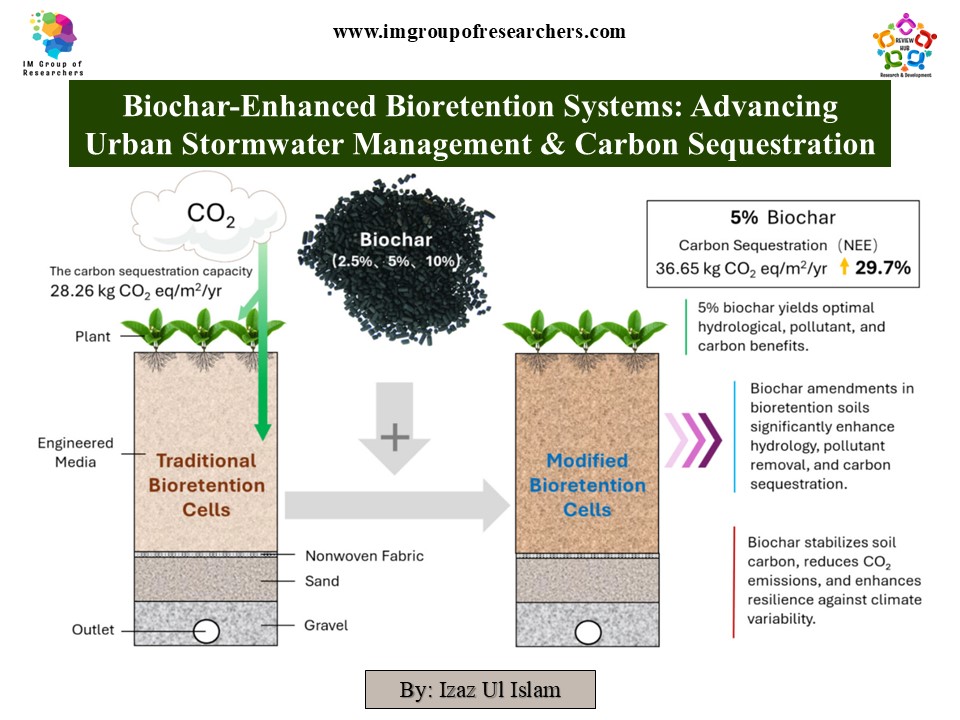
Beyond hydrology and water quality, the study offers strong evidence that biochar-enhanced bioretention systems can function as effective urban carbon sinks. Conventional bioretention soils may emit carbon dioxide as organic matter decomposes, but biochar stabilizes soil carbon and suppresses microbial mineralization.
Using closed-chamber measurements of net ecosystem exchange, the researchers found that systems amended with five percent biochar exhibited the highest net carbon uptake. Over a one-year monitoring period, these systems sequestered substantially more carbon than bioretention systems without biochar. The combined effects of reduced soil respiration and enhanced plant-driven carbon fixation highlight biochar’s role in strengthening soil-based carbon storage.
These findings position biochar-amended bioretention systems as a promising nature-based solution for cities pursuing net-zero and climate-resilient infrastructure goals.
Implications for Urban Design and Green Infrastructure
A comprehensive performance evaluation across eight indicators—hydrology, water quality, and carbon metrics—revealed that a five percent biochar amendment provides the most balanced overall performance. This concentration maximized infiltration capacity, nitrate removal, and carbon sequestration while avoiding the negative trade-offs observed at higher application rates.
Although the experiments were conducted under controlled laboratory conditions, the results offer clear guidance for practitioners. For urban planners, engineers, and environmental designers, the study emphasizes that careful calibration of biochar content is essential to unlocking its full benefits. When properly applied, biochar-enhanced bioretention systems can serve as multifunctional urban landscapes that manage stormwater, improve water quality, enhance ecological resilience, and actively contribute to climate change mitigation.
Concluding Perspective
This research advances the understanding of how engineered soil amendments influence the coupled water–carbon–nutrient dynamics of LID systems. It reinforces the idea that green infrastructure can be designed not only to adapt cities to climate change, but also to mitigate it. Biochar, when applied at moderate levels, emerges as a powerful tool for transforming bioretention systems into high-performance, climate-positive urban infrastructure.
Reference
Ho, C.-C., Su, Y.-Q., & Chiang, P.-C. (2026). Comprehensive evaluation of the hydrology, pollutant removal, and carbon sequestration performance of biochar-enriched bioretention soil. Science of the Total Environment, 1011, 181174.
Read More: Water Can Turn Into A Superacid That Makes Diamonds
Follow Us on