

Author: Izaz Ul Islam
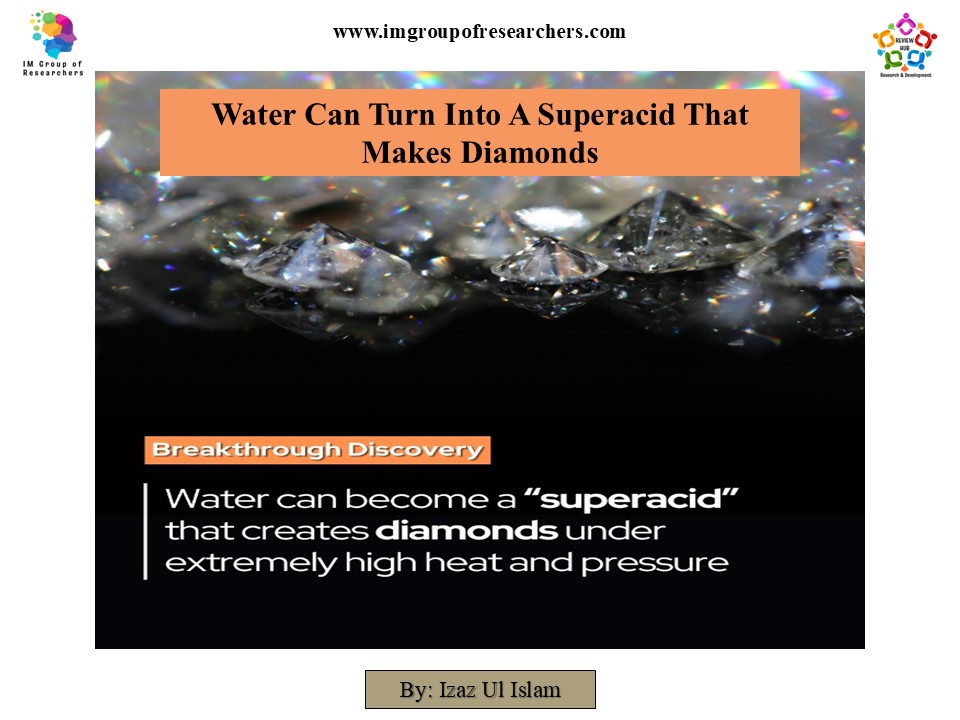
Water is usually chemistry’s peacemaker. It dissolves salts, moderates reactions, and keeps life running smoothly. But under the right — or rather wrong — conditions, water can transform into something far more extreme: a superacid powerful enough to trigger reactions that may ultimately create diamonds.
This is not science fiction. According to recent high-pressure simulations, water exposed to immense heat and pressure — like those found deep inside giant planets — behaves in ways that completely overturn our everyday intuition about chemistry.
Water, But Not As We Know It
At Earth’s surface, water (H₂O) is neutral and stable. But deep inside planets such as Uranus and Neptune, conditions are radically different:
- Pressures reach tens of gigapascals (millions of times atmospheric pressure)
- Temperatures soar to thousands of degrees Celsius
- Water coexists with methane and other hydrocarbons
Under these extreme conditions, simulations show that water molecules partially break apart into ions — forming large amounts of H₃O⁺ (hydronium). This creates an environment so rich in protons that water effectively behaves like a superacid.
In chemistry, superacids are stronger than pure sulfuric acid and can protonate molecules that normally resist reaction. Remarkably, under planetary interior conditions, water itself becomes one.
What Does “Superacidic Water” Actually Do?
One of the most striking findings from the simulations is that superacidic water can protonate methane (CH₄) — a molecule that is usually extremely unreactive.
When methane picks up an extra proton, it forms unstable intermediates (such as CH₅⁺) that can:
- Break apart
- Recombine into larger hydrocarbon chains
- Gradually condense into dense carbon structures
Given enough pressure and time, these processes can help carbon atoms rearrange into diamond-like forms.
In short: water doesn’t turn into diamonds — but it creates the chemical conditions that make diamond formation possible.
💎 Diamond Rain Inside Planets?
This research adds weight to a long-standing hypothesis in planetary science: that diamonds may form deep inside icy giant planets and fall like rain toward their cores.
Laboratory experiments have already hinted at diamond formation under similar conditions. What this new work contributes is a chemical mechanism explaining how hydrocarbons might break down and reorganize in the presence of superacidic water.
If correct, planets like Uranus and Neptune may host vast, hidden diamond layers — formed not by geology as on Earth, but by extreme fluid chemistry.
How Scientists Studied This
The findings are based on advanced atomistic simulations, not direct experiments. Reproducing planetary interior conditions in the lab is extraordinarily difficult, so researchers instead rely on quantum-level modeling to track how atoms and electrons behave under extreme thermodynamic stress.
The simulations reveal that once water crosses certain pressure-temperature thresholds, proton mobility increases dramatically — the defining feature of its superacidic behavior.
Why This Matters Beyond Planets
While this chemistry occurs far from Earth’s surface, it has broader implications:
- Planetary science: Helps explain internal structures, heat flow, and magnetic fields of icy giants.
- High-pressure chemistry: Reveals new reaction pathways that don’t exist under normal conditions.
- Materials science: Offers insight into alternative routes for forming ultra-hard carbon materials.
Perhaps most importantly, it reminds us that even the most familiar substances — like water — can behave in astonishingly unfamiliar ways when pushed to extremes.
Research Reference
The New Scientist article is based on the following scientific study:
Thévenet, T., Dian, A., Markovits, A., et al. (2025).
Water is a superacid at extreme thermodynamic conditions.
arXiv preprint arXiv:2503.10849
https://arxiv.org/abs/2503.10849
Final Thought
Water made life possible on Earth. But deep inside distant planets, the same molecule may be driving reactions powerful enough to forge diamonds. Chemistry, it turns out, is all about context and under enough pressure, even water reveals a hidden, extreme side.
Read More: A Critical Scientific Perspective on Hydrothermal Carbonization (HTC) for Sewage Sludge Management
Follow Us on