

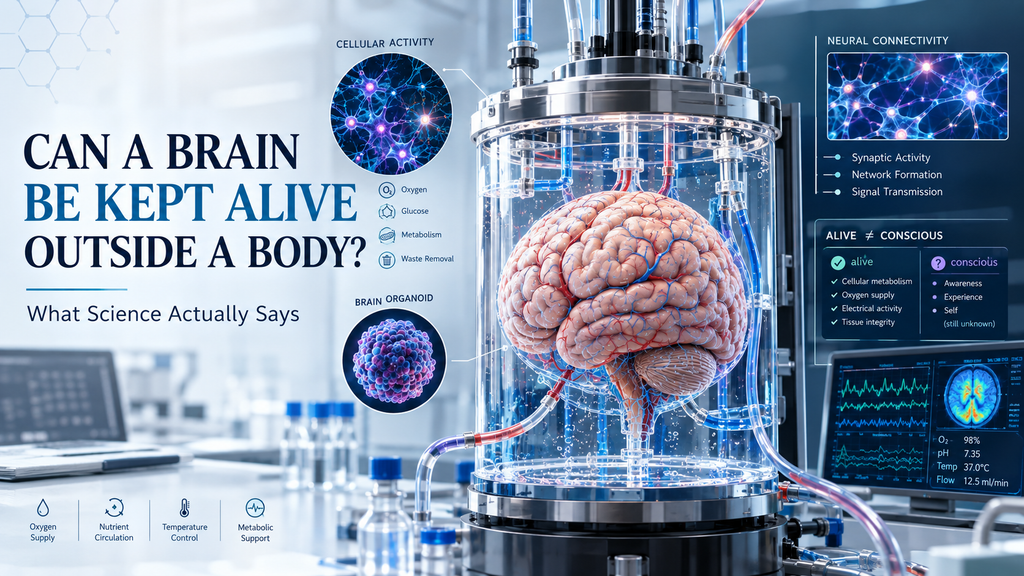
The human brain is one of the most complex biological systems ever studied. It consumes a large amount of energy, depends on a continuous supply of oxygen and nutrients, and is closely connected to the heart, lungs, immune system, and the rest of the body.
This raises a fascinating scientific question: Can a brain be kept alive outside a body?
The idea sounds like science fiction, but researchers have already demonstrated some remarkable aspects of brain survival outside the normal circulation of the body. However, there is a major difference between keeping brain cells biologically active and keeping a complete human brain alive as a functioning, conscious organ.
So, what does science actually say?
What Does “Keeping a Brain Alive” Mean?
Before answering the question, it is important to define what “alive” means.
A brain contains billions of interconnected cells. For those cells to remain functional, they require:
- Oxygen
- Glucose and other nutrients
- Water and electrolytes
- Appropriate temperature
- Removal of metabolic waste
- Controlled blood flow
- Stable chemical conditions
If the brain is deprived of oxygen for too long, its cells begin to become damaged. This is why interruption of blood flow to the brain during cardiac arrest can rapidly become life-threatening.
However, cell survival is not the same as preserving an intact, functioning brain.
A laboratory may keep individual neurons alive for extended periods. That does not mean the brain retains its normal electrical activity, information processing, consciousness, or relationship with the rest of the body.
Why Does the Brain Need the Body?
The brain is not an isolated organ.
It continuously interacts with other organs through the circulatory, nervous, endocrine, and immune systems.
The heart supplies blood.
The lungs provide oxygen and remove carbon dioxide.
The liver processes and regulates many substances.
The kidneys control water, electrolytes, and waste products.
The endocrine system provides hormones that influence brain function.
This means that creating an artificial environment for a brain is much more complicated than simply supplying oxygen.
Scientists would need to reproduce many of the functions normally provided by the body.
What Happens When Blood Flow to the Brain Stops?
When circulation stops, oxygen and nutrient delivery to brain tissue falls rapidly.
Neurons are particularly vulnerable because they have a high metabolic demand and limited energy reserves.
Without sufficient oxygen and glucose:
- ATP production decreases.
- Cellular ion gradients begin to fail.
- Neurons become electrically unstable.
- Chemical signaling becomes disrupted.
- Cellular damage develops.
- Prolonged deprivation can result in irreversible tissue injury.
This is why restoring circulation as quickly as possible is critical during cardiac arrest.
The challenge for scientists is therefore not simply to supply oxygen but to recreate an environment capable of maintaining the complex physiology of brain tissue.
Can Brain Cells Be Kept Alive Outside the Body?
Yes.
Scientists routinely grow and maintain neurons and other brain cells in laboratory environments.
Cultured neurons can survive outside the body when provided with appropriate nutrients, temperature, oxygenation, and other conditions.
Researchers can also grow more complex three-dimensional neural systems known as brain organoids.
These structures are not complete human brains. Instead, they are laboratory-grown collections of cells that can reproduce certain features of developing brain tissue.
Brain organoids are increasingly used to study development, neurological diseases, drug responses, and cellular processes.
What Are Brain Organoids?
Brain organoids are three-dimensional biological structures produced from stem cells or other precursor cells.
Under controlled laboratory conditions, these cells can organize into structures that resemble certain aspects of developing nervous tissue.
They can contain different types of neural cells and develop patterns of electrical activity.
However, a brain organoid is fundamentally different from a complete human brain.
It does not reproduce the full anatomical organization, vascular system, sensory connections, immune environment, or complex body interactions of a normal human brain.
Therefore, keeping a brain organoid alive in a laboratory should not be interpreted as keeping a human brain alive outside the body.
The Breakthrough That Changed the Conversation
One of the most important demonstrations related to brain preservation outside the body came from experiments involving pig brains.
In 2019, researchers reported an experiment in which a system called BrainEx was used to restore circulation and certain cellular functions in pig brains several hours after the animals had died.
The system delivered an artificial perfusate through the brain’s blood vessels.
Researchers observed several signs of cellular activity, including restoration of circulation and metabolic functions.
Importantly, the experiment did not demonstrate conscious activity or normal brain function.
That distinction is crucial.
The work showed that some cellular and physiological processes in the brain can potentially be restored after a period of interrupted circulation. It did not demonstrate that a complete brain could be revived with memories, consciousness, or normal behavior.
What Did BrainEx Actually Demonstrate?
The BrainEx research challenged a long-standing assumption about how quickly brain tissue becomes irreversibly damaged after circulation stops.
The researchers observed evidence of:
- Restored circulation through blood vessels
- Cellular metabolic activity
- Certain cellular functions
- Reduced or limited tissue damage compared with untreated controls
But researchers did not observe the kind of organized electrical activity associated with normal conscious brain function.
This distinction between cellular preservation and functional revival is central to understanding the science.
Why Can’t Scientists Simply Connect a Brain to a Machine?
At first glance, the solution might seem straightforward.
Build a machine that performs the functions of the heart and lungs, connect it to the brain, and provide the necessary nutrients.
In reality, the problem is much more complicated.
A functioning brain depends on tightly regulated interactions between blood vessels, neurons, glial cells, hormones, immune signals, and other biological systems.
The artificial circulation would need to maintain the correct:
- Oxygen concentration
- Carbon dioxide balance
- Glucose levels
- Electrolyte concentrations
- pH
- Temperature
- Blood pressure
- Osmotic conditions
- Metabolic waste removal
Even small disruptions could damage neural tissue.
Could an Artificial Circulatory System Support a Brain?
In principle, researchers can create artificial systems that deliver fluids and nutrients to biological tissues.
Perfusion technology is already used in medical research, organ preservation, transplantation research, and experimental biology.
The challenge becomes much greater when the target is an entire brain.
The system would have to reproduce the complex circulation required by the brain’s enormous network of microscopic blood vessels while maintaining a highly controlled biochemical environment.
It would also need to prevent swelling, inflammation, clotting, and other forms of tissue damage.
Keeping a Brain Alive Is Not the Same as Keeping It Functional
This is perhaps the most important point.
There are several different levels of biological preservation:
Level 1: Cellular Survival
Individual neurons and supporting cells remain alive.
This is routinely possible in laboratory research.
Level 2: Tissue Preservation
Larger sections of neural tissue retain cellular structure and some biological activity.
This is more difficult but has been demonstrated in experimental settings.
Level 3: Organ-Level Function
An intact brain maintains coordinated physiological and electrical activity.
This is considerably more challenging.
Level 4: Conscious Brain Function
The brain retains the organized activity associated with perception, memory, awareness, and consciousness.
There is currently no established technology demonstrating that an isolated human brain can be maintained in this state outside the body.
What About Consciousness?
Consciousness makes the question far more complicated.
Scientists still do not have a complete explanation of how subjective experience emerges from neural activity.
We understand many mechanisms involved in perception, memory, attention, sleep, and neural communication, but consciousness remains an active area of scientific research.
Therefore, keeping neurons metabolically active would not automatically mean that a brain is conscious.
The pattern, organization, connectivity, and interaction of neural networks would matter.
Could Memories Survive Outside the Body?
Human memories are associated with complex changes in neural networks.
Scientists have evidence that learning and memory involve changes in synaptic connections, cellular signaling, and network organization.
However, preserving the physical structure of a brain does not automatically demonstrate that a person’s memories or identity have been preserved in a usable form.
This is another reason why brain preservation and preservation of a person are very different scientific questions.
What Role Does the Blood-Brain Barrier Play?
The brain has a specialized protective interface known as the blood-brain barrier.
It regulates which molecules can move between the bloodstream and nervous tissue.
This barrier is essential for maintaining the brain’s chemical environment.
Any artificial system designed to support an isolated brain would therefore need to account for the complex relationship between circulating substances and neural tissue.
Simply providing oxygenated fluid would not reproduce everything that the natural circulatory system does.
Could a Brain Survive Without the Rest of the Body?
From a biological perspective, an isolated brain would face enormous challenges.
The brain normally operates within a tightly regulated internal environment called homeostasis.
The body continuously adjusts:
- Temperature
- Blood pressure
- Glucose
- Electrolytes
- Hormones
- Oxygen and carbon dioxide
- Immune responses
- Fluid balance
An artificial system would need to reproduce enough of these functions to maintain brain tissue.
This is technically possible in parts, but maintaining an intact human brain with normal integrated function remains far beyond current capabilities.
Why Animal Experiments Matter
Much of what scientists know about brain preservation comes from animal research.
Animal models allow researchers to study how neural tissue responds to oxygen deprivation, artificial circulation, cooling, inflammation, and other conditions.
These experiments can reveal important biological mechanisms.
However, results from animals cannot simply be assumed to apply directly to humans.
Human brains have unique anatomical, metabolic, and functional characteristics, making translation to human applications a major scientific challenge.
The Ethical Questions
The possibility of maintaining isolated brain tissue also creates profound ethical questions.
If a future technology could maintain an intact brain outside a body, scientists would need to determine:
- Would the brain be conscious?
- Could it experience pain or distress?
- What rights would it have?
- How could researchers determine whether consciousness was present?
- Who would be responsible for its care?
- Would maintaining such a brain be ethically justified?
These questions become particularly important because biological activity does not necessarily reveal whether subjective experience exists.
As technology advances, neuroscience and ethics will increasingly need to develop together.
Could This Technology Help Medicine?
Even if scientists never create an isolated conscious human brain, research into brain preservation could have important medical applications.
Potential benefits include:
Better Understanding of Brain Injury
Researchers can study what happens to brain tissue after oxygen deprivation and investigate methods for limiting damage.
Improved Organ Preservation
Perfusion technologies could contribute to better preservation strategies for organs used in transplantation.
Drug Development
Experimental systems can help researchers test treatments for neurological diseases under controlled conditions.
Stroke Research
Understanding how neural tissue responds to interrupted blood flow may help researchers develop better treatments for stroke.
Neuroscience
Maintaining complex neural tissue outside the body can provide new experimental opportunities for studying brain biology.
Is an Artificially Supported Brain Possible in the Future?
It is difficult to predict how far the technology will advance.
Scientists are already developing increasingly sophisticated systems for organ perfusion, neural tissue culture, brain organoids, artificial circulation, and brain-computer interfaces.
Future technologies may allow researchers to preserve increasingly complex aspects of brain physiology.
But moving from cellular survival to complete, conscious brain function would require enormous advances in neuroscience, bioengineering, medicine, and our understanding of consciousness.
There is currently no scientific basis for claiming that a fully functioning human brain can simply be removed from the body and kept conscious indefinitely by a machine.
The Science Fiction vs. The Science
Stories often portray an isolated brain connected to machines as if it were a straightforward engineering problem.
Real biology is very different.
The brain is not just a biological computer that requires electricity and oxygen. It is a living organ embedded in a highly regulated biological system.
Scientists can preserve cells.
They can culture neural tissue.
They can create brain organoids.
They can perfuse animal organs.
They can restore some cellular functions in experimentally treated animal brains.
But these achievements should not be confused with maintaining a conscious human brain outside the body.
Conclusion
So, can a brain be kept alive outside a body?
The most accurate scientific answer is: parts of brain tissue and some brain functions can be maintained outside the body under controlled experimental conditions, but science has not demonstrated a fully functioning, conscious human brain living independently outside the body.
Research such as BrainEx has shown that some cellular and physiological processes in animal brains can be preserved or restored after circulation has stopped. Brain organoids and cultured neural systems have also demonstrated that complex neural activity can exist outside the body.
However, keeping cells alive is only the beginning.
A truly functioning brain requires an extraordinarily precise biological environment, and consciousness adds another layer of complexity that science does not yet fully understand.
The idea of an isolated living brain therefore remains somewhere between advanced experimental biology and science fiction. What researchers are discovering today, however, may eventually change how we understand brain injury, organ preservation, neurological disease, and perhaps even the biological limits of life itself.
Editor: Ayesha Noor