

The Left Hand of Life: How Two Chemists Cracked the Puzzle of Molecular Handedness
By : Izaz Ul Islam
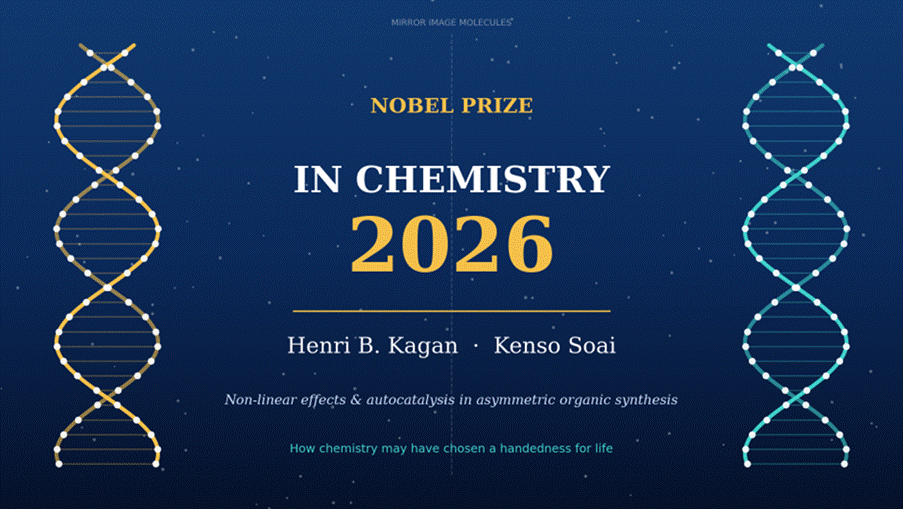
Henri B. Kagan and Kenso Soai win the Nobel Prize in Chemistry 2026 “for the discovery of non-linear effects and autocatalysis in asymmetric organic synthesis.” Here is why it matters, in plain language.
Hold up your hands and try to stack one perfectly on top of the other. You can’t. They are mirror images, almost identical, yet impossible to superimpose. Now imagine that the same quirk applies to the molecules inside your body, and that your body, along with every plant, animal, fungus and bacterium on Earth, uses only one of the two mirror-image forms. That is not a poetic metaphor. It is one of the most striking facts in all of science, and it has puzzled chemists for more than a century.
This year, the Royal Swedish Academy of Sciences has honoured two scientists whose discoveries brought us closer to understanding how that single-handedness can be created and, just as importantly, how chemists can control it. The 2026 Nobel Prize in Chemistry goes to Henri B. Kagan and Kenso Soai.
1. The mystery: why is life “homochiral”?
Many molecules are chiral, meaning they exist in two forms that are mirror images of each other, called enantiomers. In a normal laboratory reaction, chemists usually get a 50:50 mixture of both, known as a racemic mixture. Nature, however, does not play by those odds. The amino acids that build our proteins are almost all “left-handed”, and the sugars in our DNA and RNA are almost all “right-handed”. This uniform handedness is called homochirality, and it is found in all living beings.
Why does that matter? Because biology is built on molecular recognition. Enzymes, receptors and the machinery of the cell fit their partners like a hand fits a glove. A molecule’s mirror image can smell different, taste different, or act on the body in a completely different way.
A lesson written in tragedy. The thalidomide disaster of the late 1950s and early 1960s is the best-known warning about handedness in medicine. Thalidomide is a chiral molecule, and its story, though more complicated than the popular version, burned one rule into the pharmaceutical industry: you must know and control which mirror-image form you are making.
So there are two enormous questions. A practical one: how do we make only the enantiomer we want? And a profound one: how did nature end up with one hand in the first place? The 2026 laureates made breakthroughs on both.
2. Henri B. Kagan: when 1 + 1 does not equal 2
Kagan was already a pioneer of asymmetric catalysis long before this prize. In the early 1970s his group developed DIOP, one of the first chiral ligands to steer a catalyst toward one enantiomer, helping to launch a field that earlier laureates would later bring to industrial maturity. But the discovery recognised now came in the mid-1980s, and it was subtle, elegant and quietly revolutionary.
The intuitive assumption
In asymmetric catalysis, a chiral catalyst steers a reaction toward one mirror-image product. Intuitively, the purity of the product should track the purity of the catalyst. Use a catalyst that is 50% pure in one enantiomer and you should get a product that is 50% pure. Plot one against the other and you expect a straight line. A linear relationship.
The surprise
Kagan and his colleagues found that, in many reactions, it does not work that way. The product’s enantiomeric purity can be much higher or much lower than a straight line predicts. He named this phenomenon non-linear effects. A positive non-linear effect means a modest-purity catalyst can still deliver a very pure product. A negative one means purity is lost faster than expected.
The explanation lies in how catalyst molecules interact with each other. When two chiral units pair up, a left-with-left or right-with-right pair can behave very differently from a mixed left-with-right pair. If the mixed pair is inactive, or simply less active, the impure part of the catalyst is effectively locked away, and the pure part does the work. Chemists often describe this as a kind of reservoir effect.
A reaction that is non-linear is telling you how it works. — The core insight behind Kagan’s tool
Why chemists use it every day
As the Nobel committee emphasises, the fact that a reaction is non-linear gives chemists information about how it occurs. That mechanistic clue is gold: it tells a researcher whether one catalyst molecule or two are involved in the key step, and it can be used to optimise the reaction. The goal is to obtain the purest possible enantiomers of the product, which is vital for every company that makes substances meant to interact with living beings. That includes:
- Pharmaceuticals, where the wrong mirror image can be inactive or harmful.
- Flavours and scents, where the two forms of a molecule can smell or taste distinctly different.
- Agricultural chemicals, where precision means lower doses and less environmental burden.
- New materials, where handedness can determine optical and structural properties.
3. Kenso Soai: a reaction that makes its own handedness
If Kagan showed how chirality can be amplified and understood, Kenso Soai showed something that many chemists considered almost too good to be true: a reaction in which a chiral product acts as the catalyst for its own formation, and in doing so amplifies a tiny imbalance into near-total dominance of one hand.
Autocatalysis, explained
Autocatalysis means a product catalyses its own production. The more you have, the faster you make more, so a small head start snowballs. In 1995 Soai reported the reaction that now bears his name: a chiral alcohol made in the reaction acts as the catalyst that creates more of the same alcohol, with the same handedness.
The result is dramatic. Start with a very slight excess of one enantiomer, so small it is hard to detect, and run the reaction in successive rounds. Each round amplifies the excess, until it approaches a single, essentially pure hand. The reaction effectively turns a whisper into a shout.
Why the origin-of-life community took notice
Here lies the beauty. Soai’s reaction is sensitive to extremely small influences. In later work around the world, such tiny starting biases have been linked to things like the chirality of circularly polarised light or of certain crystals, and even to random statistical fluctuations. If a chemical system can amplify a minuscule, accidental imbalance into overwhelming dominance of one hand, then life’s homochirality no longer needs a miraculous starting point. It needs only a small bias and a mechanism that amplifies it.
The Nobel committee’s own framing: the Soai reaction has awakened new enthusiasm among chemists who want to understand the origins of life. Researchers around the world are now trying to repeat Soai’s achievement, but with the aim of producing homochiral amino acids and sugars, the very building blocks of life.
To be clear, this does not mean the riddle of life’s origin is solved. The Soai reaction itself uses compounds that are not found in living systems. But it has done something equally important: it has proven the principle. Spontaneous symmetry breaking and chiral amplification are real, reproducible chemistry, not wishful thinking.
4. Two discoveries, one big idea
At first glance, Kagan’s non-linear effects and Soai’s autocatalysis look like different stories. One refines how we make single-handed molecules; the other explains how single-handedness could appear from near nothing. But they share a deep thread: in chemistry, the relationship between cause and effect is often not proportional. Small differences can be amplified, and impurity can be suppressed, by the way molecules interact with each other.
| Henri B. Kagan | Kenso Soai | |
| Key concept | Non-linear effects | Asymmetric autocatalysis |
| Core idea | Product purity is not simply proportional to catalyst purity | A product catalyses its own formation and amplifies a tiny imbalance |
| Landmark period | Mid-1980s | 1995 |
| Main impact | A practical tool to probe mechanisms and optimise reactions | A model for how homochirality could arise from almost nothing |
| Audience | Pharma, flavours, agrochemicals, materials | Origin-of-life research, fundamental chemistry |
5. Why this Nobel Prize matters beyond the lab
- It is about safer, cleaner medicine. Pure enantiomers mean more effective drugs, lower doses and fewer side effects. Non-linear effects are one of the tools that make that precision routine.
- It is about efficient manufacturing. Understanding a reaction’s mechanism lets chemists use less catalyst, waste less material and get higher purity, which supports greener chemistry.
- It is about our deepest origins. Soai’s autocatalysis gives researchers a concrete, testable route to explain why life has one hand.
- It is about how science works. Both discoveries began as puzzling observations that did not match expectations. Following the anomaly led to new understanding.
6. What comes next?
The horizon is bright. Chemists are searching for new autocatalytic systems that work with biologically relevant molecules such as amino acids and sugars, and under conditions that might resemble the early Earth. In industry, non-linear-effect analysis will keep helping to design catalysts and processes that are more selective and sustainable. And for everyone studying the origin of life, the 2026 prize is a signal: homochirality is a problem that chemistry can attack, and perhaps solve.
Life’s handedness may not have been a miracle. It may have been an amplifier.
Key takeaways
- Who: Henri B. Kagan and Kenso Soai, laureates of the 2026 Nobel Prize in Chemistry.
- What for: “the discovery of non-linear effects and autocatalysis in asymmetric organic synthesis.”
- Big problem addressed: how homochirality, the single handedness of life’s molecules, can be created and controlled.
- Kagan’s gift: a way to read reaction mechanisms and obtain purer enantiomers for drugs, scents, flavours and agrochemicals.
- Soai’s gift: proof that a reaction can amplify a minuscule imbalance into a single hand, a model for the origin of life’s chirality.
Learn more
The original sources from the Nobel Prize organisation:
- Press release: https://bit.ly/4gWk4Qh
- Popular information: https://bit.ly/4iYIScY
- Advanced information: https://bit.ly/4xQTcs8