

Biology · Science History
The Nobel Prize is the ultimate badge of honor, but it has strict rules: No posthumous awards, maximum three people per prize, and sometimes the importance of a discovery is only recognized decades later.
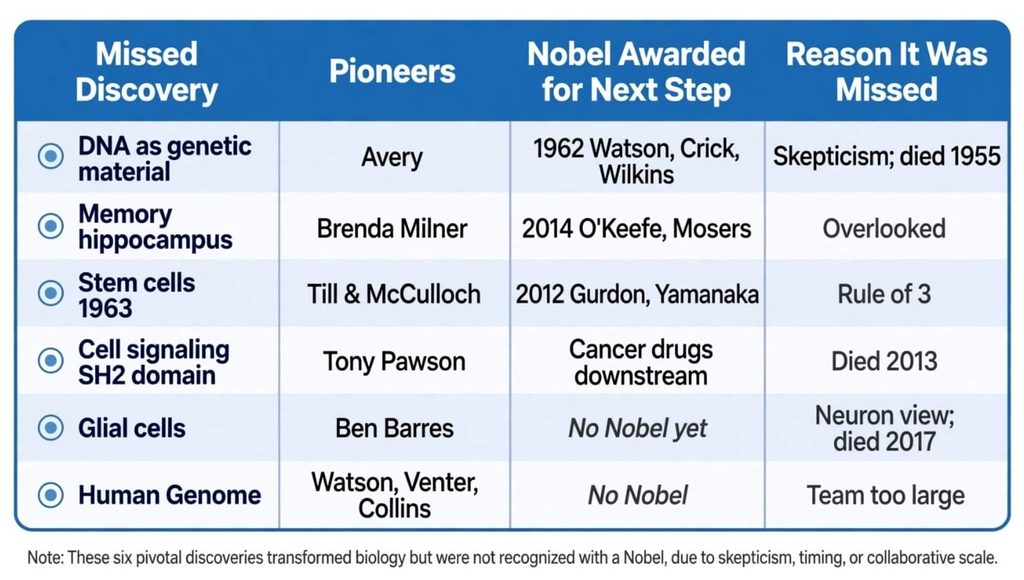
Science magazine just highlighted six landmark biology discoveries that transformed modern science but never got a Nobel. Ironically, most of the pioneers have now passed away, making a Nobel impossible forever.
1DNA as the Hereditary Material — Oswald Avery, Colin MacLeod & Maclyn McCarty (1944)
What they did:
Before Watson and Crick’s double helix in 1953, everyone thought proteins carried genetic information because proteins are more complex. At Rockefeller University, Avery’s team took virulent S-strain pneumococcus bacteria, made an extract, and added it to harmless R-strain. The R-strain became virulent.
They then destroyed proteins, RNA, and DNA one by one. Only when DNA was destroyed did the transformation stop. It was the first proof that DNA, not protein, is the genetic material.
Why no Nobel?
The scientific community was too skeptical in the 1940s. Avery was nominated multiple times but doubt lingered. He died in 1955. The 1962 Nobel for DNA structure went to Watson, Crick, and Wilkins — the next generation who built on his work.
2The Biological Basis of Memory — Brenda Milner (1957 – Present)
What she did:
Milner at McGill University studied patient H.M. (Henry Molaison) who had his medial temporal lobes, including hippocampus, removed for epilepsy. He could no longer form new memories of events.
Milner discovered something stunning: When she asked him to trace a star while looking in a mirror, his performance improved with practice, even though he had zero memory of doing the task before.
This proved memory is not one thing. The hippocampus is needed for episodic memory (remembering events), but procedural memory (learning skills) uses a different system. It founded modern neuropsychology.
Why no Nobel?
No official reason. Milner won the Kavli Prize in 2014, sharing it with John O’Keefe. A month later, O’Keefe won the Nobel for discovering the hippocampus as the brain’s GPS. Milner, who is now 108 years old and still alive, never did.
3The Discovery of Stem Cells — James Till & Ernest McCulloch (1963)
What they did:
The term “stem cell” existed, but there was no proof. Inspired by studies on radiation damage after the atomic bombs, Till (biophysicist) and McCulloch (hematologist) at Ontario Cancer Institute irradiated mouse bone marrow cells to create unique chromosome damage markers.
They transplanted these marked cells into irradiated mice. Nodules appeared in the spleen, each containing multiple blood cell types, but all cells in one nodule shared the same damage pattern — proving they came from a SINGLE parent cell. They could re-transplant and the nodules formed again. First definitive proof of self-renewing, multipotent stem cells.
Why no Nobel?
The “rule of three” problem. Later, Donald Metcalf and Leo Sachs discovered how to culture them, which was also essential. With 4+ pioneers, the committee couldn’t choose. The 2012 Nobel for stem cells went to Gurdon and Yamanaka for reprogramming, not discovery.
4How Cells Relay Signals — Tony Pawson (1980s-1990s)
What he did:
Tony Pawson at University of Toronto discovered the SH2 domain — a small protein module that specifically binds to phosphorylated tyrosine on activated cell surface receptors.
This was the missing link in signal transduction. It explained how a signal outside the cell (like a growth factor) triggers a cascade inside the cell. This concept is the foundation for almost all modern targeted cancer therapies like Gleevec.
Why no Nobel?
He was widely tipped to win. Unfortunately he died in 2013 at age 60 from cancer. Nobel Prizes are never awarded posthumously.
5Glial Cells Are Not Just Glue — Ben Barres (2000s-2010s)
What he did:
For a century, neuroscience thought neurons do all the work and glial cells are just passive “glue” or support. Stanford neuroscientist Ben Barres proved glia are active engineers.
He showed astrocytes control synapse formation, microglia prune synapses, and oligodendrocytes provide critical metabolic support. Without glia, neurons cannot function, survive, or form circuits. He transformed our view of brain diseases like Alzheimer’s as glial diseases too.
Why no Nobel?
The neuron doctrine was too dominant for too long. By the time glia were fully accepted as central, Barres died in 2017. He was also a passionate advocate for equality in science as an openly transgender scientist.
6Decoding the Human Genome — The Race That Changed Medicine
What they did:
This is the sixth breakthrough highlighted by Science as Nobel-less. The Human Genome Project led by public consortium (James Watson, Francis Collins) and the private effort by Craig Venter at Celera decoded all 3 billion letters of human DNA in 2000-2003. It created modern genomics, precision medicine, and direct-to-consumer genetics.
Why no Nobel?
Both Watson (died Nov 2025) and Venter are controversial figures. Also, the genome project involved thousands of scientists, making the 3-person limit impossible. The Nobel rule that prizes be awarded during lifetime became a stumbling block as pioneers passed away.
Why Does Stockholm Miss These Giants?
Science identifies 4 common reasons:
1Premature Skepticism: Like Avery’s DNA — too revolutionary to believe at the time.
2The Death Rule: Nobel cannot be awarded posthumously. Pawson, Barres, Till, McCulloch all died before recognition.
3The Rule of Three: Modern biology is team science. Stem cells, Human Genome involved dozens.
4Politics & Personality: Some pioneers were reclusive or controversial.
Lesson: A discovery does not become less important because it didn’t get a medal. All six breakthroughs are now in every textbook, every hospital, and every lab — with or without a Nobel.