

The Race Toward Carbon-Neutral Chemistry
Introduction
Climate change has become one of the most significant global challenges of the 21st century. Atmospheric carbon dioxide (CO₂) concentrations have increased dramatically, rising from approximately 280 parts per million (ppm) before the Industrial Revolution to more than 420 ppm today. This increase is largely driven by fossil fuel combustion, industrial activities, and deforestation.
While reducing carbon emissions remains essential, scientists are also developing innovative technologies to utilize the CO₂ already present in the atmosphere. One of the most promising approaches is CO₂-to-fuel conversion, a technology that transforms carbon dioxide from a greenhouse gas into a valuable resource for sustainable fuel production.
By converting captured CO₂ into useful fuels, researchers aim to create a circular carbon economy that supports climate mitigation while meeting future energy demands.
Understanding CO₂-to-Fuel Conversion
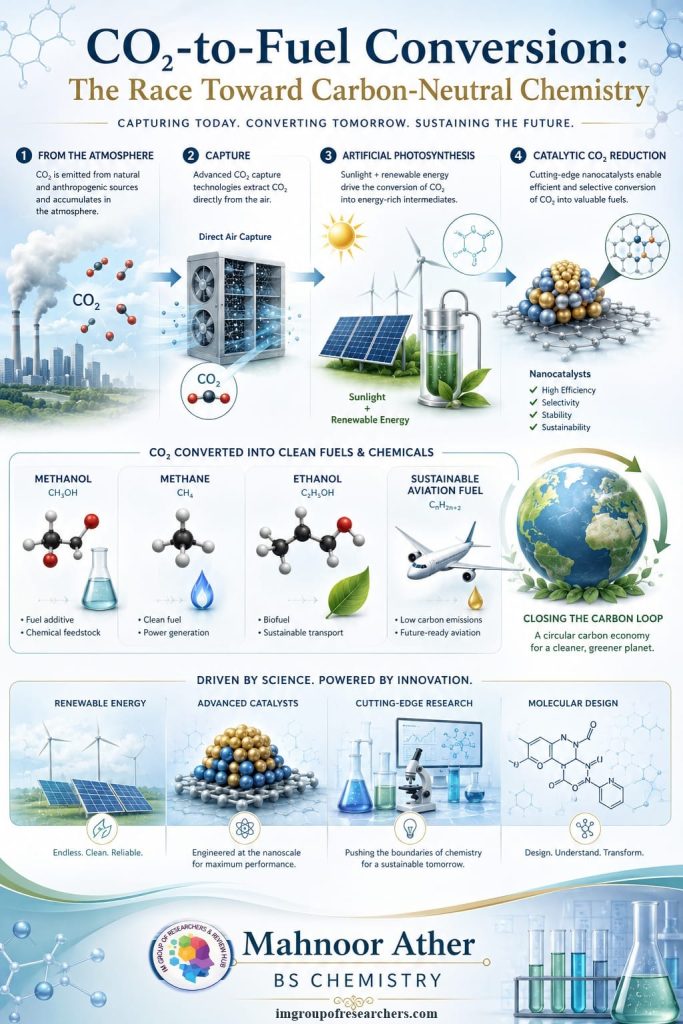
CO₂-to-fuel conversion refers to the process of transforming carbon dioxide into energy-rich fuels such as methanol, methane, ethanol, and synthetic hydrocarbons.
Instead of treating CO₂ solely as waste, scientists view it as a carbon feedstock that can be recycled into valuable products. In this approach, carbon dioxide is captured from industrial facilities or directly from the atmosphere and then converted into fuels using renewable energy.
This concept supports carbon-neutral chemistry because the carbon released during fuel consumption is balanced by the carbon previously captured, reducing the need to extract additional fossil carbon from underground reserves.
Artificial Photosynthesis: Learning from Nature
One of the most exciting developments in carbon-neutral chemistry is artificial photosynthesis.
Natural photosynthesis allows plants to absorb carbon dioxide and water while using sunlight to produce glucose and oxygen. Scientists are attempting to replicate this natural process through advanced materials, catalysts, and engineered reaction systems.
Artificial photosynthesis systems typically consist of:
- Light-absorbing materials
- Catalysts
- Reaction chambers
- CO₂ capture components
When sunlight strikes the light-absorbing materials, electrons are generated that drive chemical reactions capable of converting carbon dioxide into fuels.
Current artificial photosynthesis systems achieve solar-to-fuel conversion efficiencies ranging from 5% to 15%, significantly higher than natural plant efficiencies, which are generally below 2%.
Researchers continue to improve these systems to increase efficiency and enable large-scale deployment.
Catalytic CO₂ Reduction: The Heart of Carbon-Neutral Chemistry
Catalysts play a critical role in CO₂-to-fuel conversion technologies.
Carbon dioxide is a highly stable molecule that requires significant energy to transform into useful products. Catalysts help accelerate chemical reactions while reducing energy requirements.
Metal Catalysts
Metal-based catalysts are widely used in CO₂ reduction processes.
Common metals include:
- Copper
- Silver
- Gold
- Nickel
Among these, copper is particularly important because it can convert carbon dioxide into a wide range of valuable hydrocarbons and alcohols.
Molecular Catalysts
Molecular catalysts are specially designed compounds that promote specific chemical reactions with high selectivity.
These catalysts can efficiently produce desired fuels but often face challenges related to long-term stability and durability.
Nanostructured Catalysts
Nanotechnology has introduced a new generation of catalysts with enhanced performance.
Nanostructured catalysts provide:
- Large surface areas
- Improved reaction rates
- Better product selectivity
- Enhanced catalytic efficiency
Recent studies have reported CO₂ conversion systems achieving selectivity levels exceeding 80–90% for specific products, representing a major breakthrough in sustainable fuel production.
Sustainable Fuel Production from CO₂
The ultimate goal of CO₂ conversion technologies is to create sustainable fuels capable of replacing conventional fossil fuels.
Methanol Production
Methanol is one of the most promising products generated from captured carbon dioxide.
Methanol can be used as:
- Transportation fuel
- Chemical feedstock
- Fuel cell energy source
- Gasoline blending component
Approximately one ton of captured CO₂ can produce around 0.7 tons of methanol under suitable conversion conditions.
Synthetic Methane
Carbon dioxide can react with hydrogen through a process known as methanation to produce synthetic methane.
Synthetic methane offers several advantages:
- Compatibility with existing natural gas infrastructure
- Easier storage and transportation
- Reduced dependence on fossil natural gas
Ethanol and Liquid Hydrocarbon Fuels
Researchers are also developing technologies that convert CO₂ into ethanol and synthetic liquid fuels.
These fuels are particularly important for:
- Aviation
- Shipping
- Heavy transportation
Sustainable aviation fuels derived from captured carbon dioxide have the potential to reduce airline emissions by 60–90%, making them a valuable tool for decarbonizing difficult-to-electrify sectors.
The Role of Renewable Energy
Renewable energy is essential for making CO₂-to-fuel conversion environmentally sustainable.
If the energy required for CO₂ conversion comes from fossil fuels, the environmental benefits are significantly reduced. Therefore, renewable energy sources such as solar, wind, and hydropower are critical components of carbon-neutral fuel production.
Renewable electricity can power:
- CO₂ capture systems
- Electrochemical reduction processes
- Hydrogen production through water electrolysis
- Fuel synthesis facilities
The rapid decline in renewable energy costs has improved the economic feasibility of renewable-powered CO₂ conversion technologies.
Additionally, excess renewable electricity can be stored indirectly by converting CO₂ into fuels, providing a long-term energy storage solution.
Challenges and Limitations
Despite remarkable progress, several challenges remain before CO₂-to-fuel technologies can achieve widespread commercial adoption.
Energy Efficiency
Many CO₂ conversion systems still require substantial energy inputs. Improving conversion efficiency remains a major research priority.
Carbon Capture Costs
Capturing carbon dioxide from industrial facilities or directly from the atmosphere can be expensive, increasing overall production costs.
Catalyst Durability
Many advanced catalysts experience degradation over time, reducing efficiency and increasing operational expenses.
Infrastructure Requirements
Large-scale implementation requires significant investments in:
- Carbon capture facilities
- Renewable energy systems
- Fuel production plants
- Storage infrastructure
- Distribution networks
Addressing these challenges will be essential for expanding carbon-neutral fuel production globally.
Global Progress and Future Outlook
Governments, research institutions, and private companies worldwide are investing heavily in carbon utilization technologies.
Several pilot projects and demonstration plants are already producing fuels from captured carbon dioxide. As technology advances, production costs are expected to decrease while efficiency continues to improve.
Experts estimate that carbon capture and utilization technologies could reduce global CO₂ emissions by several gigatons annually by 2050.
Sustainable fuels derived from carbon dioxide may also supply between 10% and 20% of global transportation energy demand by mid-century.
Artificial intelligence, advanced materials science, and catalyst discovery are accelerating progress and bringing carbon-neutral chemistry closer to commercial reality.
Conclusion
CO₂-to-fuel conversion technologies are transforming the way society views carbon dioxide. Rather than treating CO₂ solely as a pollutant, researchers are increasingly recognizing it as a valuable resource for sustainable fuel production.
Through artificial photosynthesis, catalytic CO₂ reduction, renewable hydrogen production, and advanced fuel synthesis pathways, scientists are building a foundation for a carbon-neutral future.
Although challenges related to efficiency, cost, and infrastructure remain, rapid technological innovation continues to improve the viability of these systems. As renewable energy becomes more affordable and carbon management technologies mature, CO₂-to-fuel conversion is expected to play a crucial role in reducing emissions, enhancing energy security, and supporting sustainable economic growth.
The race toward carbon-neutral chemistry is not only a scientific challenge but also a critical step toward creating a cleaner, more resilient, and more sustainable future.
Editor: Ayesha Noor