

How Chemistry Is Engineering a Cleaner Future
Introduction
Energy, climate and sustainability solutions have become one of the world’s highest scientific priorities. Rising energy demand, climate change, greenhouse gas emissions, industrial pollution, and the depletion of natural resources are placing unprecedented pressure on both the environment and global economies. According to international climate assessments, transitioning toward sustainable energy systems is essential for achieving global climate goals and ensuring long-term environmental security.
At the center of these energy, climate and sustainability solutions is chemistry. From designing advanced solar materials and clean hydrogen technologies to developing carbon capture systems and next-generation energy storage, chemistry is transforming how society produces, stores, and utilizes energy.
Rather than relying solely on discovering new energy resources, the future depends on engineering smarter materials and molecular systems that improve efficiency while reducing environmental impact. The next generation of sustainable technologies will be designed at the atomic and molecular levels.
Perovskite Solar Cells: A New Generation of Affordable Renewable Energy
Solar energy is one of the most abundant renewable resources available. However, conventional silicon solar panels face limitations related to manufacturing costs, material requirements, and production complexity.
Perovskite solar cells have emerged as one of the most promising energy, climate and sustainability solutions, offering higher efficiency and lower production costs.
Why Perovskite Solar Cells Are Revolutionary
High Energy Conversion Efficiency
Perovskite materials convert sunlight into electricity with remarkable efficiency. Laboratory efficiencies have improved rapidly within a relatively short period, making them one of the fastest-developing photovoltaic technologies.
Low Manufacturing Costs
Unlike conventional silicon solar panels, perovskite solar cells can potentially be manufactured using low-temperature solution processing and printing techniques. These simpler production methods may significantly reduce manufacturing costs.
Flexible and Lightweight Design
Perovskite solar cells can be manufactured on lightweight and flexible substrates, allowing applications beyond traditional rooftop installations.
Potential applications include:
- Building-integrated photovoltaics
- Portable electronic devices
- Wearable technologies
- Flexible solar panels
- Smart windows
Current Challenges
Although promising, several challenges remain before commercial deployment becomes widespread.
Stability
Exposure to moisture, oxygen, heat, and ultraviolet radiation can reduce long-term performance.
Environmental Concerns
Many high-performance perovskites contain lead. Researchers are developing lead-free alternatives with improved environmental safety.
Large-Scale Manufacturing
Maintaining high efficiency and product consistency during industrial-scale production remains an active area of research.
Hydrogen Storage: The Missing Piece of the Hydrogen Economy
Hydrogen is widely recognized as a clean fuel because fuel cells produce only water during operation. However, one of the greatest barriers to a hydrogen-based economy is efficient hydrogen storage.
Hydrogen molecules are extremely small and have very low density, making storage and transportation technically challenging.
Why Hydrogen Storage Is Difficult
Current challenges include:
- Low volumetric energy density
- High compression requirements
- Cryogenic storage costs
- Transportation complexity
- Infrastructure limitations
Chemistry-Based Hydrogen Storage Technologies
Chemistry is providing innovative solutions that could overcome these barriers.
Metal Hydrides
Certain metals and alloys can safely absorb hydrogen within their crystal structures.
Advantages include:
- Improved storage safety
- Reduced operating pressure
- Higher volumetric hydrogen density
Metal-Organic Frameworks (MOFs)
Metal-organic frameworks are highly porous crystalline materials capable of storing large amounts of hydrogen.
Researchers can precisely engineer their pore size and chemical structure to improve storage performance.
Liquid Organic Hydrogen Carriers
Special organic molecules chemically bind hydrogen during storage and release it when required.
These systems simplify transportation while utilizing existing fuel infrastructure.
Future Impact
Efficient hydrogen storage could transform:
- Clean transportation
- Green steel production
- Sustainable chemical manufacturing
- Renewable electricity storage
- Global energy systems
Hydrogen storage remains one of the most important energy, climate and sustainability solutions for achieving carbon neutrality.
Sustainable Cement: Decarbonizing the Construction Industry
Construction supports modern civilization, yet cement manufacturing accounts for approximately 7–8% of global carbon dioxide emissions.
Most emissions occur during limestone calcination, where carbon dioxide is released as part of the chemical process.
Chemistry is enabling cleaner construction materials that significantly reduce environmental impacts.
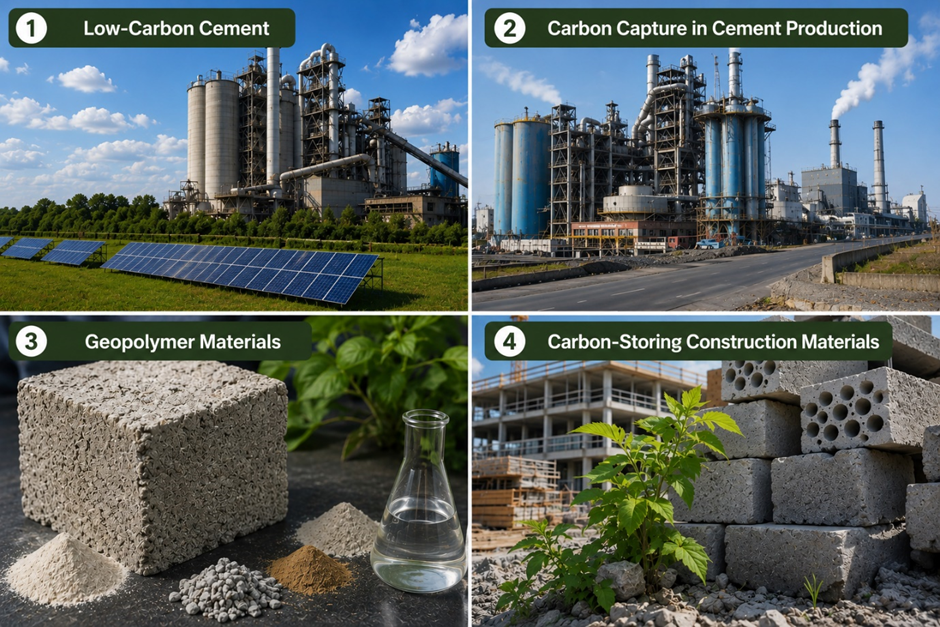
Low-Carbon Cement
Researchers are developing alternative cement formulations requiring lower production temperatures and producing fewer greenhouse gas emissions.
Carbon Capture During Cement Production
Advanced carbon capture technologies can collect carbon dioxide before it enters the atmosphere, allowing permanent storage or industrial utilization.
Geopolymer Cement
Geopolymer materials utilize industrial by-products such as fly ash and blast furnace slag instead of conventional Portland cement.
Benefits include:
- Lower emissions
- Improved durability
- Waste recycling
- Reduced energy consumption
Carbon-Storing Construction Materials
Future building materials may actively absorb atmospheric carbon dioxide throughout their service life, transforming buildings into long-term carbon storage systems.
Designing Molecules to Capture Methane from the Atmosphere
Methane is among the most powerful greenhouse gases. Although atmospheric methane concentrations are much lower than carbon dioxide, methane traps significantly more heat over shorter timescales.
Capturing methane directly from the atmosphere represents one of the newest energy, climate and sustainability solutions under investigation.
Advanced Molecular Engineering
Scientists are designing highly selective materials capable of recognizing and capturing methane molecules.
Metal-Organic Frameworks
Highly porous MOFs can selectively trap methane through carefully engineered pore structures.
Molecular Filters
Artificial molecular filters are designed to distinguish methane molecules from surrounding atmospheric gases.
Advanced Catalysts
Novel catalysts can convert captured methane into useful fuels and industrial chemicals instead of allowing it to escape into the atmosphere.
Current Challenges
Several technical obstacles remain:
- Extremely low atmospheric methane concentration
- High energy requirements
- Large-scale deployment costs
- Long-term material durability
Despite these challenges, molecular engineering represents a promising strategy for reducing greenhouse gas emissions.
Permanent Energy Storage: Enabling a Fully Renewable Future
Renewable energy sources such as solar and wind are inherently intermittent. Electricity generation depends on weather conditions and daylight availability.
Reliable long-duration energy storage is therefore essential for achieving a sustainable energy system.
Next-Generation Batteries
Researchers are developing advanced battery chemistries offering:
- Higher energy density
- Longer operational lifetime
- Improved safety
- Sustainable raw materials
- Faster charging capability
Chemical Energy Storage
Renewable electricity can be converted into hydrogen through water electrolysis.
Electricity → Hydrogen → Long-Term Energy Storage
Stored hydrogen can later be converted back into electricity whenever renewable generation decreases.
Molecular Solar Fuels
Scientists are developing molecular systems capable of:
- Capturing sunlight
- Storing solar energy in chemical bonds
- Releasing stored energy when required
These systems mimic natural photosynthesis and could revolutionize renewable energy storage.
Chemistry: The Foundation of Future Sustainability
Modern chemistry extends far beyond laboratory research. It is becoming one of the most important scientific disciplines for addressing climate change, energy security, environmental protection, and sustainable industrial development.
Through advanced materials, catalytic processes, molecular engineering, and renewable energy technologies, chemistry is creating practical energy, climate and sustainability solutions that support cleaner industries and healthier ecosystems.
Continued investment in chemical innovation will accelerate the transition toward a carbon-neutral economy while improving global energy security.
Conclusion
The future of energy, climate and sustainability solutions will be shaped by scientific innovation at the molecular scale. Advanced solar materials, hydrogen storage technologies, sustainable cement production, methane capture systems, and long-duration energy storage demonstrate how chemistry is redefining the relationship between energy and the environment.
Rather than relying solely on new energy resources, tomorrow’s sustainable world will depend on smarter materials, cleaner chemical processes, and innovative molecular engineering.
The future of energy is renewable.
The future of sustainability is powered by chemistry.
References
- Green, M. A. et al. The Emergence of Perovskite Solar Cells. Nature Photonics, 2014.
- National Renewable Energy Laboratory (NREL). Perovskite Solar Cell Research.
- International Energy Agency (IEA). The Future of Hydrogen, 2019.
- International Energy Agency (IEA). Technology Roadmap: Low-Carbon Transition in the Cement Industry.
- Li, J. R., Sculley, J., Zhou, H. C. Metal–Organic Frameworks for Separations. Chemical Reviews, 2012.
- Intergovernmental Panel on Climate Change (IPCC). Climate Change Assessment Reports.
- U.S. Department of Energy. Energy Storage Grand Challenge.
- Olah, G. A., Goeppert, A., Prakash, G. K. S. Beyond Oil and Gas: The Methanol Economy. Wiley.
Editor: Ayesha Noor