

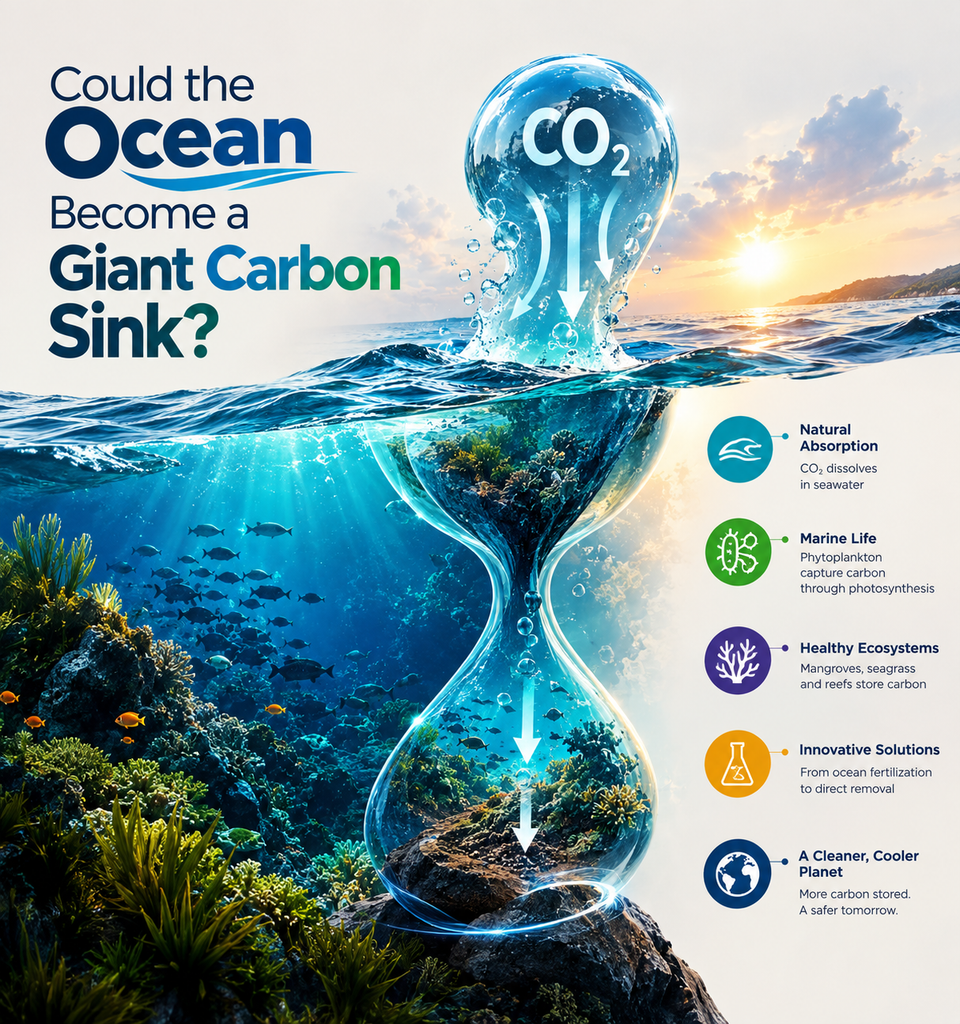
The ocean covers more than 70% of Earth’s surface and plays a major role in regulating the planet’s climate. Every year, the ocean absorbs a substantial portion of the carbon dioxide released into the atmosphere, helping slow the buildup of greenhouse gases and limiting global warming.
But an important question is emerging in climate science: Could the ocean become an even larger carbon sink and help remove more carbon dioxide from the atmosphere?
Scientists are exploring several approaches, including restoring marine ecosystems, enhancing biological carbon uptake, and developing technologies that remove carbon dioxide directly from seawater. These approaches could potentially contribute to climate mitigation, but they also raise important questions about effectiveness, environmental risks, energy requirements, and long term carbon storage.
How the Ocean Naturally Absorbs Carbon Dioxide
The ocean is one of Earth’s largest natural carbon reservoirs. Carbon dioxide from the atmosphere dissolves into seawater and participates in a series of chemical reactions that form dissolved carbon species, including bicarbonate and carbonate.
This process is part of the ocean carbon cycle.
The ocean also absorbs carbon through biological activity. Microscopic marine organisms called phytoplankton use sunlight, carbon dioxide, and nutrients to produce organic matter through photosynthesis.
Some of this organic carbon is consumed by marine organisms, while a portion sinks into deeper waters. When carbon is transported away from the atmosphere and stored in the deep ocean or sediments, it can remain isolated from the atmosphere for extended periods.
This combination of physical, chemical, and biological processes makes the ocean a powerful natural carbon sink.
Why the Ocean Matters for Climate Change
The ocean does more than absorb carbon dioxide. It also stores enormous amounts of heat.
As atmospheric greenhouse gas concentrations increase, the ocean absorbs much of the additional heat associated with global warming. This moderates the rate of atmospheric warming but also creates serious consequences for marine ecosystems.
Increasing carbon dioxide absorption also changes ocean chemistry.
When carbon dioxide dissolves in seawater, it contributes to ocean acidification. Lower seawater pH can make it more difficult for some marine organisms to build and maintain calcium carbonate structures.
Coral reefs, shellfish, and other marine organisms can therefore be affected by changes in ocean chemistry.
The ocean’s role as a carbon sink is consequently both a climate benefit and a complex environmental challenge.
Can Marine Ecosystems Store More Carbon?
One promising approach is to protect and restore marine ecosystems that naturally capture and store carbon.
Mangroves and Coastal Wetlands
Mangrove forests can capture carbon through plant growth and store substantial amounts of carbon in biomass and coastal sediments.
Protecting existing mangrove ecosystems can therefore provide multiple benefits, including carbon storage, coastal protection, habitat preservation, and support for marine biodiversity.
Seagrass Meadows
Seagrass ecosystems can also capture atmospheric carbon through photosynthesis and store organic carbon in underwater sediments.
Although they occupy relatively small areas compared with terrestrial forests, healthy seagrass ecosystems can make important contributions to coastal carbon storage.
Salt Marshes
Salt marshes capture carbon through plant growth and sediment accumulation. Their waterlogged conditions can slow the decomposition of organic matter, allowing carbon to remain stored in sediments for long periods.
Protecting these ecosystems may therefore provide a nature based approach to carbon management.
The Potential of Ocean Fertilization
Another proposed approach is ocean fertilization.
Phytoplankton require nutrients such as nitrogen, phosphorus, and in some ocean regions iron to grow. Scientists have investigated whether adding limiting nutrients could stimulate phytoplankton growth and increase carbon dioxide uptake.
The basic idea is relatively simple:
More nutrients → More phytoplankton → More photosynthesis → Greater carbon uptake
However, the actual carbon storage potential is much more complicated.
Increasing phytoplankton growth does not automatically mean that large quantities of carbon will remain stored in the deep ocean. Much of the organic matter may be consumed or decomposed near the surface, returning carbon dioxide to the atmosphere.
Ocean fertilization could also affect marine food webs, oxygen levels, and nutrient cycles.
For these reasons, scientists continue to investigate its effectiveness and potential environmental consequences.
Direct Ocean Carbon Removal
Instead of relying entirely on biological processes, researchers are developing technologies that directly remove carbon dioxide from seawater.
The basic principle is that seawater contains carbon in several chemical forms. If carbon dioxide is extracted from seawater, the ocean can potentially absorb additional carbon dioxide from the atmosphere to restore chemical equilibrium.
This creates a potential cycle:
Atmospheric CO₂ → Ocean → Carbon removal technology → CO₂ removed from seawater
The extracted carbon dioxide could then potentially be stored permanently underground or converted into useful products.
This approach is sometimes described as direct ocean capture or ocean based carbon dioxide removal.
Electrochemical Carbon Removal
Electrochemical systems are among the technologies being investigated for removing carbon dioxide from seawater.
These systems use electricity to alter seawater chemistry and separate carbon containing compounds.
If powered by low carbon electricity, electrochemical carbon removal could potentially provide a pathway for extracting carbon dioxide while avoiding some of the limitations associated with conventional carbon capture.
However, important challenges remain.
Researchers must improve:
- Energy efficiency
- Carbon removal rates
- Equipment durability
- Cost effectiveness
- Treatment of seawater
- Environmental safety
- Permanent carbon storage
The technology is still developing, and large scale deployment requires careful evaluation.
Ocean Alkalinity Enhancement
Another emerging approach is ocean alkalinity enhancement.
The concept involves increasing the alkalinity of seawater so that it can absorb more carbon dioxide while converting it into relatively stable dissolved forms.
In simplified terms, increasing ocean alkalinity could shift seawater chemistry toward greater carbon storage capacity.
Potential materials being investigated include alkaline minerals and compounds that can react with seawater.
However, large scale implementation could have ecological and chemical consequences that are not yet fully understood.
Scientists therefore need to determine how these approaches affect marine organisms, seawater chemistry, nutrient cycles, and coastal ecosystems.
Could Ocean Carbon Removal Become Permanent?
Removing carbon dioxide is only useful for climate mitigation if the carbon remains stored for a sufficiently long period.
This creates an important distinction between carbon removal and temporary carbon uptake.
For example, a marine organism may absorb carbon dioxide through photosynthesis, but if that carbon is quickly decomposed or respired back into the atmosphere, the long term climate benefit may be limited.
Permanent or durable storage requires carbon to remain isolated from the atmosphere for decades, centuries, or potentially much longer.
Deep ocean storage, mineralization, and geological storage are among the approaches being studied for longer duration carbon storage.
The Major Challenges
The idea of turning the ocean into a larger carbon sink is scientifically fascinating, but it is not a simple solution to climate change.
Environmental Risks
The ocean is a highly interconnected ecosystem. Large scale manipulation of seawater chemistry or biological productivity could produce unexpected effects.
Changes in nutrient availability could influence marine food webs, oxygen levels, and biodiversity.
Energy Requirements
Some ocean carbon removal technologies require significant amounts of energy.
If that energy comes from fossil fuels, the climate benefits could be greatly reduced.
Low carbon electricity will therefore be essential for many technology based carbon removal approaches.
Cost
Carbon removal technologies must eventually become economically competitive if they are to operate at meaningful scales.
Developing infrastructure for seawater processing, carbon separation, transportation, and permanent storage could require substantial investment.
Measuring Carbon Removal
Scientists also need reliable methods to determine how much carbon has actually been removed and how long it remains stored.
Accurate measurement, reporting, and verification will be essential before large scale ocean carbon removal can be considered a dependable climate strategy.
The Ocean Is Not a Replacement for Emission Reduction
One of the most important principles in carbon management is that carbon removal should not be viewed as a substitute for reducing greenhouse gas emissions.
Preventing carbon dioxide from entering the atmosphere in the first place is generally more straightforward than removing it later.
Ocean based carbon removal could potentially complement:
- Renewable energy
- Energy efficiency
- Electrification
- Industrial decarbonization
- Forest conservation
- Sustainable agriculture
- Carbon capture and storage
The goal should be to combine emission reduction with responsible carbon removal rather than relying on a single technology.
What Could the Future Look Like?
The future of ocean carbon management may involve several approaches working together.
Healthy mangrove forests, seagrass meadows, salt marshes, and other marine ecosystems could protect natural carbon storage. At the same time, advanced technologies could potentially remove additional carbon dioxide from seawater or increase the ocean’s capacity to store carbon.
Artificial intelligence and advanced sensors could also improve monitoring.
Future systems may continuously measure:
- Carbon dioxide concentrations
- Ocean acidity
- Temperature
- Dissolved oxygen
- Nutrient levels
- Biological activity
This information could help researchers understand how carbon removal affects marine ecosystems and improve the performance of emerging technologies.
Conclusion
Could the ocean become a giant carbon sink?
The ocean already is one of Earth’s most important carbon sinks, and scientists are investigating whether its carbon storage capacity can be safely enhanced.
From mangrove restoration and seagrass conservation to ocean alkalinity enhancement, electrochemical carbon removal, and direct extraction of carbon dioxide from seawater, researchers are exploring multiple pathways to increase ocean based carbon storage.
However, the ocean is not an unlimited carbon disposal system. It is a complex living environment, and large scale intervention could create environmental consequences that are difficult to predict.
The most promising future may therefore involve a combination of emission reduction, ecosystem restoration, scientific innovation, and carefully evaluated carbon removal technologies.
The question is no longer simply whether the ocean can absorb more carbon.
The bigger question is whether humanity can increase ocean carbon storage without damaging the ecosystem that makes it possible.