

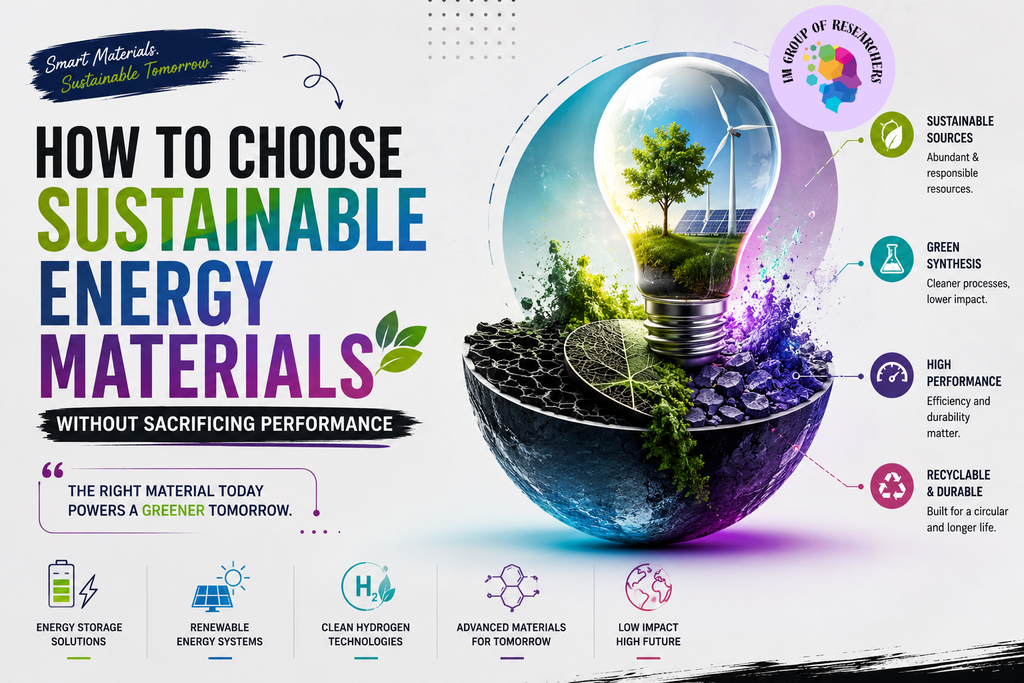
The transition toward cleaner energy is not only about generating renewable power; it also depends on what materials we use to build energy technologies. From batteries and supercapacitors to fuel cells, solar cells, and hydrogen systems, the choice of materials directly affects performance, cost, environmental impact, and long-term sustainability.
But there is a growing challenge: Can energy materials be made more sustainable without compromising their performance?
This question is becoming increasingly important as researchers and industries look beyond conventional materials toward green synthesis, resource-efficient processing, recyclable components, and lower-impact alternatives.
Choosing a sustainable energy material, therefore, should not simply mean selecting the material with the lowest environmental footprint. The better approach is to evaluate performance and sustainability together.
What Makes an Energy Material Sustainable?
A sustainable energy material should ideally perform well while reducing environmental and resource-related impacts throughout its lifecycle.
Several factors should be considered:
- Resource availability: Is the material based on abundant or scarce resources?
- Environmental impact: How much energy, water, and chemicals are required during production?
- Green synthesis: Can safer solvents, renewable feedstocks, or low-energy synthesis routes be used?
- Performance: Does the material provide sufficient energy density, power density, conductivity, stability, or efficiency?
- Durability: Can it maintain its performance over extended operating cycles?
- Recyclability: Can valuable components be recovered and reused?
- Toxicity: Does its production or disposal create risks for people or ecosystems?
- Scalability: Can the material be produced efficiently beyond laboratory conditions?
A material that performs exceptionally well but requires scarce resources, toxic chemicals, or energy-intensive processing may not be the most sustainable choice.
Why Performance Alone Is No Longer Enough
Traditionally, energy materials have often been evaluated using technical parameters such as conductivity, capacity, efficiency, stability, or energy density.
These measurements remain essential—but they do not tell the complete story.
Consider two materials with similar electrochemical performance. If one requires rare elements and energy-intensive processing while the other can be produced using abundant resources and a greener synthesis route, their overall sustainability profiles can be very different.
This is why material selection should move from a performance-only approach toward a performance-plus-sustainability approach.
The goal is not to replace high-performance materials with materials that simply have a smaller environmental footprint. Instead, researchers need to identify materials capable of delivering competitive performance with a lower overall environmental burden.
Green Synthesis Can Change the Material Selection Equation
One of the most promising approaches is green synthesis.
Green synthesis focuses on reducing the environmental impact of material preparation through strategies such as:
- safer solvents and reagents
- reduced reaction temperatures
- lower energy consumption
- shorter synthesis routes
- reduced waste generation
- renewable or bio-derived resources
- solvent recovery and reuse
- improved atom efficiency
For advanced energy materials, synthesis can sometimes represent a significant part of the material’s environmental footprint.
Therefore, simply choosing a “green” raw material does not automatically make the final material sustainable. How that material is synthesized matters too.
A material synthesized from abundant precursors using a low-energy, low-waste process may offer a more attractive sustainability profile than a theoretically greener material requiring complicated and resource-intensive processing.
The Readiness Factor: Is the Material Ready for Real-World Use?
Another factor often overlooked in sustainable material selection is technology readiness.
A material may demonstrate impressive results in a laboratory but still be far from practical implementation.
Before selecting a material for future energy technologies, researchers should ask:
Is the material ready to move beyond the laboratory?
This involves considering:
- reproducibility of synthesis
- availability of raw materials
- manufacturing complexity
- scalability
- cost
- safety
- long-term stability
- compatibility with existing technologies
- environmental impact at larger production scales
This is particularly important because a material that is highly sustainable at a few-gram laboratory scale may face completely different environmental and economic challenges when manufactured at industrial scale.
Sustainability should therefore be evaluated alongside technology readiness; not after it.
Performance and Sustainability Should Be Evaluated Together
A practical material-selection strategy can consider both technical and sustainability indicators.
For energy-storage materials, for example, researchers may evaluate:
| Performance Factor | Sustainability Consideration |
|---|---|
| Energy density | Resource intensity |
| Power density | Processing energy |
| Electrical conductivity | Chemical requirements |
| Cycle stability | Material lifetime |
| Rate capability | Manufacturing complexity |
| Coulombic efficiency | Overall energy consumption |
| Cost | Resource availability |
| Structural stability | Recyclability |
This approach makes it easier to identify materials that provide a balanced combination of performance, sustainability, cost, and practical feasibility.
Should We Choose Materials or Material Composites?
Sometimes the best solution is not a single material.
Combining materials into a composite can allow researchers to compensate for the weaknesses of individual components. For example, one component may provide high conductivity while another contributes structural stability, surface area, catalytic activity, or energy-storage capacity.
However, composites introduce another sustainability question:
Does combining two or more materials actually improve the overall sustainability of the system?
A composite should therefore be evaluated based on its complete lifecycle rather than simply its improved laboratory performance.
If a small amount of a second component significantly improves lifetime or efficiency, the composite may provide a sustainability advantage. If it introduces scarce resources, toxic components, or complicated processing without meaningful performance gains, the benefit may be limited.
Lifecycle Thinking Is Essential
A truly sustainable energy material should be assessed across its entire lifecycle:
Raw materials → Synthesis → Manufacturing → Application → Degradation → Recycling or Disposal
This prevents researchers from focusing on only one stage of the material’s environmental impact.
For example, a material may have a relatively green synthesis route but depend on scarce raw materials. Another may require more energy during production but offer significantly longer operating life and better recyclability.
The question is therefore not simply:
“Is this material green?”
A better question is:
“How sustainable is this material across its entire lifecycle while delivering the required performance?”
A Practical Framework for Selecting Sustainable Energy Materials
A useful selection process can be divided into five stages.
1. Define the Required Performance
Start by identifying the technical requirements of the intended application.
Determine which properties matter most such as energy density, power density, conductivity, efficiency, stability, operating temperature, or cycle life.
2. Screen the Material Resources
Examine the elements and compounds involved.
Ask whether they are abundant, geographically concentrated, difficult to extract, toxic, or potentially recyclable.
3. Evaluate the Synthesis Route
Do not evaluate only the final material.
Analyze the synthesis process itself:
What solvents are used? How much energy is required? How much waste is generated? Can the process be simplified?
4. Assess Technology Readiness
Determine whether the material can realistically progress from laboratory research toward scalable manufacturing.
High performance with poor reproducibility or difficult processing may limit real-world value.
5. Compare Performance With Environmental Impact
Finally, compare technical performance against sustainability indicators.
The strongest candidate is not necessarily the material with the highest performance or the lowest environmental impact individually. It is the material that achieves the best overall balance.
The Future of Sustainable Energy Materials
The future of energy materials is moving toward a more integrated design philosophy.
Researchers are increasingly expected to think beyond:
“How can we make this material perform better?”
The more important question may become:
“How can we make it perform better while using fewer resources, generating less waste, consuming less energy, and remaining practical to manufacture and recycle?”
This shift could influence the development of next-generation batteries, supercapacitors, fuel cells, solar technologies, hydrogen systems, and other emerging energy technologies.
Conclusion
Choosing sustainable energy materials does not require abandoning performance. Instead, it requires redefining what high performance means.
A genuinely promising energy material should combine strong technical properties with responsible resource use, greener synthesis, durability, scalability, safety, and end-of-life considerations.
The most sustainable material is therefore not necessarily the newest or the highest-performing material. It is the material that can deliver the right performance with the lowest reasonable environmental and resource burden across its lifecycle.
As the energy sector moves toward a more sustainable future, this balanced approach to material selection could become just as important as the performance metrics traditionally used to evaluate new technologies.
Editor: Ayesha Noor