

Introduction
Modern medicine has long depended on animal testing and limited human tissue samples to study diseases and develop treatments. However, these methods often fail to fully replicate how the human body behaves.
Today, advances in biotechnology and stem cell science are changing this reality. Researchers are now creating lab grown human organs, miniature tissues known as organoids, and synthetic embryo like structures that closely mimic human biology.
Lab grown human organs are becoming one of the most important innovations in regenerative medicine. These breakthroughs are transforming medical research by allowing scientists to study diseases in more realistic human models while reducing dependence on traditional animal testing.
What Are Lab Grown Human Organs
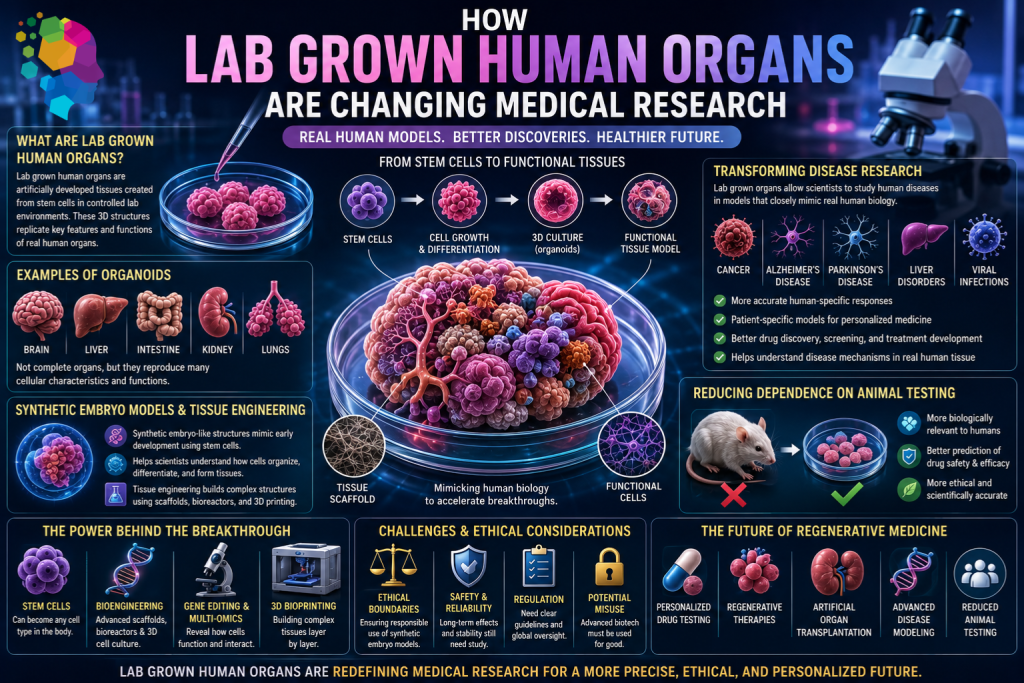
Lab grown human organs are artificially developed tissues created from stem cells in controlled laboratory environments. These structures are designed to imitate the biological functions and organization of real human organs.
One of the most important developments in this field is the creation of Organoids. Organoids are small three dimensional structures that resemble simplified versions of organs such as the brain, liver, intestine, kidney, and lungs.
Although they are not complete organs, organoids reproduce many cellular and functional characteristics of real tissues. This makes them valuable tools for studying human biology and disease.
Synthetic Embryo Models and Tissue Engineering
Researchers are also developing synthetic embryo like models using stem cells. These structures imitate certain stages of early embryonic development without using fertilized embryos.
These systems help scientists understand how cells organize, differentiate, and form tissues during the earliest stages of life. They are providing new insights into developmental disorders, infertility, and genetic diseases.
At the same time, tissue engineering technologies are enabling scientists to grow increasingly complex biological structures in laboratory environments.
How Lab Grown Human Organs Are Transforming Disease Research
Lab grown human organs allow scientists to study diseases in systems that closely resemble real human tissues.
Researchers can now model conditions such as
Cancer
Alzheimer’s disease
Parkinson’s disease
Liver disorders
Genetic diseases
Viral infections
Unlike traditional animal models, organoids often reproduce human specific biological responses more accurately. This improves the reliability of experimental results and drug testing.
Scientists can also create patient specific organoids using a person’s own cells, enabling more personalized approaches to medicine and treatment development.
Reducing Dependence on Animal Testing
One of the most significant impacts of lab grown human organs is their potential to reduce animal testing in biomedical research.
Animal models do not always accurately predict human responses to drugs and diseases. Lab grown tissues provide a more biologically relevant alternative for studying toxicity, treatment effectiveness, and disease progression.
As these systems become more advanced, they may reduce ethical concerns associated with animal experimentation while improving scientific accuracy.
The Role of Stem Cells and Biotechnology
The development of lab grown human organs depends heavily on stem cell technology.
Stem cells have the unique ability to develop into different specialized cell types. By controlling growth conditions and signaling molecules, researchers can guide stem cells to form complex tissue structures.
Advances in bioengineering, tissue scaffolding, and three dimensional cell culture are further improving the realism and functionality of these laboratory grown systems.
These innovations are pushing regenerative medicine closer to the possibility of creating transplantable organs in the future.
Ethical and Scientific Challenges
Despite their promise, lab grown organs and synthetic embryo models raise important ethical and scientific questions.
Researchers must consider
Ethical boundaries surrounding synthetic embryo research
Long term safety and reliability of lab grown tissues
Regulatory oversight for future medical applications
Potential misuse of advanced biotechnology
Balancing scientific progress with ethical responsibility remains essential as this field continues to evolve.
The Future of Regenerative Medicine
The future of lab grown human organs is advancing rapidly. Scientists hope these technologies will eventually enable
Personalized drug testing
Regenerative therapies
Artificial organ transplantation
Advanced disease modeling
Reduced reliance on animal testing
As biotechnology continues to progress, the boundary between laboratory models and functional biological systems may become increasingly sophisticated.
Conclusion
Lab grown human organs are redefining biomedical research. By creating realistic human tissue systems in the laboratory, scientists can study diseases with greater precision while reducing dependence on traditional animal testing.
These technologies represent a major step toward more ethical, accurate, and personalized medicine.
The development of lab grown human organs could redefine the future of disease research, regenerative medicine, and personalized healthcare.
Editor: Ayesha Noor