

Introduction
Life on Earth is built from chemistry. Every cell, protein, and strand of DNA originates from chemical reactions involving simple atoms and molecules. Yet one of the greatest scientific mysteries still remains unanswered how did life first begin?
Understanding the origin of life remains one of the biggest challenges in modern science. An increasingly fascinating possibility is that some of the chemical ingredients necessary for life did not originate entirely on Earth. Instead, they may have formed in space long before our planet existed.
The field of Astrochemistry explores how molecules form and evolve in interstellar clouds, comets, asteroids, and planetary systems. Recent discoveries suggest that many organic compounds linked to biology already exist throughout the universe.
This raises a profound question can astrochemistry explain the origin of life?
What Is Astrochemistry
Astrochemistry is the study of chemical reactions and molecules in space environments. It combines chemistry, astronomy, and physics to understand how matter behaves beyond Earth.
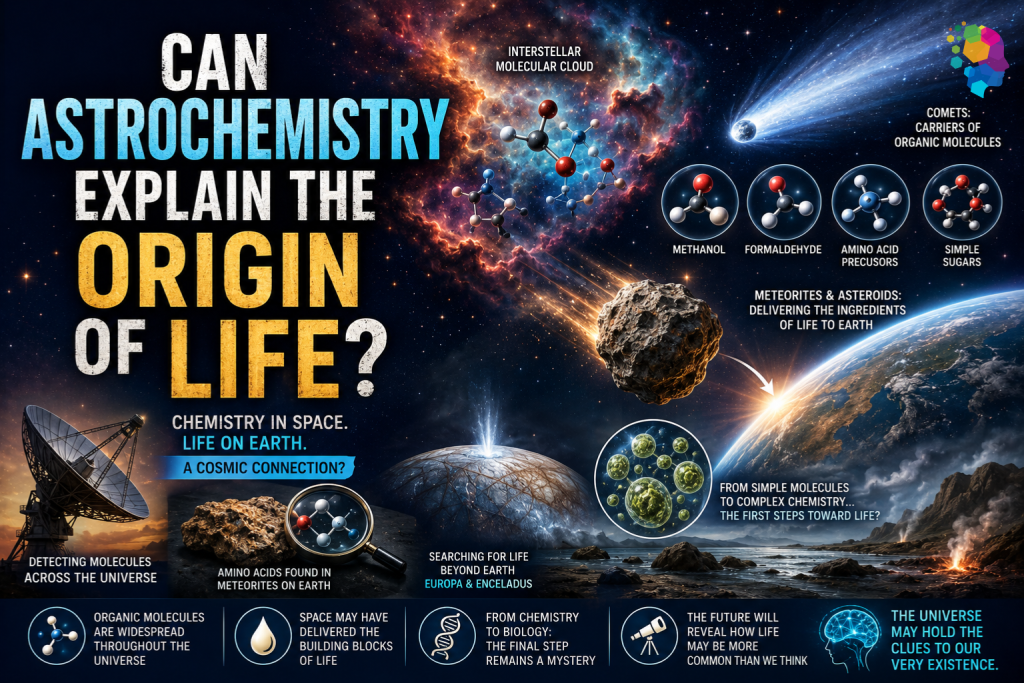
Despite the extreme conditions of space, scientists have discovered a surprising variety of molecules in interstellar clouds and cosmic dust. These include water, alcohols, amino acid precursors, and other complex organic compounds.
Many of these molecules form on icy dust grains exposed to radiation and ultraviolet light. These environments act like microscopic chemical laboratories spread across the cosmos.
Organic Molecules in Space
One of the strongest arguments connecting astrochemistry to the origin of life is the discovery of organic molecules beyond Earth.
Meteorites that have landed on Earth contain amino acids, which are essential building blocks of proteins. Scientists have also detected carbon based molecules in comets and star forming regions throughout the galaxy.
Compounds such as methanol, formaldehyde, and simple sugars have been identified in space environments. These discoveries suggest that prebiotic chemistry may be widespread across the universe rather than unique to Earth.
If the ingredients for biology exist throughout space, the chemistry associated with life may be a natural outcome of cosmic evolution.
The Role of Interstellar Clouds
Interstellar molecular clouds are enormous regions of gas and dust where stars and planets form. These clouds are chemically rich and capable of producing increasingly complex molecules over time.
At extremely low temperatures, atoms and simple molecules freeze onto dust grains. Over time, icy layers form and enable chemical reactions driven by radiation from nearby stars. These reactions gradually produce more complex organic compounds.
Eventually, these molecules can become incorporated into comets, asteroids, and newly forming planets. This suggests that planets like Earth may inherit pre assembled chemical ingredients from space before life even emerges.
Could Space Chemistry Explain the Origin of Life
One major hypothesis proposes that comets and meteorites delivered organic molecules to early Earth billions of years ago. This idea is often linked to panspermia and cosmic delivery theories.
During the early formation of the solar system, Earth experienced intense bombardment from space objects. These impacts may have transported water and prebiotic molecules essential for biological chemistry.
Although this theory does not fully explain how life itself began, it may explain how the raw chemical ingredients became available on Earth.
In this sense, space may have acted as a vast chemical supplier for the origin of life.
Chemistry Beyond Earth
The search for life is now extending beyond Earth. Scientists are studying Mars, icy moons such as Europa and Enceladus, and distant exoplanets for chemical signatures linked to biology.
If complex organic chemistry is discovered elsewhere in the universe, it would strengthen the idea that the origin of life may be connected to universal chemical processes rather than rare events unique to Earth.
Future space missions and telescopes may reveal whether the chemistry linked to life is common throughout planetary systems.
Challenges and Unanswered Questions
Although astrochemistry provides important clues, major questions remain unresolved.
Scientists still do not fully understand how nonliving chemistry transitioned into self replicating biological systems. The existence of organic molecules alone does not automatically create life.
Researchers are still investigating
How stable complex molecules remain in harsh space environments
Whether enough organic material reached early Earth
How simple molecules evolved into RNA, proteins, and living cells
These questions remain central to origin of life research.
The Future of Astrochemical Research
Advances in spectroscopy, laboratory simulations, and space exploration are rapidly expanding the field of astrochemistry.
Powerful telescopes can now detect molecular signatures in distant star systems, while laboratory experiments recreate space conditions to study chemical evolution directly.
Scientists hope these discoveries will clarify how cosmic chemistry connects to biology and whether life could emerge elsewhere in the universe.
Conclusion
The chemistry of space is revealing that the universe is far more chemically active than scientists once imagined. Organic molecules previously thought unique to Earth are now known to exist throughout interstellar space, comets, and planetary systems.
Although researchers have not yet fully solved the mystery surrounding the origin of life, astrochemistry suggests that the essential ingredients for biology may be woven into the fabric of the cosmos itself.
Astrochemistry may ultimately help scientists explain the origin of life on Earth and potentially elsewhere in the universe.