

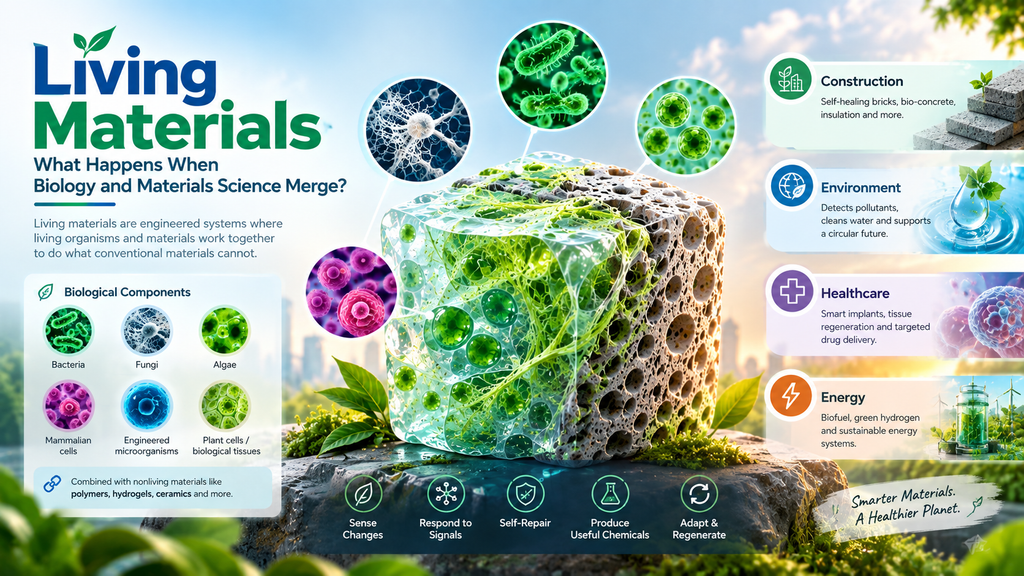
Imagine a building material that can grow, repair itself, respond to its environment, or even produce useful chemicals. Instead of treating materials as completely passive substances, scientists are exploring systems that combine the capabilities of living organisms with the functionality of engineered materials.
This emerging field, known as living materials, brings together biology, materials science, biotechnology, synthetic biology, chemistry, and engineering. The goal is not simply to make biological materials, but to create engineered systems in which living cells and materials work together to perform functions that conventional materials cannot easily achieve.
What Are Living Materials?
Living materials are engineered materials that contain living biological components capable of carrying out specific functions.
These biological components can include:
• Bacteria
• Fungi
• Algae
• Mammalian cells
• Genetically engineered microorganisms
• Plant cells or biological tissues
The living organisms may be embedded within, attached to, or integrated with a nonliving material such as a polymer, hydrogel, scaffold, ceramic, or other structural matrix.
The result is a hybrid system that combines the physical properties of materials with the dynamic capabilities of biology.
Why Combine Biology and Materials Science?
Traditional materials are generally designed to perform a specific function under defined conditions. A polymer can provide flexibility, a metal can provide strength, and a semiconductor can control electrical signals.
Living organisms, however, have remarkable capabilities that conventional materials generally lack.
Cells can:
• Sense changes in their surroundings
• Respond to chemical signals
• Repair biological structures
• Produce molecules
• Adapt to changing conditions
• Reproduce and regenerate
• Carry out complex biochemical reactions
By incorporating these capabilities into engineered materials, researchers hope to create materials that are more adaptive, responsive, and multifunctional.
This is one of the most interesting aspects of living materials: instead of simply designing what a material is, scientists can potentially design what a material can do.
How Are Living Materials Made?
The design of living materials depends on the intended application.
One approach involves placing microorganisms inside a protective material such as a hydrogel. The hydrogel provides a three-dimensional environment where cells can remain alive while the surrounding material provides mechanical structure.
Another strategy uses microorganisms that naturally produce structural materials.
For example, certain bacteria can produce extracellular polymers, while fungi can form extensive networks of biological filaments. Researchers can engineer these biological systems or combine them with synthetic materials to produce new types of composites.
Hydrogels and Living Cells
Hydrogels are particularly attractive because they contain large amounts of water and can provide a relatively suitable environment for biological activity.
Scientists can incorporate cells into hydrogels and engineer the cells to perform functions such as sensing chemicals, producing proteins, or responding to environmental signals.
This creates a material that is not simply a container for cells but can function as an engineered biological system.
Self-Healing Materials
One of the most exciting possibilities of living materials is self-healing.
Conventional materials can crack, fracture, or degrade over time. Repair normally requires external intervention.
Living systems already possess natural repair mechanisms. Researchers are therefore investigating whether these mechanisms can be incorporated into engineered materials.
For example, microorganisms could potentially produce mineral deposits or polymers that help seal cracks within a material.
In the future, living materials could potentially be used in infrastructure where small amounts of damage trigger biological processes that help restore structural integrity.
Living Materials for Construction
Construction is one area where biological materials could have major environmental implications.
Researchers are exploring biological approaches for producing materials such as bricks, concrete-like composites, insulation materials, and structural components.
Some microorganisms can participate in biomineralization, producing mineral structures through biological processes.
This raises the possibility of construction materials that are capable of partially repairing themselves or producing structural components using biological activity.
However, practical implementation requires careful control of mechanical strength, environmental stability, biological activity, and long-term durability.
Living Materials as Environmental Sensors
Living materials can also act as biological sensors.
A genetically engineered microorganism can be designed to respond to a particular chemical or environmental condition. When the microorganism detects its target, it may produce a measurable signal such as fluorescence or another detectable output.
Embedding such cells into a material could create a surface or device capable of detecting:
• Toxic chemicals
• Heavy metals
• Pathogens
• Changes in pH
• Environmental pollutants
• Specific biological molecules
This could lead to new approaches for environmental monitoring and biosensing.
Living Materials for Pollution Control
Another potential application is environmental remediation.
Certain microorganisms naturally interact with pollutants and can transform, degrade, or immobilize specific contaminants.
Researchers are investigating whether these biological capabilities can be incorporated into engineered materials.
For example, a living material could potentially contain microorganisms capable of processing a pollutant while the surrounding matrix keeps the biological system localized.
Such systems could eventually contribute to wastewater treatment, soil remediation, and pollutant monitoring.
Living Materials and Carbon Capture
The combination of biology and materials science could also influence carbon management.
Photosynthetic organisms such as algae and cyanobacteria naturally convert carbon dioxide into biomass using light.
Researchers can potentially integrate these organisms into engineered materials or structures to create systems that interact with atmospheric carbon dioxide.
This concept could lead to materials that do more than provide structural functions. They could potentially participate in carbon transformation and biological production.
However, the overall carbon benefit depends on factors such as energy requirements, biomass management, durability, and the complete life cycle of the material.
Could Living Materials Grow Themselves?
One of the most futuristic possibilities is materials that can grow rather than simply be manufactured.
Conventional manufacturing generally follows a subtractive or assembly-based approach. Raw materials are processed, shaped, assembled, and transported.
Biological systems work differently. Organisms can build complex structures from relatively simple starting materials through processes such as growth, self-organization, and metabolism.
Scientists are exploring whether these principles can be harnessed to manufacture materials with reduced energy consumption or less waste.
Instead of manufacturing every component externally, future systems might use biological growth as part of the manufacturing process.
Living Materials in Medicine
Medicine is another promising area.
Living materials could potentially be designed to interact dynamically with biological tissues.
Possible applications include:
• Tissue engineering
• Regenerative medicine
• Drug delivery
• Biosensing
• Wound healing
• Implantable systems
Living cells could provide biological functions while an engineered scaffold provides physical support.
This approach could help bridge the gap between synthetic materials and living tissues.
The Role of Synthetic Biology
Synthetic biology is an important technology behind many living-material concepts.
Scientists can modify microorganisms so that they perform specific functions or respond to particular signals.
For example, cells can potentially be engineered to:
- Detect a specific chemical
- Activate a biological pathway
- Produce a desired molecule
- Change a material property
- Trigger a visible or measurable signal
This creates a programmable interface between biology and materials science.
The material provides the physical environment, while the engineered cells provide biological intelligence.
What Makes Living Materials Different?
The fundamental difference is that conventional materials are largely passive, whereas living materials can potentially be dynamic systems.
A conventional sensor might detect a chemical using a fixed chemical or electronic mechanism.
A living sensor could potentially contain cells that detect the chemical, process the signal biologically, and generate a response.
Similarly, a conventional structural material can lose functionality after damage, while a living material could potentially initiate biological processes that contribute to repair.
This does not mean living materials will replace conventional materials. Instead, they could provide capabilities that are difficult to achieve through conventional engineering alone.
Major Challenges
Despite their potential, living materials are still an emerging research field and face significant challenges.
Maintaining Biological Activity
Cells need suitable conditions to survive and function. Temperature, moisture, nutrients, oxygen, pH, and other environmental factors can strongly affect biological activity.
Mechanical Stability
A material must often remain structurally stable while containing living organisms. Designing a matrix that is both mechanically useful and biologically compatible is challenging.
Controlling Growth
Living organisms can reproduce and change over time. Researchers need ways to control biological activity so that the material remains predictable and safe.
Long-Term Stability
A material designed for years of operation must maintain its properties over extended periods. Biological systems can behave differently as environmental conditions change.
Biosafety and Containment
When engineered microorganisms are used, preventing unintended release or ecological effects becomes an important consideration.
Manufacturing at Scale
Producing living materials consistently and economically remains another major challenge. Laboratory-scale demonstrations must eventually be translated into reliable manufacturing processes.
Are Living Materials Really “Alive”?
This question is more complicated than it appears.
A living material may contain living cells, but the entire material is not necessarily considered a living organism.
Instead, it is better understood as a hybrid system in which living and nonliving components interact.
The biological component provides functions such as sensing, metabolism, growth, or repair, while the nonliving component provides structural support, protection, or specific physical properties.
This distinction is important because it shows that the field is not simply about creating artificial organisms. It is about engineering useful interactions between biological systems and materials.
What Could the Future Look Like?
The long-term vision for living materials is remarkably broad.
Future materials could potentially:
• Detect environmental pollutants
• Repair small amounts of structural damage
• Capture or transform chemicals
• Respond to changes in temperature or humidity
• Produce valuable biological molecules
• Support tissue regeneration
• Adapt to changing environmental conditions
• Participate in sustainable manufacturing
Imagine a wall that detects harmful pollutants, a coating that responds to environmental damage, or a construction material capable of biologically repairing microscopic cracks.
These concepts may sound futuristic, but many of the underlying technologies are already being investigated in laboratories.
The Bigger Picture
The emergence of living materials represents a change in how scientists think about materials.
For centuries, materials science focused largely on controlling structure, composition, and physical properties.
Now, researchers are increasingly asking whether materials can also be designed to sense, respond, adapt, regenerate, and interact with biological systems.
This convergence could create an entirely new class of engineered matter.
Living materials are unlikely to replace metals, ceramics, polymers, or other conventional materials across the board. Their greatest value may instead come from applications where biological activity provides a unique advantage.
Conclusion
Living materials sit at the intersection of biology and materials science, combining the structural advantages of engineered materials with the dynamic capabilities of living organisms.
From self-healing construction materials and environmental sensors to regenerative medicine and biological manufacturing, the field could open new possibilities for designing materials that behave less like passive objects and more like responsive systems.
The most fascinating question may not be whether biology can be incorporated into materials, but how far scientists can go in engineering materials that grow, sense, respond, and repair themselves.
The future of materials science may not be completely synthetic. It could be part biological, part engineered, and potentially alive.