
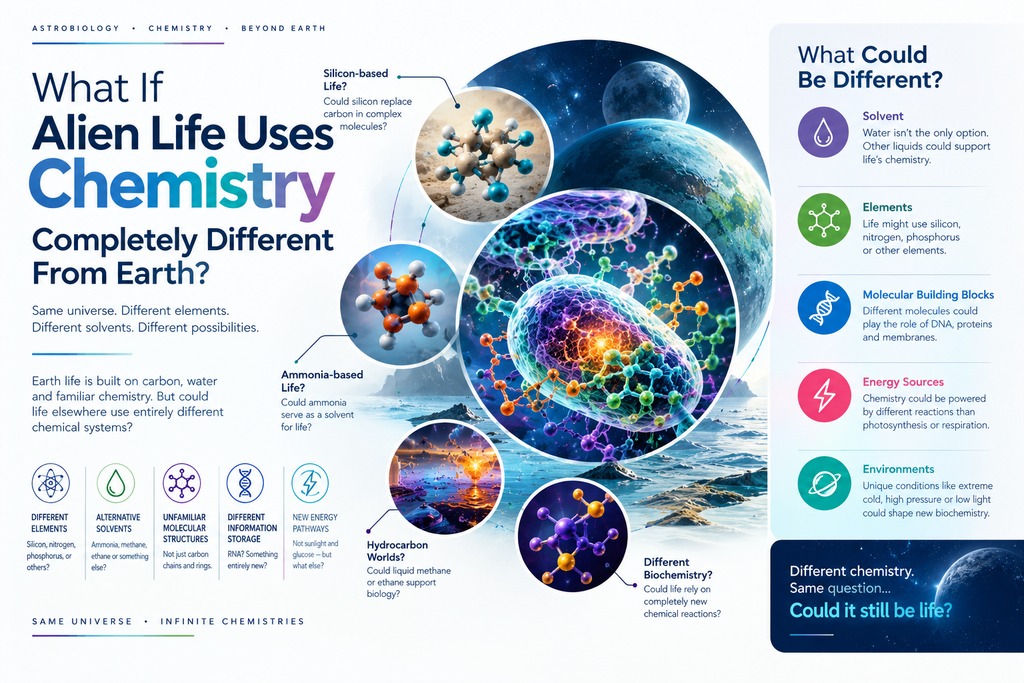
For centuries, humans have imagined life beyond Earth. Most of these ideas begin with a familiar assumption: alien life would probably need chemistry similar to our own.
Earth life is built mainly from carbon, uses liquid water as its primary solvent, stores genetic information in complex molecules, and depends on a remarkable network of chemical reactions.
But is this the only possible way for life to exist?
Scientists studying astrobiology and the chemistry of life are increasingly exploring a fascinating possibility: extraterrestrial organisms might use chemical systems that are very different from those found on Earth.
If that is true, our search for alien life could be much more difficult than simply looking for organisms that resemble bacteria, plants, or animals.
Why Is Earth’s Chemistry So Important?
Every organism known to science is based on chemistry.
Cells use molecules to store energy, build structures, communicate, reproduce, and maintain themselves. On Earth, carbon plays a central role because of its extraordinary ability to form stable bonds with many other elements.
Carbon can create:
- Long molecular chains
- Rings
- Branched structures
- Complex three-dimensional molecules
- Multiple types of chemical bonds
This versatility allows carbon to form proteins, carbohydrates, lipids, nucleic acids, and countless other molecules.
Water is equally important.
It is an excellent solvent, supports many chemical reactions, remains liquid across a useful temperature range, and has unusual physical properties that are important for biological systems.
But the fact that Earth life uses carbon and water does not automatically prove that all possible life must do the same.
What Does “Different Chemistry” Actually Mean?
Alien life with different chemistry does not necessarily mean life made from completely unknown elements.
Instead, it could mean that extraterrestrial organisms use familiar elements in unfamiliar combinations.
For example, alien organisms might potentially use:
- A different primary solvent
- Different energy-producing reactions
- Alternative molecular structures
- Different ways of storing information
- Different metabolic pathways
- Chemical building blocks rarely used by Earth organisms
The important question is whether these systems could perform the basic functions associated with life.
A living system needs some way to maintain organization, obtain energy, process information, reproduce, and respond to its environment.
Could Life Exist Without Water?
Water is central to Earth biology, but scientists have considered whether other liquids could support complex chemistry.
One of the most intriguing possibilities involves liquid hydrocarbons.
Saturn’s moon Titan has lakes and seas containing liquid methane and ethane on its extremely cold surface.
Titan therefore provides a natural laboratory for studying environments that are dramatically different from Earth.
Could chemistry in such an environment become sufficiently complex to support something resembling life?
Scientists do not currently have evidence that life exists on Titan. However, its unusual chemistry makes it an important target for astrobiology.
What About Ammonia?
Ammonia has also been discussed as a possible alternative solvent for life.
Under certain conditions, ammonia can participate in many chemical reactions and can dissolve a range of substances.
A hypothetical organism living in an ammonia-rich environment could therefore have chemistry very different from terrestrial biology.
However, alternative solvents also create major challenges.
The temperature and pressure conditions must allow the solvent to remain useful, while the chemical reactions needed for complex self-organizing systems must also be possible.
So the question is not simply:
“Can another liquid replace water?”
It is:
“Can another solvent support the complete network of chemistry required for a self-sustaining living system?”
Could Silicon Replace Carbon?
One of the most famous ideas in speculative astrobiology is silicon-based life.
Silicon sits directly below carbon in the periodic table and can form four chemical bonds.
This has led scientists and science-fiction writers to imagine organisms in which silicon plays a role similar to carbon.
But there is an important difference.
Carbon is exceptionally versatile in forming stable molecular structures under many conditions relevant to life. Silicon chemistry behaves differently, especially in the presence of oxygen and water.
Silicon dioxide, for example, forms a solid network rather than the flexible molecular structures produced by carbon dioxide.
That does not prove silicon-based life is impossible.
It means that if such life exists, it may require environmental conditions very different from those on Earth.
Could Life Use Other Elements?
Carbon and silicon are not the only elements scientists can consider.
Depending on the environment, other elements could participate in unusual chemical networks.
Phosphorus, sulfur, nitrogen, metals, and other elements already play important roles in terrestrial biochemistry.
The difference is that alien organisms could potentially organize these elements in ways that have no close biological equivalent on Earth.
For example, an organism living in a highly reducing environment might exploit chemical reactions that would be difficult or impossible under Earth’s atmospheric conditions.
Alien Metabolism Could Be Completely Different
On Earth, organisms obtain energy through processes such as photosynthesis, respiration, fermentation, and other metabolic pathways.
But metabolism is ultimately about using chemical or physical energy to maintain an organized system.
Alien organisms could potentially exploit energy sources that are unusual from a terrestrial perspective.
Possible energy sources might include:
- Chemical reactions between minerals
- Hydrogen and carbon compounds
- Sulfur chemistry
- Geothermal energy
- Radiation
- Redox reactions in subsurface environments
- Chemical gradients in oceans or atmospheres
Some of these processes already occur naturally on Earth, especially in environments such as deep-sea hydrothermal vents.
The important difference would be how an alien system organizes these reactions into a self-sustaining biological network.
What If Alien Life Does Not Need Oxygen?
Earth animals depend on oxygen for aerobic respiration, but oxygen is not a universal requirement for life.
Many microorganisms on Earth survive without oxygen.
Some use sulfur compounds, nitrate, carbon dioxide, metals, or other substances in their metabolism.
This gives scientists an important lesson:
Life does not necessarily require the environmental conditions humans consider normal.
An alien ecosystem could therefore exist in an environment that appears hostile to humans but contains suitable chemical energy for another form of life.
Could Alien Life Use a Different Genetic System?
One of the most fascinating possibilities concerns information storage.
Earth organisms use DNA and RNA to store and transmit genetic information.
These molecules are remarkably effective because their chemical structures allow information to be copied and passed between generations.
But scientists have demonstrated that chemistry can produce alternative nucleic-acid-like molecules.
Researchers have developed synthetic genetic polymers known as XNAs that can store and transmit biological information under experimental conditions.
This suggests that the chemistry of biological information storage may not be limited to the exact molecular architecture used by Earth organisms.
An extraterrestrial organism could theoretically use a different molecular system for storing hereditary information.
Could Alien Life Be Based on Completely Different Molecules?
Possibly.
Life on Earth uses a relatively specific set of molecular building blocks, including amino acids, nucleotides, sugars, lipids, and many other compounds.
But chemistry offers an enormous number of possible molecular structures.
A different planetary environment could favor molecules that are rare or unstable on Earth.
For example, extremely cold environments, highly acidic conditions, high pressures, or unusual atmospheric compositions could produce chemical pathways that are uncommon in terrestrial biology.
This is why astrobiologists are interested in life as we do not know it.
The Challenge of Defining Life
The idea of alien chemistry creates another problem:
How do we know something is alive if it does not resemble Earth life?
Scientists do not have one universally accepted definition of life.
Common characteristics include:
- Metabolism
- Reproduction
- Evolution
- Response to the environment
- Energy use
- Maintenance of internal organization
But an unfamiliar system might not display all of these characteristics in the same way.
Imagine discovering a complex chemical system on another planet that consumes energy, maintains its structure, produces copies of itself, and changes over generations.
Even if it contained no DNA, no proteins, and no water, scientists would still have to determine whether it qualifies as life.
Could We Miss Alien Life?
Yes, this is one of the major concerns in astrobiology.
Most life-detection instruments are designed around chemical and biological patterns that scientists understand from Earth.
For example, researchers may search for:
- Organic molecules
- Water
- Oxygen
- Methane
- Carbon dioxide
- Atmospheric chemical imbalances
- Biosignatures
These are useful clues, but they may not capture every possible form of life.
If alien organisms use an unexpected solvent or produce unfamiliar chemical byproducts, traditional biosignatures might not be sufficient.
Searching for Biosignatures Beyond Earth
A biosignature is a measurable feature that could indicate the presence of life.
On Earth, oxygen and methane can be produced by biological processes, although they can also arise through nonbiological chemistry.
Future telescopes and spacecraft may search for combinations of atmospheric gases, surface chemistry, minerals, or other environmental patterns that are difficult to explain without biological activity.
But if alien life uses radically different chemistry, scientists may need to expand the concept of a biosignature.
Instead of asking only:
“Where is the chemistry that looks like Earth life?”
researchers may need to ask:
“Where do we see chemistry that is unusually organized, persistent, and difficult to explain through known nonbiological processes?”
Could Life Exist in Liquid Methane?
Titan is particularly interesting because its surface environment is dominated by hydrocarbons rather than liquid water.
The moon has rivers, lakes, clouds, and rainfall involving methane and ethane.
Scientists have proposed hypothetical membrane-like structures that could form under Titan’s extremely cold conditions.
These proposed structures are very different from the phospholipid membranes of Earth cells.
However, there is currently no confirmed evidence of life on Titan.
The importance of Titan is that it demonstrates how planetary environments can produce chemistry that is dramatically different from Earth’s surface chemistry.
What About Life Inside Other Planets and Moons?
Alien life may not need to live on a planetary surface.
Several moons in our Solar System are believed to have subsurface oceans or environments where chemical reactions could occur.
These include worlds such as:
- Europa
- Enceladus
- Ganymede
- Titan
Some of these environments may contain water, minerals, organic compounds, and potential energy sources.
Life in such environments could be very different from life on Earth’s surface because of differences in pressure, temperature, available nutrients, and energy sources.
Could Alien Life Use Radiation?
Radiation is usually considered harmful to humans and many organisms.
However, some organisms on Earth can tolerate remarkably high levels of radiation.
Certain microorganisms have evolved powerful mechanisms for repairing radiation-induced damage.
This demonstrates another important principle: an environment that appears extreme from a human perspective is not necessarily biologically impossible.
An alien organism might potentially evolve chemical systems that use or tolerate environmental radiation in ways unfamiliar to terrestrial biology.
Why Chemistry Is Central to the Search for Alien Life
Astronomy can tell us where potentially interesting worlds are located.
Planetary science can reveal their temperatures, atmospheres, geological activity, and surface conditions.
But chemistry helps scientists ask a deeper question:
Could these environments support complex self-organizing systems?
This is why the search for extraterrestrial life is closely connected to chemistry.
Scientists are not simply looking for creatures. They are looking for chemical evidence of biological processes.
What Would Truly Strange Alien Life Look Like?
It is impossible to know.
A hypothetical alien organism could resemble nothing found on Earth.
It might not have cells in the familiar sense. It might use a solvent other than water. It might store information in molecules unlike DNA. Its metabolism could rely on chemical reactions that terrestrial organisms rarely use.
It could even challenge our assumptions about what constitutes a biological system.
However, these possibilities remain hypothetical until observations provide evidence.
Scientists must distinguish between chemically plausible possibilities and confirmed examples of extraterrestrial life.
The Future of Astrobiology
As space missions and astronomical instruments become more advanced, scientists will have better opportunities to investigate chemically unusual environments.
Future research could examine:
- Ocean worlds
- Exoplanet atmospheres
- Titan’s organic chemistry
- Subsurface planetary environments
- Extreme terrestrial ecosystems
- Laboratory simulations of extraterrestrial chemistry
- Alternative genetic and metabolic systems
Laboratory chemistry is particularly important because researchers can test whether proposed alternative forms of life are chemically feasible.
Could We Be Looking for Life in the Wrong Way?
Perhaps the biggest lesson is that Earth should be treated as one example of life, not necessarily the universal template.
Earth provides our only confirmed example of biology, so it naturally guides the search for extraterrestrial life.
But scientists must also remain open to the possibility that nature can organize matter in ways that have not yet been observed.
The challenge is finding the balance between imagination and evidence.
A completely different form of life should be scientifically possible before it is treated as a realistic possibility, and a potential discovery must be tested carefully against nonbiological explanations.
Conclusion
What if alien life uses chemistry completely different from Earth?
It could change the way humanity searches for life in the universe.
Alien organisms might potentially use alternative solvents, unusual metabolic pathways, different information-storage molecules, or chemical building blocks that are uncommon in terrestrial biology.
However, none of these possibilities has yet been confirmed as an example of extraterrestrial life.
What scientists do know is that chemistry is remarkably diverse. Earth itself contains organisms living in environments once considered impossible, demonstrating that biology can adapt to extraordinary conditions.
The search for alien life may therefore require more than looking for another Earth.
It may require scientists to search for unexpected chemistry, unusual energy flows, complex molecular organization, and chemical patterns that cannot be easily explained without biology.
Perhaps the most exciting possibility is not that scientists will discover an alien organism that looks like something from science fiction.
It is that they could discover a form of chemistry that forces humanity to rethink what life itself can be.
Editor: Ayesha Noor