

Introduction
Freshwater scarcity has become one of the most pressing global challenges of the 21st century. Rapid population growth, climate change, urbanization, groundwater depletion, and increasing industrial demand are placing tremendous pressure on conventional water resources. According to the United Nations, billions of people experience water shortages for at least part of the year, while many regions face recurring droughts and declining freshwater reserves.
Although freshwater resources are limited, the Earth’s atmosphere contains an enormous reservoir of water vapor. At any given moment, the atmosphere holds approximately 13,000 cubic kilometers of water in the form of moisture. This hidden resource has inspired scientists and engineers to develop atmospheric water harvesting, an innovative technology that extracts drinking water directly from the air.
Atmospheric Water Harvesting offers a sustainable solution for producing clean water in regions where traditional water supplies are limited. As advances in materials science, renewable energy, and nanotechnology continue to improve efficiency, this technology is becoming an increasingly important component of global water security.
What Is Atmospheric Water Harvesting?
Atmospheric Water Harvesting is the process of collecting water vapor from the atmosphere and converting it into liquid drinking water. Unlike groundwater extraction or desalination, atmospheric water harvesting does not rely on rivers, lakes, or underground aquifers. Instead, it captures moisture that naturally exists in the air.
The amount of water vapor in the atmosphere varies depending on humidity, temperature, and geographical location. Even relatively dry environments contain measurable amounts of atmospheric moisture that can be harvested using advanced technologies.
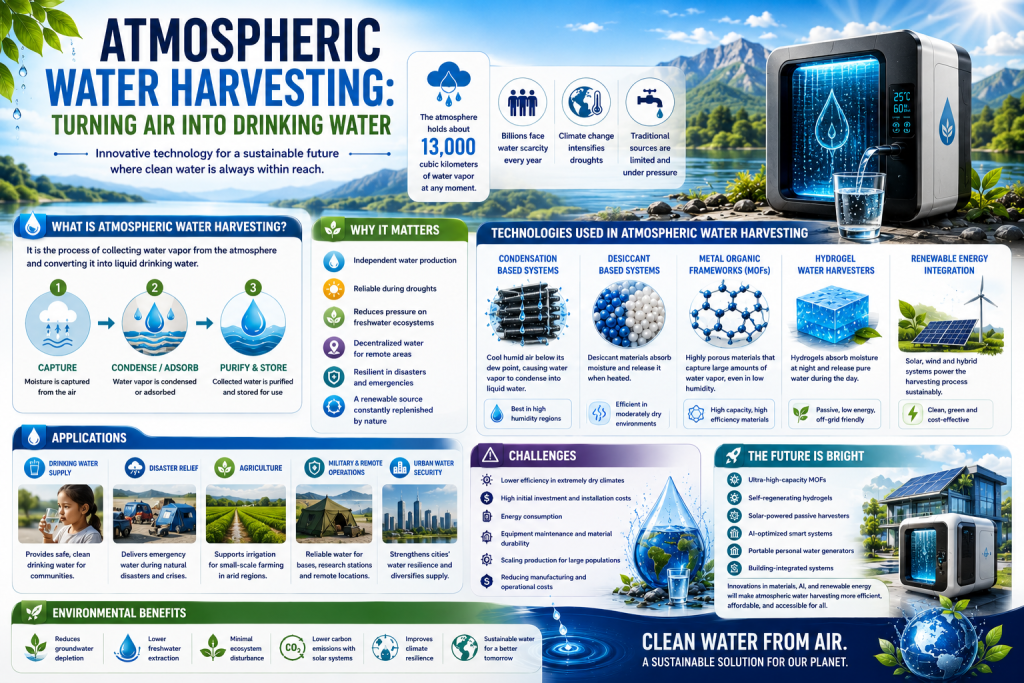
Modern atmospheric water harvesting systems generally involve three main steps:
- Capturing moisture from the air
- Condensing or adsorbing the water vapor
- Purifying and storing the collected water for safe consumption
This approach enables continuous water production while reducing dependence on increasingly stressed freshwater resources.
Why Atmospheric Water Harvesting Matters
Global demand for freshwater continues to increase due to population growth, industrial development, and agricultural expansion. Meanwhile, climate change is disrupting rainfall patterns and increasing the frequency of droughts.
Atmospheric Water Harvesting provides several important advantages:
- Independent water production without groundwater extraction
- Reliable drinking water during drought conditions
- Reduced pressure on freshwater ecosystems
- Decentralized water supply for remote communities
- Improved resilience during natural disasters and emergencies
Because atmospheric moisture is constantly replenished through the Earth’s natural water cycle, atmospheric water harvesting represents a renewable source of freshwater.
Technologies Used in Atmospheric Water Harvesting
Recent scientific advances have significantly improved the efficiency of atmospheric water harvesting technologies.
Condensation Based Systems
The most common atmospheric water generators operate by cooling humid air below its dew point. As the air cools, water vapor condenses into liquid water that is collected and filtered before use.
These systems function similarly to air conditioners but are specifically designed for water production. They perform best in regions with relatively high humidity.
Desiccant Based Water Harvesting
Desiccant materials absorb water vapor directly from the surrounding air. Once saturated, they release the captured water when heated.
Common desiccant materials include:
- Silica gel
- Lithium chloride
- Calcium chloride
- Zeolites
These systems consume less electricity than traditional condensation technologies and can operate efficiently in moderately dry environments.
Metal Organic Frameworks (MOFs)
One of the most exciting developments in Atmospheric Water Harvesting is the use of Metal Organic Frameworks (MOFs).
MOFs are highly porous materials capable of capturing large amounts of water vapor, even under low humidity conditions. Their enormous internal surface area allows them to adsorb moisture efficiently before releasing it through gentle heating using solar energy.
Researchers continue developing next-generation MOFs with higher water adsorption capacity, improved stability, and lower production costs.
Hydrogel Water Harvesters
Hydrogels are polymer materials that can absorb and retain significant quantities of water.
Modern hydrogel technologies can collect atmospheric moisture during the night and release purified water when exposed to sunlight during the day. These passive systems require little or no external electricity, making them attractive for off-grid applications.
Renewable Energy and Atmospheric Water Harvesting
Combining Atmospheric Water Harvesting with renewable energy creates highly sustainable water production systems.
Solar-powered atmospheric water generators are becoming increasingly popular because they eliminate the need for fossil fuel electricity. Photovoltaic panels provide the energy required for condensation or heating while reducing greenhouse gas emissions.
Researchers are also investigating hybrid systems that combine:
- Solar energy
- Wind energy
- Passive radiative cooling
- Advanced moisture-absorbing materials
These integrated technologies improve efficiency while lowering operating costs.
Applications of Atmospheric Water Harvesting
Atmospheric water harvesting has numerous practical applications across different sectors.
Drinking Water Supply
Communities facing water shortages can use atmospheric water generators to produce safe drinking water without relying on groundwater or surface water sources.
Disaster Relief
Natural disasters frequently disrupt water infrastructure. Portable atmospheric water harvesting units can rapidly provide emergency drinking water following earthquakes, hurricanes, floods, and humanitarian crises.
Agriculture
Researchers are exploring atmospheric water harvesting systems to provide irrigation water for small-scale farming in arid and semi-arid regions.
Military and Remote Operations
Military bases, scientific research stations, and remote communities often lack reliable water supplies. Atmospheric water harvesting reduces the logistical challenges associated with transporting water over long distances.
Urban Water Security
As cities experience increasing water demand, atmospheric water harvesting may become part of diversified urban water management strategies alongside recycling and desalination.
Challenges of Atmospheric Water Harvesting
Despite its tremendous potential, atmospheric water harvesting still faces several technical and economic challenges.
Production efficiency decreases in extremely dry climates where humidity levels are very low. Initial installation costs can also be relatively high for advanced systems.
Other challenges include:
- Energy consumption
- Equipment maintenance
- Material durability
- Scaling production for large populations
- Reducing manufacturing costs
Continued research in materials science, nanotechnology, and renewable energy is expected to overcome many of these limitations.
Future of Atmospheric Water Harvesting
The future of Atmospheric Water Harvesting is closely linked to advances in chemistry, materials engineering, artificial intelligence, and renewable energy.
Scientists are developing smart atmospheric water harvesting systems capable of automatically adjusting their operation according to weather conditions. Artificial intelligence can optimize water production while minimizing energy consumption.
Emerging innovations include:
- Ultra-high-capacity MOFs
- Self-regenerating hydrogels
- Solar-powered passive water harvesters
- Nanomaterial-based moisture collectors
- Portable personal water generators
- Building-integrated atmospheric water harvesting systems
As manufacturing costs decline and efficiency improves, atmospheric water harvesting is expected to become an important contributor to global freshwater supplies.
Environmental Benefits of Atmospheric Water Harvesting
Unlike groundwater pumping or seawater desalination, Atmospheric Water Harvesting has a relatively low environmental footprint when powered by renewable energy.
Major environmental benefits include:
- Reduced groundwater depletion
- Lower freshwater extraction
- Minimal ecosystem disturbance
- Lower carbon emissions with solar-powered systems
- Improved climate resilience
- Sustainable water production in water-stressed regions
These benefits make atmospheric water harvesting an attractive solution for achieving long-term water sustainability.
Conclusion
Atmospheric Water Harvesting is transforming the way humanity thinks about freshwater resources. By extracting water directly from the atmosphere, this innovative technology provides a sustainable alternative to conventional water supplies while reducing pressure on rivers, lakes, and groundwater reserves.
Advances in Metal Organic Frameworks, hydrogels, renewable energy, nanotechnology, and smart water harvesting systems are making atmospheric water harvesting increasingly efficient and economically viable. As climate change intensifies global water scarcity, turning air into drinking water may become one of the most important technological solutions for ensuring water security, supporting sustainable development, and improving the quality of life for future generations.
Editor: Ayesha Noor