

Introduction
The world’s oceans cover more than 70% of Earth’s surface and support countless forms of life, regulate the global climate, and provide food and livelihoods for billions of people. For decades, marine ecosystems were primarily valued for fisheries and transportation. Today, however, scientists recognize that the oceans contain an enormous reservoir of biological diversity capable of transforming medicine, biotechnology, agriculture, energy, and environmental protection.
Blue Biotechnology and Sustainable Oceans have emerged as one of the fastest-growing scientific fields, focusing on the responsible use of marine organisms to develop innovative medicines, industrial enzymes, biomaterials, biofuels, and environmentally friendly chemicals. Marine microorganisms, algae, sponges, corals, seaweeds, and deep-sea organisms possess unique biological properties that cannot be found in terrestrial species, making them invaluable resources for future scientific discoveries.
As the world seeks sustainable alternatives to fossil-based products and environmentally harmful industrial processes, Blue Biotechnology and Sustainable Oceans are becoming essential for building a healthier planet and a more sustainable economy.
What Is Blue Biotechnology?
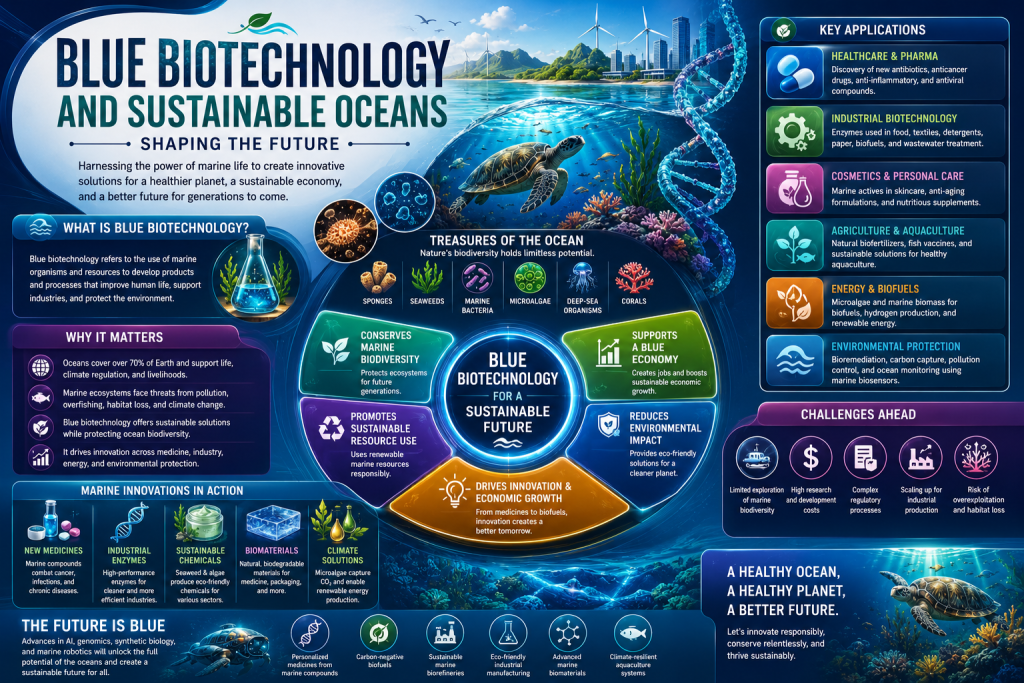
Blue biotechnology refers to the application of marine biological resources for scientific, industrial, environmental, and medical purposes. Unlike traditional biotechnology, which mainly focuses on plants and terrestrial microorganisms, blue biotechnology explores the vast diversity of life found in oceans, seas, coastal ecosystems, and deep-sea environments.
Marine organisms have evolved under extreme conditions, including high pressure, low temperatures, intense salinity, and limited sunlight. These unique environments have enabled them to produce extraordinary enzymes, proteins, pigments, and bioactive compounds with significant commercial and scientific value.
Today, Blue Biotechnology and Sustainable Oceans are driving innovations across multiple industries while promoting the conservation and responsible use of marine ecosystems.
Why Blue Biotechnology Matters for Sustainable Oceans
Healthy oceans are essential for maintaining global biodiversity, regulating climate, and supporting economic development. However, marine ecosystems face increasing threats from pollution, overfishing, habitat destruction, and climate change.
Blue biotechnology provides solutions that combine economic growth with environmental conservation. Instead of exploiting marine resources unsustainably, researchers focus on developing renewable technologies that minimize ecological damage while maximizing scientific and industrial benefits.
This approach supports the concept of a sustainable blue economy, where marine resources are utilized responsibly to generate long-term environmental, social, and economic value.
Marine Organisms as Sources of New Medicines
One of the most promising applications of Blue Biotechnology and Sustainable Oceans is the discovery of new medicines.
Marine organisms naturally produce bioactive compounds to defend themselves against predators, infections, and environmental stress. Many of these compounds exhibit powerful antibacterial, antiviral, antifungal, anti-inflammatory, and anticancer properties.
Scientists have identified thousands of marine natural products from organisms such as:
- Marine sponges
- Seaweeds
- Soft corals
- Marine bacteria
- Cyanobacteria
- Deep-sea fungi
Several marine-derived drugs have already been approved for treating cancer, chronic pain, and rare diseases, while many more are currently undergoing clinical trials.
As antibiotic resistance continues to rise worldwide, marine microorganisms may provide the next generation of life-saving antimicrobial compounds.
Blue Biotechnology in Industrial Enzymes
Marine microorganisms produce enzymes that remain highly active under extreme temperatures, pressures, and salinity levels. These enzymes are increasingly replacing conventional industrial chemicals because they are more efficient and environmentally friendly.
Marine enzymes are widely used in:
- Food processing
- Pharmaceutical manufacturing
- Textile production
- Paper and pulp industries
- Biofuel production
- Wastewater treatment
Unlike traditional industrial catalysts, marine enzymes often require less energy and generate fewer harmful by-products, reducing both production costs and environmental impacts.
Sustainable Chemicals from Marine Resources
The growing demand for environmentally friendly products has increased interest in sustainable chemicals derived from marine biomass.
Seaweeds, algae, and marine microorganisms can produce valuable chemicals used in:
- Cosmetics
- Biodegradable plastics
- Nutritional supplements
- Food additives
- Agricultural products
- Renewable biofuels
Microalgae are particularly attractive because they grow rapidly without competing for agricultural land or freshwater resources. They absorb carbon dioxide during growth while producing valuable lipids, proteins, pigments, and bioactive compounds.
These innovations demonstrate how Blue Biotechnology and Sustainable Oceans can support both environmental sustainability and industrial development.
Biomaterials Inspired by Marine Life
Marine organisms provide inspiration for developing advanced biomaterials with remarkable mechanical and biological properties.
Examples include:
- Biodegradable polymers from algae
- Medical hydrogels derived from seaweed polysaccharides
- Bioadhesives inspired by mussels
- Lightweight structural materials modeled after coral skeletons
- Tissue engineering scaffolds using marine collagen
These biomaterials are increasingly being used in wound healing, drug delivery systems, regenerative medicine, biomedical implants, and sustainable packaging.
Because many marine-derived materials are biodegradable and renewable, they offer environmentally friendly alternatives to petroleum-based plastics.
Blue Biotechnology and Climate Change Solutions
Climate change is one of the greatest environmental challenges facing humanity. Marine biotechnology offers several innovative approaches to mitigate its impacts.
Microalgae naturally capture large amounts of carbon dioxide through photosynthesis while producing oxygen and biomass. This biomass can be converted into renewable fuels, animal feed, fertilizers, and valuable chemicals.
Researchers are also exploring marine microorganisms capable of:
- Capturing atmospheric carbon dioxide
- Producing renewable hydrogen
- Removing pollutants from seawater
- Restoring damaged coral reefs
- Monitoring ocean health using biosensors
These technologies highlight the important role of Blue Biotechnology and Sustainable Oceans in supporting global climate action and achieving long-term environmental sustainability.
Challenges Facing Blue Biotechnology
Despite its enormous potential, blue biotechnology still faces several scientific and commercial challenges.
Marine biodiversity remains largely unexplored, with millions of species yet to be identified. Accessing deep-sea environments requires advanced technologies and significant financial investment.
Other major challenges include:
- Sustainable harvesting of marine organisms
- High research and development costs
- Complex regulatory approval processes
- Scaling laboratory discoveries for industrial production
- Protecting marine biodiversity from overexploitation
International collaboration, responsible resource management, and continued investment in marine research are essential for overcoming these challenges.
Future of Blue Biotechnology and Sustainable Oceans
The future of Blue Biotechnology and Sustainable Oceans is expected to be driven by advances in artificial intelligence, genomics, synthetic biology, nanotechnology, and marine robotics.
Scientists are increasingly using machine learning to identify new marine compounds, predict biological activity, and accelerate drug discovery. Genome sequencing technologies are helping researchers understand marine microorganisms that cannot be cultured using traditional laboratory methods.
Future innovations may include:
- Personalized medicines from marine compounds
- Carbon-negative biofuels
- Sustainable marine biorefineries
- Eco-friendly industrial manufacturing
- Advanced marine biomaterials
- Climate-resilient aquaculture systems
As scientific knowledge continues to expand, the oceans are expected to become one of humanity’s most valuable sources of sustainable innovation.
Conclusion
Blue Biotechnology and Sustainable Oceans represent one of the most exciting frontiers of modern science. Marine organisms are providing new medicines, industrial enzymes, biomaterials, renewable chemicals, and climate solutions that have the potential to transform healthcare, manufacturing, agriculture, and environmental protection.
By combining scientific innovation with responsible ocean conservation, blue biotechnology offers a pathway toward sustainable economic growth while protecting marine ecosystems for future generations. As researchers continue to unlock the hidden potential of the oceans, Blue Biotechnology and Sustainable Oceans will play an increasingly important role in building a cleaner, healthier, and more sustainable world.