

The global energy industry is going through a major transformation. Solar and wind power are expanding rapidly, battery technology is improving, and industries are searching for cleaner alternatives to fossil fuels.
Amid this transition, green hydrogen is attracting growing attention as a potential clean energy carrier.
But there is an important question in 2026:
Is green hydrogen finally ready to transform the energy industry, or is it still years away from becoming commercially competitive at scale?
The answer is more complicated than a simple yes or no.
Green hydrogen has made significant progress. Electrolyzer capacity is expanding, investment is increasing, and large projects are moving forward. At the same time, high production costs, limited infrastructure, uncertain demand, and project delays remain significant challenges.
According to the International Energy Agency (IEA), low-emissions hydrogen production is expected to reach a record level in 2026, although it will still represent only a small share of total global hydrogen production.
This makes 2026 an important year for the hydrogen industry. The focus is gradually shifting from ambitious announcements toward real-world deployment, cost reduction, and commercial viability.
What Is Green Hydrogen?
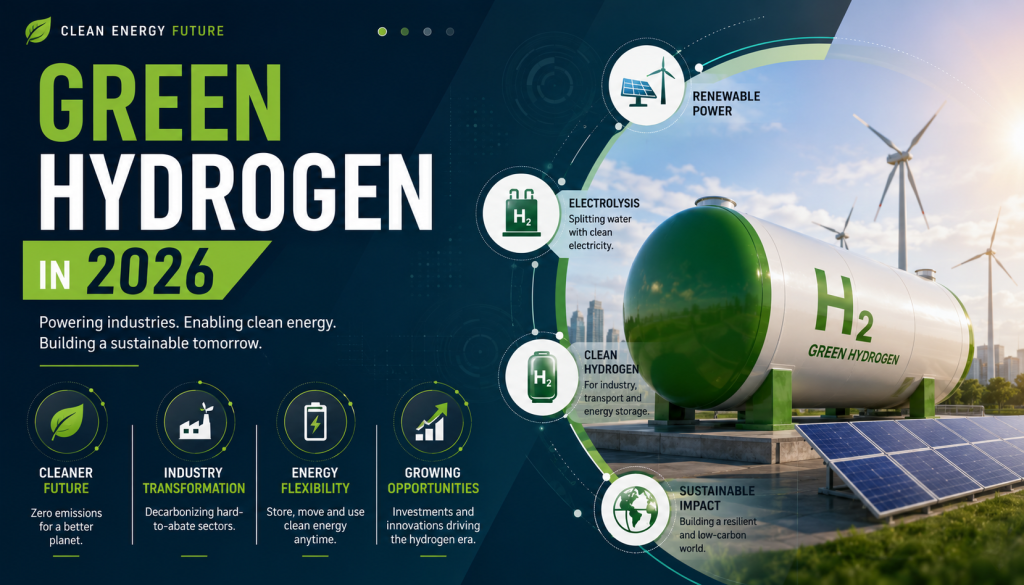
Green hydrogen is hydrogen produced using renewable electricity, typically from solar or wind power.
The most common method is water electrolysis. During this process, an electrolyzer uses electricity to split water into hydrogen and oxygen.
When the electricity comes from renewable sources, hydrogen can be produced with significantly lower greenhouse gas emissions than conventional hydrogen made from fossil fuels.
This makes green hydrogen particularly interesting for industries where direct electrification is difficult.
Electricity can directly power an electric vehicle, for example. However, replacing fossil fuels in certain industrial processes, chemical production, shipping, and other hard-to-electrify sectors can be much more complicated.
This is where green hydrogen could play an important role.
Why Is Green Hydrogen Important in 2026?
Hydrogen itself is not a new technology. It has been used for decades in industries such as oil refining and chemical manufacturing.
The major change is how hydrogen is produced and how it could support the transition toward a lower-carbon energy system.
Global hydrogen demand exceeded 100 million tonnes in 2025, with traditional industrial applications accounting for almost all of this demand. At the same time, low-emissions hydrogen production increased significantly.
The challenge is therefore not simply creating a hydrogen market. The world already has one.
The challenge is transitioning existing hydrogen production away from fossil fuels while creating new applications for clean hydrogen.
Potential applications include:
- Green steel production
- Fertilizer and ammonia production
- Chemical manufacturing
- Shipping
- Aviation fuels
- Long-duration energy storage
- Heavy transport
- Industrial heating
- Renewable energy integration
This makes hydrogen more than simply another fuel. It could become an important energy carrier and industrial feedstock.
How Is Green Hydrogen Produced?
The basic process is relatively straightforward.
Renewable Electricity
Solar panels and wind turbines generate electricity from renewable sources.
Water Electrolysis
The electricity is supplied to an electrolyzer, which separates water into hydrogen and oxygen.
Hydrogen Production
The hydrogen is collected and processed for use, storage, or transportation.
Storage and Transportation
Hydrogen can be compressed, stored, transported, or converted into hydrogen-based products such as ammonia and synthetic fuels.
The science behind this process is already well established.
The bigger challenge is making the entire system affordable, reliable, scalable, and commercially competitive.
Is Green Hydrogen Becoming More Affordable?
Cost remains one of the biggest challenges facing green hydrogen.
Renewable hydrogen is generally more expensive than fossil-based hydrogen in many markets. However, the cost gap can narrow when renewable electricity becomes cheaper, electrolyzers become more efficient, and fossil fuel prices increase.
Several factors influence the cost of green hydrogen, including:
- Renewable electricity prices
- Electrolyzer efficiency
- Electrolyzer capital costs
- Operating hours
- Water availability
- Financing costs
- Hydrogen storage
- Transportation
- Infrastructure
- Project scale
This means there is no single global price for green hydrogen.
A project located near abundant and inexpensive renewable electricity can have very different economics from a project operating in a region with expensive electricity and high financing costs.
The Electrolyzer Race Is Accelerating
Electrolyzers are at the heart of green hydrogen production.
Several technologies are being developed and deployed, including:
- Alkaline electrolyzers
- Proton exchange membrane (PEM) electrolyzers
- Solid oxide electrolyzers
- Anion exchange membrane (AEM) electrolyzers
According to the IEA, global installed electrolysis capacity more than doubled in 2025, exceeding 4 GW. Additional capacity is also under construction and expected to become operational in 2026.
China is currently a major force in electrolyzer manufacturing and deployment, while Europe and other regions are also developing large-scale projects.
However, the industry is entering a more competitive phase.
Manufacturing capacity has expanded rapidly, while some hydrogen projects have been delayed or cancelled because demand and economics have not developed as quickly as initially expected.
This is an important sign that the industry is moving from hype toward commercial reality.
Where Could Green Hydrogen Have the Biggest Impact?
Green hydrogen is unlikely to replace electricity everywhere.
Its strongest role may be in sectors where direct electrification is difficult, expensive, or technically challenging.
Green Steel
Steel production is one of the most promising applications for hydrogen-based decarbonization.
Hydrogen can potentially replace coal-based processes in certain direct-reduced iron production methods.
However, the economics remain challenging, particularly when green hydrogen is significantly more expensive than conventional fuels.
Fertilizer Production
Ammonia production already represents a major source of hydrogen demand.
Replacing fossil-based hydrogen with renewable hydrogen could significantly reduce emissions associated with fertilizer production.
Because the industrial demand already exists, fertilizer production could become one of the more practical early markets for green hydrogen.
Shipping
Long-distance shipping is difficult to electrify using conventional batteries alone.
Hydrogen-derived fuels such as green ammonia and synthetic fuels could potentially play a role in reducing emissions from maritime transportation.
Aviation
Direct hydrogen use in aviation remains technically challenging.
However, green hydrogen could be used to produce synthetic aviation fuels, creating an indirect pathway toward lower-carbon aviation.
Long-Duration Energy Storage
Solar and wind generation fluctuate depending on weather conditions and time of day.
Excess renewable electricity could potentially be converted into hydrogen and stored for later use.
In this way, hydrogen could function as a form of chemical energy storage.
Green Hydrogen and Renewable Energy Could Work Together
One of the most interesting aspects of green hydrogen is its potential relationship with renewable electricity.
Imagine a region producing large amounts of solar power during the day.
If electricity generation exceeds immediate demand, some of that electricity could be used to produce hydrogen.
The hydrogen could then be:
Produced → Stored → Transported → Used Later
This could create another pathway for utilizing renewable energy that might otherwise be curtailed.
However, hydrogen production involves energy losses. It should therefore not automatically replace batteries or direct electrification.
The real opportunity may be choosing the right technology for the right application.
Investment in Green Hydrogen Is Growing
Investment is another important indicator of the industry’s development.
The IEA estimates that capital spending on low-emissions hydrogen projects reached almost $7 billion in 2025, nearly twice the level recorded in 2024.
Investment in electrolysis is also expected to represent a significant portion of low-emissions hydrogen investment in 2026.
However, investment momentum is not uniform.
Some projects have experienced delays, cancellations, or changes in their development timelines because of high costs, financing challenges, uncertain demand, and changing market conditions.
This creates a mixed picture.
The money is coming in, but investors are becoming more selective.
That could ultimately be positive for the industry.
Instead of pursuing every ambitious hydrogen project, companies and governments may increasingly focus on projects with:
- Reliable renewable electricity
- Strong industrial demand
- Long-term customers
- Suitable infrastructure
- Government support
- Competitive financing
What Is Holding Green Hydrogen Back?
Despite its potential, green hydrogen faces several major challenges.
High Production Costs
The biggest issue remains economics.
If hydrogen produced from fossil fuels remains significantly cheaper, businesses have limited financial incentives to switch without supportive policies or carbon pricing.
Infrastructure
Hydrogen requires suitable infrastructure for production, compression, storage, transportation, distribution, and end use.
Building this infrastructure requires significant investment.
Lack of Guaranteed Demand
Hydrogen producers need customers willing to purchase hydrogen over the long term.
Without reliable offtake agreements, it becomes difficult to justify billions of dollars of investment in new production facilities.
Renewable Electricity Requirements
Green hydrogen requires substantial amounts of electricity.
If that electricity comes from carbon-intensive sources, the environmental benefits can be significantly reduced.
Regulation and Certification
Hydrogen projects increasingly depend on clear standards defining what qualifies as renewable or low-emissions hydrogen.
Different regulations between countries and regions can make international hydrogen trade more complicated.
Is Green Hydrogen Really “Green”?
The word hydrogen describes a molecule, not its environmental impact.
Hydrogen can be produced through different pathways.
Green hydrogen: Produced through electrolysis using renewable electricity.
Grey hydrogen: Typically produced from natural gas without capturing the resulting carbon emissions.
Blue hydrogen: Produced from fossil fuels while using carbon capture and storage to reduce emissions.
Low-emissions hydrogen: A broader category covering hydrogen production pathways with relatively low associated emissions.
This distinction matters because hydrogen itself does not automatically mean clean energy.
Its environmental impact depends heavily on the production method and energy source.
What Does the Future of Green Hydrogen Look Like?
The most realistic future is probably not a world where hydrogen replaces oil, gas, batteries, and electricity.
Instead, hydrogen could become one component of a much larger clean-energy system.
Electricity will likely remain the most efficient option for many applications.
Batteries will remain important for many forms of transportation and energy storage.
Hydrogen could occupy a more specialized but important position in sectors that are difficult to electrify directly.
The IEA expects low-emissions hydrogen production to reach another record level in 2026, but the industry still faces challenges in achieving many previously announced targets for 2030.
This makes the next few years particularly important.
So, Is Green Hydrogen Ready to Transform the Energy Industry?
Not yet, but 2026 could be a turning point.
The technology is no longer purely experimental.
Large electrolyzers are operating, billions of dollars are being invested, new hydrogen supply chains are being developed, and industrial applications are moving toward commercial deployment.
However, the industry still needs to solve several fundamental problems:
Lower costs.
More reliable demand.
Better infrastructure.
Clearer regulations.
Cheaper financing.
Larger supplies of renewable electricity.
The hydrogen industry is therefore moving from a period of ambitious announcements toward a more demanding phase focused on execution, economics, and real-world deployment.
That may ultimately be a good thing.
The future of green hydrogen will not be determined by how many projects are announced. It will be determined by how many projects can actually produce affordable hydrogen, secure long-term customers, and operate successfully at scale.
Final Thoughts
Green hydrogen in 2026 is at an important crossroads.
It has enormous potential, particularly for industries that cannot easily rely on direct electrification. At the same time, the technology faces serious economic, infrastructure, and market challenges.
The coming years will reveal whether green hydrogen can move from promising technology to competitive energy solution.
For now, the most accurate conclusion is neither that green hydrogen is overhyped nor that it is ready to replace conventional energy.
It is entering the commercialization phase.
And that could be the most important stage yet.
The real question is no longer “Can we produce green hydrogen?”
The real question is: Can we produce enough of it, cheaply enough, and in the right places to make a meaningful difference?
The answer could help shape the future of the global energy industry.
Editor: Ayesha Noor