

Introduction
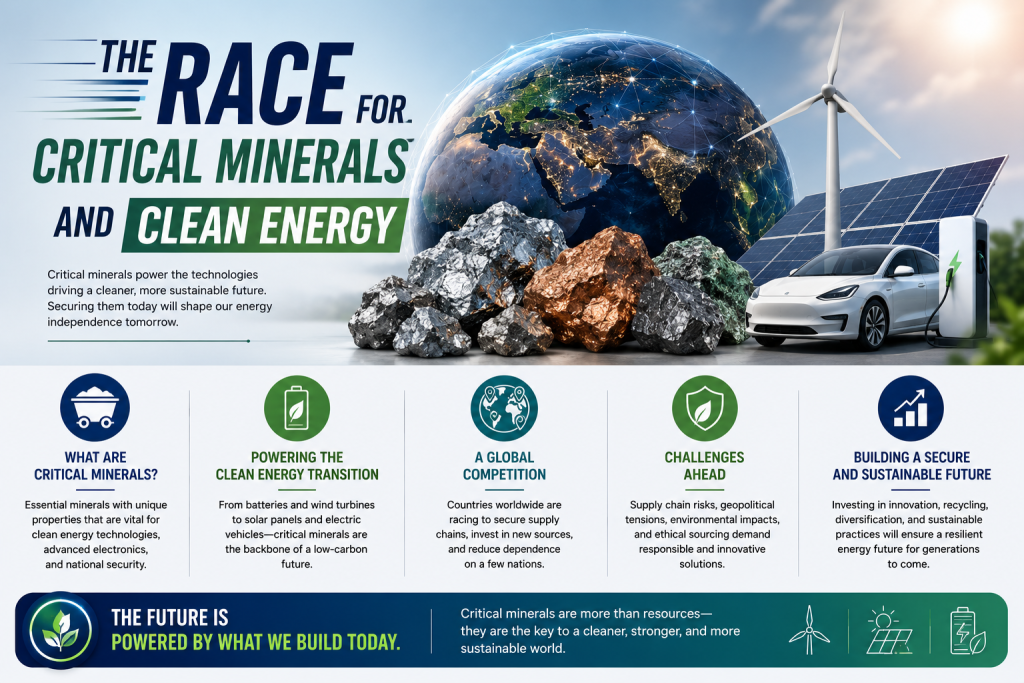
The global transition to clean energy is changing the way the world thinks about natural resources. Solar panels, wind turbines, electric vehicles, batteries, power grids, and energy storage systems all depend on materials that are very different from the coal, oil, and natural gas that powered the previous energy era. These materials are known as critical minerals.
Lithium, cobalt, nickel, graphite, copper, rare earth elements, and several other minerals are becoming increasingly important for modern energy technologies. As countries accelerate the transition toward renewable energy and electric transportation, demand for these resources is expected to increase.
This has created a new global competition.
The race for critical minerals is no longer only about mining resources. It is about securing supply chains, developing cleaner extraction methods, improving recycling, creating alternative materials, and ensuring that the clean energy transition remains economically and environmentally sustainable.
What Are Critical Minerals?
Critical minerals are natural resources considered essential for important technologies and industries while also facing potential risks to their supply.
Their importance comes from their unique physical and chemical properties.
For example:
- Lithium is essential for many rechargeable batteries.
- Cobalt can improve battery stability and performance.
- Nickel is widely used in high energy density battery technologies.
- Graphite is an important material for battery anodes.
- Copper is essential for electrical wiring, motors, transformers, and power grids.
- Rare earth elements are used in permanent magnets, electric motors, wind turbines, and advanced electronics.
The exact list of critical minerals differs between countries because each nation has different industrial requirements and supply chain risks.
Why Are Critical Minerals Important for Clean Energy?
The clean energy transition requires enormous quantities of infrastructure and advanced technologies.
A conventional fossil fuel power plant mainly depends on a continuous supply of fuel. Renewable energy systems, by contrast, require significant quantities of materials during manufacturing and construction.
Solar panels require materials such as silicon, silver, aluminum, and copper.
Wind turbines require steel, copper, and, in some designs, rare earth elements for permanent magnets.
Electric vehicles require large battery packs containing materials such as lithium, nickel, graphite, manganese, and sometimes cobalt.
Energy storage systems also require substantial quantities of battery materials.
This means that the future of clean energy will depend not only on renewable electricity generation but also on reliable access to the minerals needed to build that infrastructure.
Lithium: The Mineral Behind the Battery Revolution
Lithium has become one of the most strategically important minerals in the modern energy economy.
Lithium ion batteries are widely used in electric vehicles, smartphones, laptops, renewable energy storage systems, and many other technologies.
Lithium’s electrochemical properties allow batteries to store significant amounts of energy while remaining relatively lightweight.
As electric vehicle adoption expands and grid scale battery storage becomes more important, demand for lithium is expected to remain strong.
However, increasing lithium production also raises questions about water consumption, land use, environmental impacts, processing capacity, and supply chain security.
Researchers are therefore exploring more efficient extraction technologies, including direct lithium extraction, as well as improved battery recycling and alternative battery chemistries.
Cobalt and the Search for Better Batteries
Cobalt has historically played an important role in several lithium ion battery chemistries because it can improve structural stability and battery performance.
However, concerns about supply concentration, environmental impacts, cost, and ethical issues associated with some mining operations have encouraged researchers and manufacturers to reduce their dependence on cobalt.
Newer battery technologies are increasingly using chemistries that require less cobalt or eliminate it entirely.
This illustrates an important principle of the clean energy transition: technological innovation can reduce pressure on critical mineral supplies.
Nickel and High Energy Density Batteries
Nickel is another important material for battery manufacturing.
Nickel rich battery cathodes can provide high energy density, making them attractive for electric vehicles where driving range and battery weight are important considerations.
However, nickel production can have significant environmental impacts, depending on the source and extraction method.
The challenge is therefore not simply to increase nickel production but to develop cleaner mining, processing, recycling, and battery manufacturing systems.
Copper: The Backbone of Electrification
Copper may not receive as much attention as lithium, but it is fundamental to the electrification of the global economy.
Copper is an excellent electrical conductor and is used extensively in:
- Power transmission lines
- Electric motors
- Transformers
- Charging infrastructure
- Solar installations
- Wind turbines
- Electric vehicles
- Energy storage systems
As electricity demand increases and countries build larger renewable energy networks, copper demand could become a major constraint.
Expanding copper supply can take many years because new mines require extensive exploration, investment, permitting, construction, and infrastructure.
Recycling copper will therefore become increasingly important.
Rare Earth Elements and Advanced Energy Technologies
Rare earth elements are a group of chemically similar metals with specialized magnetic, optical, and electronic properties.
Elements such as neodymium, praseodymium, dysprosium, and terbium are particularly important for certain high performance permanent magnets.
These magnets can be used in electric motors and some wind turbine technologies.
Because rare earth supply chains are geographically concentrated, disruptions can have significant consequences for industries that depend on them.
Developing alternative magnet technologies, increasing recycling, and diversifying supply chains are therefore major areas of research.
The Hidden Challenge: Mineral Supply Chains
The critical minerals challenge extends far beyond mining.
A mineral may be mined in one country, processed in another, converted into a chemical compound somewhere else, and eventually incorporated into a battery or electronic component in another region.
This creates complex global supply chains.
A country may have mineral deposits but still depend heavily on other countries for refining and processing.
For this reason, mineral security increasingly involves:
- Mining
- Mineral processing
- Refining
- Manufacturing
- Transportation
- Recycling
- Strategic reserves
- International cooperation
The clean energy transition therefore requires resilient supply chains from the mine to the final product.
Can Mining Become More Sustainable?
Mining has environmental consequences, including land disturbance, water consumption, waste generation, and greenhouse gas emissions.
Increasing mineral demand creates a difficult question: how can the world obtain the materials required for clean technologies without creating new environmental problems?
Scientists and engineers are developing approaches to make mineral extraction more efficient and sustainable.
These include improved mineral processing, lower energy consumption, water recycling, waste reduction, renewable powered mining operations, and technologies capable of extracting valuable materials from previously uneconomic resources.
The goal is not to eliminate mining entirely but to reduce its environmental footprint while meeting growing material demand.
Direct Lithium Extraction
Direct lithium extraction is one example of emerging technology that could transform mineral production.
Traditional lithium production methods can involve large evaporation ponds or extensive mineral processing, depending on the resource.
Direct lithium extraction uses selective materials and chemical processes to separate lithium from brines.
Researchers are investigating adsorbents, ion selective membranes, solvent extraction systems, and other technologies that could improve lithium recovery.
If these approaches can be scaled economically while reducing environmental impacts, they could become an important part of future lithium supply.
Recycling: The Second Mineral Supply
Mining is not the only way to obtain critical minerals.
Recycling can recover valuable materials from batteries, electronics, motors, solar equipment, and other technologies at the end of their useful lives.
This creates the possibility of a circular mineral economy.
For example, materials recovered from used batteries can potentially be processed and incorporated into new battery production.
Recycling can reduce waste while lowering dependence on newly mined resources.
However, effective recycling requires efficient collection systems, economically viable recovery technologies, appropriate regulations, and battery designs that facilitate material recovery.
Can Technology Reduce Mineral Demand?
Another important solution is to design technologies that require fewer critical minerals.
Battery researchers are developing alternative chemistries that use different combinations of materials.
Sodium ion batteries, for example, are attracting attention because sodium is abundant and widely distributed.
Other emerging technologies include solid state batteries, iron based battery systems, advanced flow batteries, and other long duration energy storage technologies.
The goal is not necessarily to find one universal replacement for every critical mineral.
Instead, a diverse range of technologies could reduce dependence on individual materials and make the overall energy system more resilient.
Artificial Intelligence and Critical Mineral Discovery
Artificial intelligence is also entering the critical minerals sector.
Machine learning can help researchers analyze geological data, identify potential mineral deposits, optimize exploration strategies, and improve mineral processing.
AI can also support battery research by helping scientists identify promising materials and predict their properties.
This could accelerate the development of new materials and reduce the time required to discover alternatives to scarce or expensive resources.
The Geopolitics of Critical Minerals
Critical minerals are becoming increasingly important in international relations.
Countries want reliable access to the resources required for electric vehicles, renewable energy systems, semiconductors, batteries, and advanced technologies.
This has created competition over mineral deposits, refining capacity, processing technologies, and supply chains.
Governments are responding by developing domestic mining projects, building strategic partnerships, investing in recycling, supporting alternative technologies, and establishing policies designed to strengthen mineral security.
The result is a new form of global competition in which access to materials can influence technological and economic power.
Can the Clean Energy Transition Become Truly Sustainable?
The clean energy transition cannot be considered sustainable simply because it replaces fossil fuels with renewable electricity.
The entire technology lifecycle must be considered.
This includes:
- Where materials come from
- How minerals are extracted
- How much energy mining requires
- How much water is consumed
- How materials are processed
- How products are manufactured
- How technologies are transported
- How equipment is recycled
- What happens at the end of its useful life
A sustainable energy system therefore requires both clean energy and responsible material management.
The Future of Critical Minerals
The race for critical minerals is likely to become even more important as countries expand renewable energy, electric transportation, energy storage, and digital infrastructure.
However, the future will not necessarily depend on simply mining more minerals.
A successful strategy will combine:
Responsible mining + cleaner processing + material efficiency + recycling + alternative technologies + resilient supply chains
This approach can reduce environmental pressure while improving the security of the materials required for the clean energy transition.
Conclusion
The clean energy revolution is creating a new demand for the materials that make modern technologies possible. Lithium, cobalt, nickel, graphite, copper, and rare earth elements are becoming essential components of batteries, electric vehicles, renewable energy systems, power networks, and advanced technologies.
But the race for critical minerals also creates significant environmental, economic, and geopolitical challenges.
The solution will require more than expanding mining. Cleaner extraction technologies, efficient mineral processing, recycling, alternative materials, battery innovation, and stronger international cooperation will all be essential.
The future of clean energy depends not only on how much renewable electricity we can generate, but also on whether we can obtain and manage the materials needed to build that energy system responsibly.
The next great energy race may not be for oil or gas. It may be for the minerals that power a cleaner world.
Editor: Ayesha Noor