

Introduction
As climate change intensifies and global net zero commitments accelerate, countries and industries are searching for scalable alternatives to fossil fuels. Traditional energy systems remain heavily dependent on coal, oil, and natural gas, creating major environmental and economic challenges.
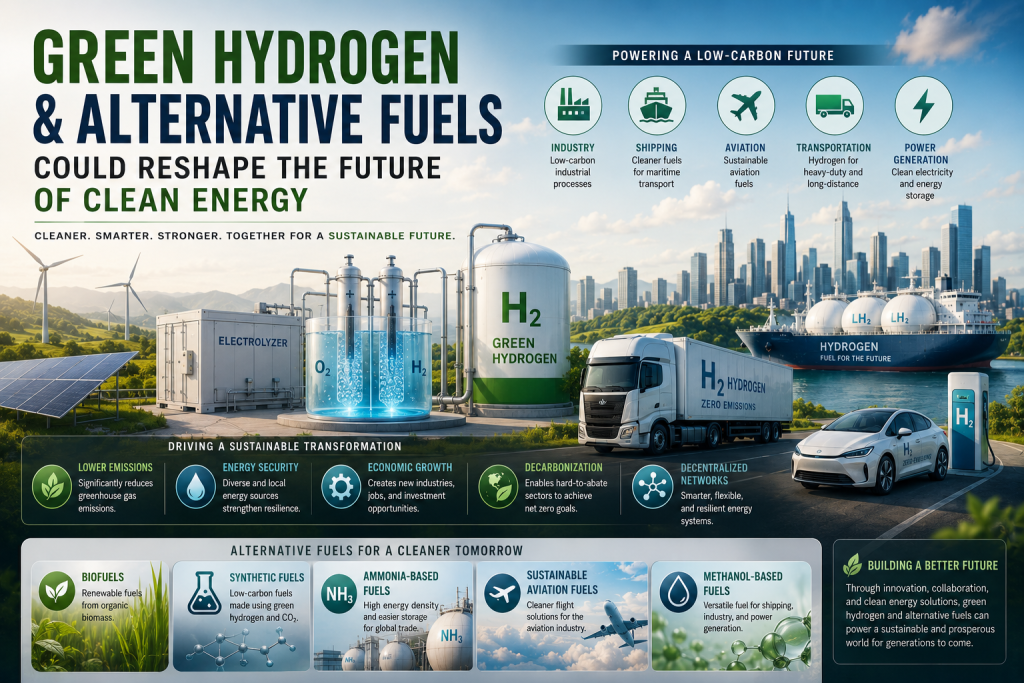
Among the most promising solutions are green hydrogen and alternative fuels. These emerging energy technologies are attracting global attention because they offer the potential to reduce carbon emissions while supporting industrial growth, transportation, and long term energy security.
Researchers are now investigating how green hydrogen can be produced economically, stored efficiently, and integrated into large scale industrial infrastructure. At the same time, decentralized clean energy networks are emerging as an important strategy for improving sustainability and supply chain resilience.
What Is Green Hydrogen
Green Hydrogen is hydrogen generated through the electrolysis of water using renewable energy sources such as solar, wind, or hydropower.
Unlike conventional hydrogen production, which often relies on fossil fuels, green hydrogen produces little to no direct carbon emissions.
During electrolysis, electricity splits water into hydrogen and oxygen:
The resulting hydrogen can then be used as a clean fuel for transportation, industry, electricity generation, and energy storage.
Why Green Hydrogen Matters for Climate Goals
Global net zero targets require major reductions in greenhouse gas emissions across multiple sectors. However, some industries remain difficult to fully electrify using conventional renewable energy alone.
These sectors include:
Heavy manufacturing
Steel production
Chemical industries
Shipping
Aviation
Long distance transportation
Green hydrogen offers a potential low carbon energy source for these hard to decarbonize industries.
Because hydrogen contains high energy density and produces water rather than carbon dioxide during use, many scientists consider it a critical component of future sustainable energy systems.
Alternative Fuels Beyond Hydrogen
Alongside green hydrogen, researchers are developing several alternative fuels aimed at reducing fossil fuel dependence.
These include:
Biofuels
Synthetic fuels
Ammonia based fuels
Sustainable aviation fuels
Methanol based energy systems
Many of these fuels are designed to integrate with existing transportation and industrial infrastructure, making large scale adoption potentially more feasible.
Scientists are also exploring hybrid systems that combine renewable electricity, hydrogen, and advanced fuel technologies to create more flexible energy networks.
The Challenge of Industrial Scalability
Despite its promise, scaling green hydrogen production remains one of the biggest challenges facing the clean energy transition.
Large scale hydrogen systems require:
Massive renewable electricity generation
Advanced electrolyzer technologies
Efficient hydrogen storage systems
Expanded transportation infrastructure
Industrial distribution networks
Currently, producing green hydrogen remains more expensive than fossil fuel based hydrogen in many regions.
Researchers are therefore focused on improving electrolyzer efficiency, reducing renewable energy costs, and developing more affordable industrial processes.
Hydrogen Storage and Transportation Challenges
Hydrogen is extremely light and difficult to store efficiently.
Because of its low volumetric density, hydrogen often requires compression, liquefaction, or chemical conversion before transportation and storage.
Scientists are investigating several storage approaches including:
Compressed hydrogen tanks
Liquid hydrogen systems
Underground storage facilities
Metal hydrides
Ammonia based hydrogen carriers
Developing safe and economically viable hydrogen logistics systems will be essential for global adoption.
Decentralized Clean Energy Networks
One of the most important emerging trends in climate technology is the shift toward decentralized clean energy systems.
Instead of relying entirely on centralized fossil fuel infrastructure, decentralized networks use local renewable energy production combined with hydrogen generation and energy storage technologies.
These systems could improve:
Energy resilience
Grid flexibility
Supply chain stability
Rural energy access
Disaster preparedness
Decentralized hydrogen production may also reduce transportation losses and infrastructure bottlenecks.
Supply Chain Logistics and Infrastructure Development
The transition toward green hydrogen and alternative fuels requires major investments in industrial infrastructure and global supply chains.
Governments and private industries are now planning:
Hydrogen pipelines
Renewable powered industrial hubs
Export terminals
Refueling networks
Integrated energy corridors
Countries with abundant renewable energy resources may become future exporters of green hydrogen and sustainable fuels.
This shift could reshape global energy economics and international trade systems.
The Future of Climate Technology and Sustainability
Climate technology is rapidly becoming one of the most important scientific and industrial priorities of the twenty first century.
Advances in renewable energy, hydrogen systems, carbon reduction technologies, and sustainable infrastructure are driving a global transformation in how energy is produced and distributed.
If current technological and economic barriers can be overcome, green hydrogen and alternative fuels may become central pillars of future low carbon economies.
Conclusion
Green hydrogen and alternative fuels represent more than emerging energy technologies. They represent a potential transformation of global energy systems, industrial sustainability, and climate resilience.
Although significant scientific, economic, and logistical challenges remain, ongoing advances in climate technology are accelerating the transition toward cleaner and more decentralized energy networks.
As nations pursue net zero goals, green hydrogen may become one of the defining technologies shaping the future of sustainable civilization.
Editor: Ayesha Noor