

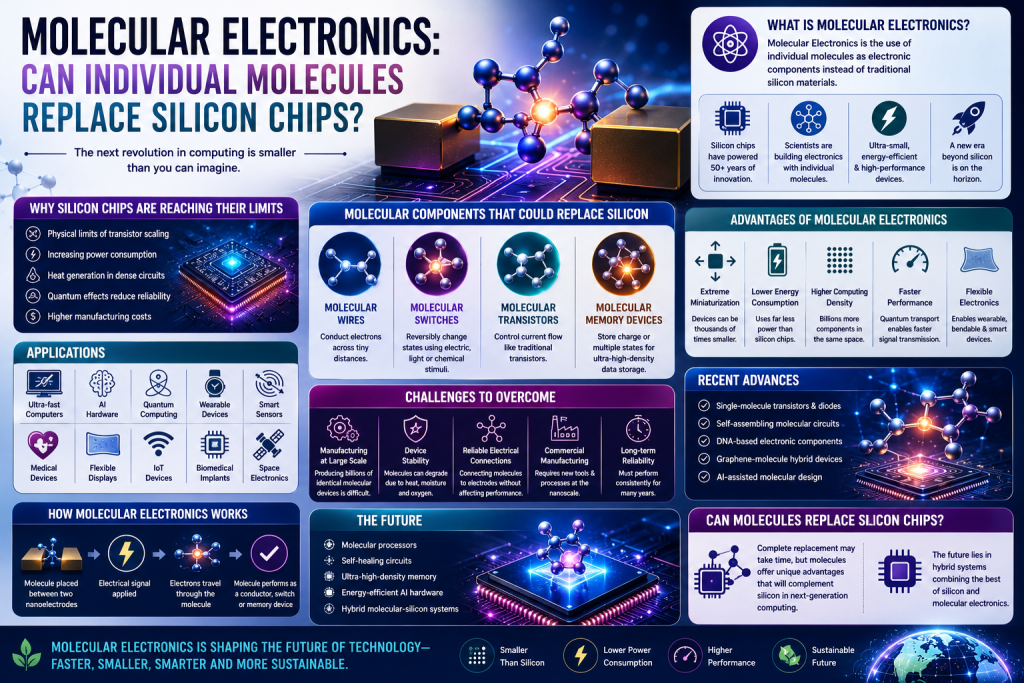
Introduction
For more than five decades, silicon-based microchips have driven the digital revolution, powering everything from smartphones and laptops to artificial intelligence, medical devices, and space exploration. As electronic devices become smaller, faster, and more energy efficient, conventional silicon technology is approaching its physical and technological limits. Engineers are now facing one of the biggest challenges in modern electronics: how to continue increasing computing power when transistors can no longer be significantly miniaturized.
This challenge has led researchers to explore Molecular Electronics, an emerging field that investigates whether individual molecules can function as electronic components. Instead of using billions of silicon transistors, molecular electronics aims to build circuits where single molecules perform the roles of switches, wires, memory units, and transistors.
If successful, Molecular Electronics could revolutionize computing by enabling ultra-small, energy-efficient, and high-performance electronic devices, opening a new era beyond conventional silicon chips.
What Is Molecular Electronics?
Molecular Electronics is a branch of nanotechnology that studies the use of individual molecules as electronic components. Rather than relying on semiconductor materials such as silicon, molecular electronics uses specially designed organic or inorganic molecules capable of conducting, storing, or switching electrical signals.
At the molecular scale, electrons behave differently than they do in conventional electronic devices. Researchers exploit these unique quantum properties to create nanoscale circuits with remarkable performance characteristics.
The primary objective of molecular electronics is to replace or complement silicon technology with molecular-scale devices that consume less energy while offering greater computational density.
Why Silicon Chips Are Reaching Their Limits
Silicon has been the foundation of the electronics industry for decades because of its excellent electrical properties and mature manufacturing technologies. However, continued miniaturization is becoming increasingly difficult.
Several factors limit future silicon chip development:
- Physical limitations of transistor scaling
- Increasing power consumption
- Heat generation in densely packed circuits
- Higher manufacturing costs
- Quantum effects that reduce transistor reliability
As transistor dimensions approach only a few nanometers, electrons begin to tunnel through insulating materials, reducing efficiency and increasing power loss.
These limitations are encouraging researchers to investigate alternatives such as Molecular Electronics for the next generation of computing technologies.
How Molecular Electronics Works
In molecular electronics, carefully designed molecules act as functional electronic components.
Scientists position individual molecules between two nanoscale electrodes. When an electrical voltage is applied, electrons move through the molecule, allowing it to function as a conductor, semiconductor, or switch depending on its molecular structure.
Different molecular properties determine how electrical signals are transmitted, including:
- Molecular size
- Atomic arrangement
- Chemical bonding
- Electron distribution
- Energy levels
By modifying molecular structures through chemical synthesis, researchers can precisely control their electronic behavior for specific applications.
Molecular Components That Could Replace Silicon
One of the most exciting aspects of Molecular Electronics is the possibility of replacing traditional electronic components with single molecules.
Molecular Wires
Certain organic molecules can transport electrons across extremely small distances, acting as nanoscale electrical wires.
These molecular wires may enable electronic circuits thousands of times smaller than current silicon-based devices.
Molecular Switches
Some molecules can reversibly change between two stable states when exposed to electrical signals, light, or chemical stimuli.
These molecular switches function similarly to the transistors used in today’s computers but occupy only a fraction of the space.
Molecular Transistors
Researchers are developing molecular transistors capable of controlling electrical current using individual molecules.
Although still under development, molecular transistors represent one of the most promising alternatives to conventional semiconductor devices.
Molecular Memory Devices
Certain molecules can store electrical charge or maintain multiple electronic states, making them suitable for ultra-high-density data storage.
Future molecular memory devices could significantly increase storage capacity while reducing energy consumption.
Advantages of Molecular Electronics
If successfully commercialized, Molecular Electronics offers numerous advantages over conventional silicon technology.
Extreme Miniaturization
Individual molecules measure only a few nanometers, allowing electronic devices to become dramatically smaller.
Lower Energy Consumption
Molecular electronic devices require much less electrical power, improving battery life and reducing energy demands.
Higher Computing Density
Because molecules are extremely small, billions more electronic components can fit within the same chip area.
Faster Electronic Performance
Quantum transport mechanisms may enable faster signal transmission compared to conventional semiconductor devices.
Flexible Electronics
Many molecular materials can be incorporated into flexible electronic devices, wearable technologies, and smart textiles.
Applications of Molecular Electronics
The future applications of Molecular Electronics extend far beyond traditional computing.
Potential applications include:
- Ultra-fast computers
- Artificial intelligence hardware
- Quantum computing interfaces
- Flexible electronic displays
- Wearable medical devices
- Smart sensors
- Internet of Things (IoT) devices
- Nanoelectronic circuits
- Biomedical implants
- Space electronics
These applications could transform industries ranging from healthcare to telecommunications and aerospace.
Challenges Facing Molecular Electronics
Despite remarkable progress, several scientific and engineering challenges remain before molecular electronics can replace silicon chips.
Major challenges include:
Manufacturing at Large Scale
Producing billions of identical molecular devices with high precision remains extremely difficult.
Device Stability
Some molecular electronic components degrade over time due to heat, moisture, oxygen, or repeated electrical operation.
Reliable Electrical Connections
Connecting individual molecules to nanoscale electrodes without affecting their electronic properties is a major engineering challenge.
Commercial Manufacturing
Current semiconductor fabrication methods are not designed for molecular-scale electronics, requiring entirely new manufacturing technologies.
Long-Term Reliability
Future molecular devices must demonstrate stable performance over many years before commercial adoption becomes practical.
Recent Advances in Molecular Electronics
Researchers worldwide continue making significant progress in molecular electronics.
Recent advances include:
- Single-molecule transistors
- Molecular diodes
- Self-assembling molecular circuits
- DNA-based electronic components
- Carbon-based molecular conductors
- Graphene-molecule hybrid devices
- Artificial intelligence-assisted molecular design
Advances in nanotechnology, quantum chemistry, and computational modeling are accelerating the discovery of new molecular materials with improved electronic performance.
Future of Molecular Electronics
The future of Molecular Electronics is closely connected with artificial intelligence, quantum computing, advanced chemistry, and nanotechnology.
Scientists envision hybrid electronic systems where molecular devices work alongside conventional silicon processors rather than replacing them immediately.
Future developments may include:
- Molecular computer processors
- Self-healing electronic circuits
- Ultra-high-density memory chips
- Molecular logic gates
- Energy-efficient artificial intelligence hardware
- Flexible molecular electronics for wearable technologies
As research continues, molecular electronics may become one of the key technologies driving the next generation of computing and information processing.
Can Individual Molecules Replace Silicon Chips?
Although Molecular Electronics has demonstrated remarkable scientific potential, replacing silicon chips entirely remains a long-term goal.
Silicon technology continues to dominate because of its reliability, mature manufacturing processes, and large-scale commercial production. However, molecular electronics offers unique advantages that could complement silicon in applications requiring extreme miniaturization, lower energy consumption, and higher computational density.
Many researchers believe the future lies in hybrid systems that combine conventional semiconductor technology with molecular electronic devices, gradually expanding the role of molecules in advanced computing.
Conclusion
Molecular Electronics represents one of the most exciting frontiers in nanotechnology and modern electronics. By using individual molecules as electronic components, scientists are exploring new ways to overcome the physical limitations of silicon chips while creating smaller, faster, and more energy-efficient devices.
Although significant challenges remain, advances in chemistry, materials science, quantum physics, and nanotechnology continue to bring molecular electronics closer to practical applications. Whether molecules completely replace silicon chips or work alongside them, Molecular Electronics is expected to play a central role in shaping the future of computing, electronics, and next-generation digital technologies.
Editor: Ayesha Noor