

Introduction
What if we could produce clean fuel the same way plants produce energy? This idea is no longer just theoretical. Scientists are now developing systems that mimic natural photosynthesis to generate fuel using sunlight, water, and carbon dioxide. This emerging field, known as artificial photosynthesis, represents a major breakthrough in sustainable energy research. It offers a pathway to address two of the most pressing global challenges energy demand and climate change at the same time.
What Is Artificial Photosynthesis
Artificial photosynthesis is a process that replicates how plants convert sunlight into chemical energy. In nature, plants use sunlight to transform water and carbon dioxide into glucose and oxygen.
Scientists are designing advanced chemical systems that follow a similar principle but instead produce usable fuels such as hydrogen or carbon based fuels. These systems rely on catalysts, light absorbing materials, and electrochemical reactions to drive the transformation.
Unlike traditional renewable energy sources, artificial photosynthesis stores energy in chemical form, making it easier to transport and use when needed.
How the Process Works
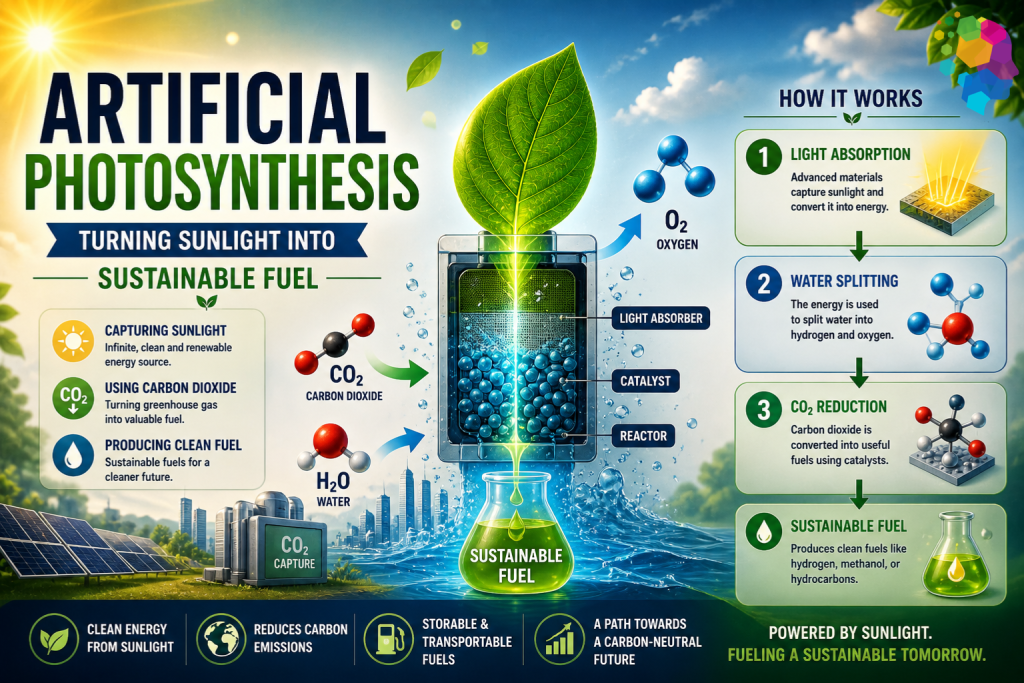
Artificial photosynthesis typically involves three key steps
Light absorption
Special materials capture sunlight and convert it into energy
Water splitting
This energy is used to split water into hydrogen and oxygen
Carbon dioxide reduction
Carbon dioxide is converted into fuels such as methane, methanol, or other hydrocarbons
These reactions are driven by catalysts that make the process efficient and sustainable.
Why Artificial Photosynthesis Matters
Artificial photosynthesis stands out because it tackles two global issues simultaneously
Clean energy production
It generates renewable fuels without relying on fossil resources
Carbon reduction
It uses carbon dioxide as a raw material, helping to reduce greenhouse gas levels
Energy storage
It converts solar energy into chemical fuels that can be stored and transported easily
This makes it a powerful solution for building a carbon neutral energy system.
Current Advances in Research
Recent developments in artificial photosynthesis have focused on improving efficiency and scalability.
Scientists are designing new catalysts that can speed up reactions while reducing energy loss. Nanomaterials and semiconductor technologies are being used to enhance light absorption and reaction efficiency.
Some experimental systems have already demonstrated the ability to produce hydrogen fuel directly from sunlight and water. Others are working on converting carbon dioxide into liquid fuels that can integrate with existing energy infrastructure.
Although still in the research stage, progress is rapid and promising.
Challenges and Limitations
Despite its potential, artificial photosynthesis faces several challenges
Low efficiency compared to natural systems
High cost of advanced materials and catalysts
Difficulty in scaling up for industrial use
Long term stability of reaction systems
Overcoming these challenges is essential before the technology can be widely adopted.
The Future of Artificial Photosynthesis
The future of artificial photosynthesis is closely tied to advances in chemistry, materials science, and engineering.
Researchers aim to develop systems that are more efficient, cost-effective, and durable. Integration with solar technologies and industrial processes could make this approach a key part of future energy systems.
In the long term, this technology could enable the production of clean fuels on a global scale, reducing dependence on fossil fuels and lowering carbon emissions significantly.
Conclusion
Artificial photosynthesis is redefining how we think about energy production. By mimicking nature, scientists are creating systems that turn sunlight, water, and carbon dioxide into sustainable fuel.
This innovation has the potential to reshape the global energy landscape while addressing climate change at its source.
If successfully developed at scale, this approach could become one of the most transformative technologies of the 21st century.
Editor: Ayesha Noor