

Introduction
For decades, waste management has been symbolized by a simple act throwing something into a blue recycling bin. But today, circular chemistry is challenging this outdated system by redesigning how materials are created, used, and reused.
Most materials still follow a linear path take, make, and dispose. This approach leads to massive environmental loss and inefficient use of resources. Circular chemistry offers a new vision where waste is no longer something to manage but something to eliminate by design.
In this emerging paradigm, waste is not the end of a product’s life. It becomes the beginning of a continuous cycle.
The Problem with the Blue Bin Mentality
Traditional recycling systems are limited. Despite global efforts, a large portion of materials especially plastics still end up as waste rather than being reused effectively.
The issue lies in the linear economy model, where products are designed without considering their afterlife. Once used, they are discarded, creating environmental and economic loss.
Recycling alone cannot solve this problem. A deeper transformation is needed, and this is where circular chemistry becomes essential.
What Is Circular Chemistry
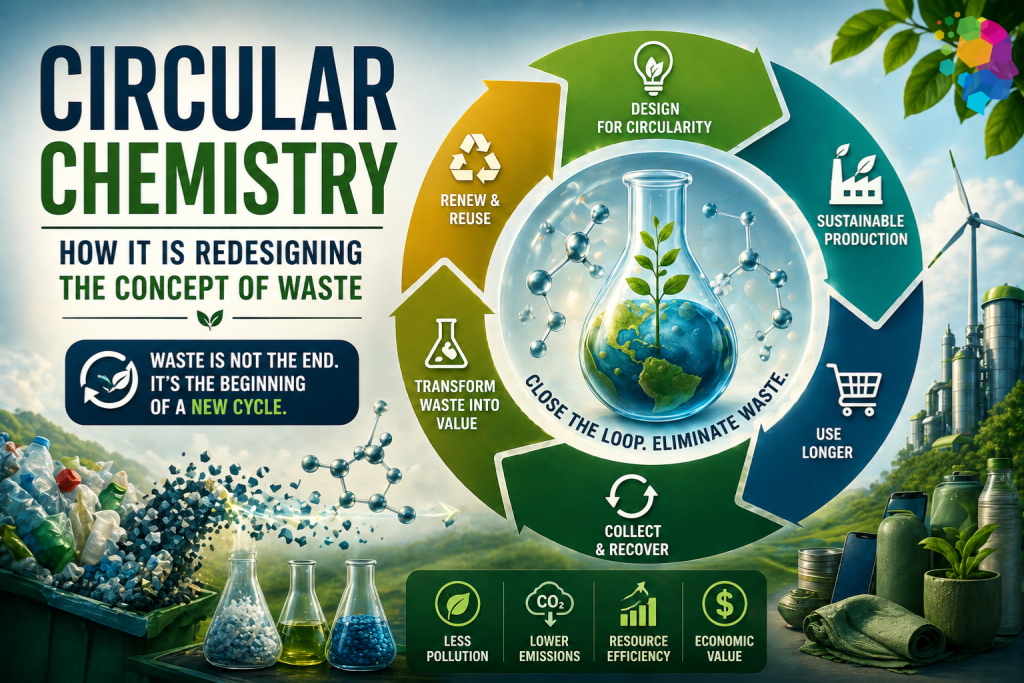
Circular chemistry applies the principles of the circular economy at a molecular and material level. Instead of simply managing waste, it focuses on designing materials and chemical processes that prevent waste from being created in the first place.
This approach aims to
Keep materials in continuous use
Recover valuable components from waste streams
Design products that can be easily reused or transformed
Replace fossil based inputs with renewable or recycled feedstocks
Circular chemistry treats waste as a valuable resource and ensures that materials remain part of a continuous loop rather than being discarded.
From Waste to Resource A Chemical Revolution
One of the most exciting aspects of circular chemistry is its ability to convert waste into valuable materials.
Recent advances show that plastic waste can be chemically broken down into its original building blocks and reused to create new products. Some processes can even transform waste into fuels or high value chemicals, reducing environmental impact while creating economic opportunities.
This process, often called chemical recycling or upcycling, represents a major shift from conventional recycling methods. Instead of losing quality, materials can retain or even increase their value.
Circular chemistry is not just a concept, it is becoming a foundation of modern sustainable science.
The Role of Technology in Circular Systems
Modern technologies are accelerating the growth of circular chemistry.
Artificial intelligence and advanced sorting systems are improving how materials are identified and separated, making recycling more efficient and accurate.
Digital tracking tools now allow industries to monitor materials throughout their lifecycle, ensuring they remain within a closed loop.
At the same time, innovations in catalysis and green chemistry are enabling cleaner and more energy efficient transformations of waste into usable resources.
Designing Out Waste The Core Principle
The most powerful idea behind circular chemistry is simple waste should never exist by design.
Instead of asking how to manage waste, scientists and engineers now focus on
Can products be reused multiple times
Can they be easily disassembled
Can materials be recovered without losing quality
This shift is already influencing industries such as packaging, construction, and electronics, where products are being redesigned for durability and recyclability.
Circular chemistry ensures that materials continuously flow through the economy without becoming waste.
Why Circular Chemistry Matters Now
The urgency for change has never been greater. Global waste generation is increasing rapidly, and natural resources are becoming limited.
Circular chemistry provides a sustainable solution by
Reducing dependence on raw materials
Minimizing environmental pollution
Lowering carbon emissions
Creating economic value from waste
Industries around the world are now adopting circular chemistry as part of their long term sustainability strategies. This shift is not just scientific, it is economic and environmental.
The Future A World Without Waste
The future of circular chemistry goes far beyond recycling. It imagines a world where
Products are designed for continuous reuse
Waste is constantly converted into valuable resources
Industrial systems operate in closed loops
The concept of trash disappears entirely
Advances in material science, biotechnology, and chemical engineering are bringing this vision closer to reality.
What we once considered waste is now being recognized as one of the most valuable resources of the modern world.
Conclusion
The blue recycling bin was only the beginning. While it helped raise awareness, it cannot solve the global waste crisis on its own.
Circular chemistry represents a deeper transformation by redesigning how materials are created and used. It turns waste into value and removes it from the system entirely.
Circular chemistry is redefining how our world works by creating a system where nothing is wasted and everything is reused.
The real question is no longer how we manage waste, but how we eliminate it completely.