

Introduction
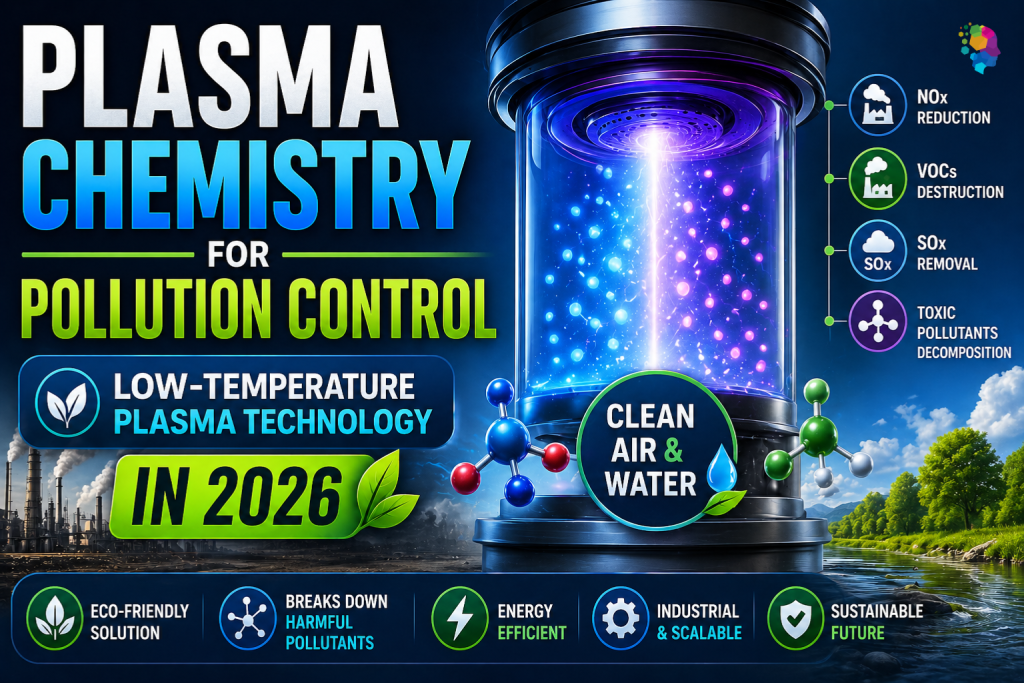
Air and water pollution remain among the most urgent environmental challenges in 2026. Traditional treatment methods often struggle to remove persistent organic pollutants, toxic gases, and industrial emissions efficiently. This is where plasma chemistry is emerging as a transformative solution.
Low temperature plasma technology offers a powerful and energy efficient way to break down harmful pollutants at the molecular level without requiring extreme heat. By combining physics, chemistry, and environmental engineering, this approach is rapidly gaining attention in modern pollution control strategies.
What Is Plasma Chemistry
Plasma is often called the fourth state of matter. It consists of ionized gas containing electrons, ions, and reactive species. In plasma chemistry, these highly energetic particles interact with pollutants, triggering chemical reactions that break them down into less harmful substances.
Unlike thermal plasma, low temperature plasma operates near room temperature, making it suitable for sensitive environments and energy efficient applications.
How Low Temperature Plasma Works
Low temperature plasma generates reactive species such as
Free radicals
Ozone
Excited atoms and molecules
These reactive components attack pollutants and decompose them through oxidation and reduction reactions.
For example, harmful gases like nitrogen oxides and volatile organic compounds can be converted into less toxic compounds through plasma induced reactions.
Key Applications in 2026
Air Pollution Control
Low temperature plasma is widely used to remove
Nitrogen oxides from vehicle emissions
Sulfur compounds from industrial exhaust
Volatile organic compounds from factories
This makes it highly valuable for urban air quality improvement.
Water Treatment
Plasma activated water systems can destroy
Bacteria and viruses
Pharmaceutical residues
Toxic organic chemicals
This technology is especially useful where conventional water treatment fails.
Industrial Waste Management
Industries are adopting plasma reactors to treat hazardous waste gases and chemical byproducts. The ability to break down complex molecules without additional chemicals makes it environmentally friendly.
Advantages of Plasma Technology
Operates at low temperatures
Reduces need for chemical additives
High efficiency in breaking complex pollutants
Minimal secondary waste production
Scalable for industrial and small scale use
Challenges and Limitations
Despite its potential, some challenges remain
High initial setup cost
Energy optimization still under research
Scaling for large industries requires further innovation
However, ongoing research in plasma engineering is rapidly addressing these issues.
Why It Matters in 2026
With stricter environmental regulations and increasing pollution levels, plasma chemistry is becoming a key tool in sustainable technology. Governments and industries are investing heavily in this field to achieve cleaner air and water.
Low temperature plasma is not just an experimental concept anymore. It is moving toward large scale deployment and real world impact.
Future Outlook
The future of plasma chemistry lies in
Integration with renewable energy systems
AI controlled plasma reactors for efficiency
Portable pollution control devices
Advanced materials for better plasma generation
As research progresses, this technology could redefine how we approach environmental protection.
Conclusion
Plasma chemistry for pollution control represents a powerful shift toward cleaner and more efficient environmental solutions. Low temperature plasma technology in 2026 is bridging the gap between scientific innovation and real world sustainability.
Its ability to destroy pollutants at the molecular level without extreme conditions makes it one of the most promising tools in the fight against global pollution.
Editor: Ayesha Noor