

Introduction
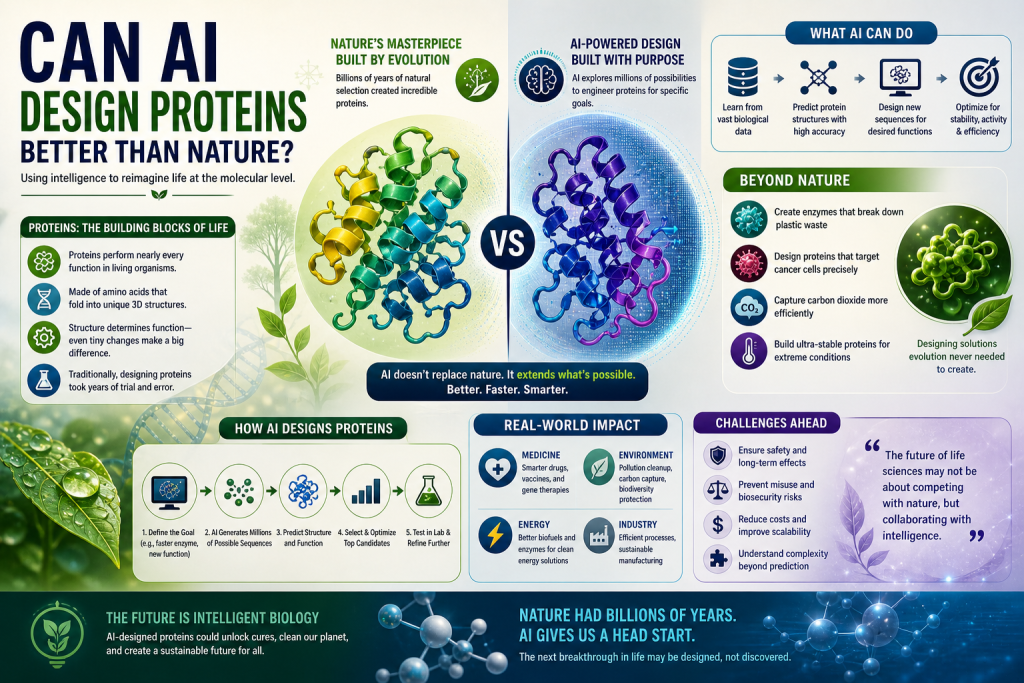
Proteins are the fundamental building blocks of life, responsible for nearly every biological function in living organisms. From catalyzing chemical reactions to supporting immune defense, their structure determines their function with remarkable precision.
But what if we could design proteins from scratch, with functions that do not exist in nature? With the rise of artificial intelligence, this question is no longer theoretical. Scientists are now using AI to predict, design, and optimize proteins at an unprecedented scale.
The real question is not whether AI can assist biology, but whether it can outperform nature itself.
What Are Proteins and Why They Matter
Proteins are complex molecules made of amino acids that fold into specific three dimensional structures. This folding determines how a protein behaves and interacts with other molecules.
Even a small change in structure can completely alter a protein’s function. This makes protein design one of the most challenging problems in modern science.
Traditionally, discovering or engineering proteins required years of experimental work. Now, AI is dramatically accelerating this process.
How AI Is Transforming Protein Design
Artificial intelligence is revolutionizing protein science by predicting how amino acid sequences fold into functional structures. Systems like AlphaFold have achieved near experimental accuracy in predicting protein structures.
This breakthrough has opened the door to designing entirely new proteins with specific functions. AI models can now
Analyze vast biological datasets
Predict protein folding with high accuracy
Design new sequences for desired functions
Optimize proteins for stability and efficiency
What once took years can now be achieved in days or even hours.
Designing Proteins Beyond Nature
One of the most exciting possibilities is the creation of proteins that do not exist in nature.
AI can design enzymes that break down plastic waste, proteins that target specific cancer cells, or molecules that capture carbon dioxide more efficiently than natural systems.
Unlike evolution, which works slowly through trial and error, AI can explore millions of possibilities in a fraction of the time. This allows scientists to move beyond natural limitations and create highly specialized biological tools.
Can AI Really Outperform Nature
Nature has had billions of years to refine proteins through evolution. These proteins are highly efficient and adapted to specific environments.
However, evolution is not perfect. It optimizes for survival, not necessarily for industrial or medical applications.
AI, on the other hand, can design proteins for specific goals such as
Higher catalytic efficiency
Greater stability under extreme conditions
Targeted therapeutic action
In this sense, AI is not replacing nature but extending its capabilities. It allows us to design proteins that nature never needed to create.
Real World Applications
AI designed proteins are already showing promise across multiple fields
Medicine
Designing targeted drugs and personalized therapies
Environmental science
Creating enzymes that degrade pollutants and plastics
Energy
Developing biological systems for carbon capture and sustainable fuel production
Biotechnology
Engineering enzymes for industrial processes with higher efficiency
These applications highlight how AI driven protein design can reshape entire industries.
Challenges and Ethical Considerations
Despite its potential, AI driven protein design comes with challenges
Ensuring accuracy and reliability of predictions
Understanding long term biological effects
Preventing misuse in harmful applications
Balancing innovation with ethical responsibility
As this technology advances, careful regulation and responsible research will be essential.
The Future of AI Designed Proteins
The future of protein design lies at the intersection of artificial intelligence, biology, and chemistry.
As AI models become more advanced, they will not only predict structures but also simulate entire biological systems. This could lead to fully programmable biology, where proteins are designed as easily as software.
Such advancements could revolutionize medicine, sustainability, and manufacturing.
Conclusion
The question is no longer whether AI can design proteins, but how far it can go.
AI has already demonstrated the ability to match and sometimes surpass natural processes in speed and precision. While nature remains an extraordinary source of inspiration, AI offers a new dimension of control and creativity.
Rather than competing with nature, AI is becoming a powerful tool to enhance it.
In the coming years, the collaboration between artificial intelligence and biology may redefine what is possible in science and technology.