

Introduction
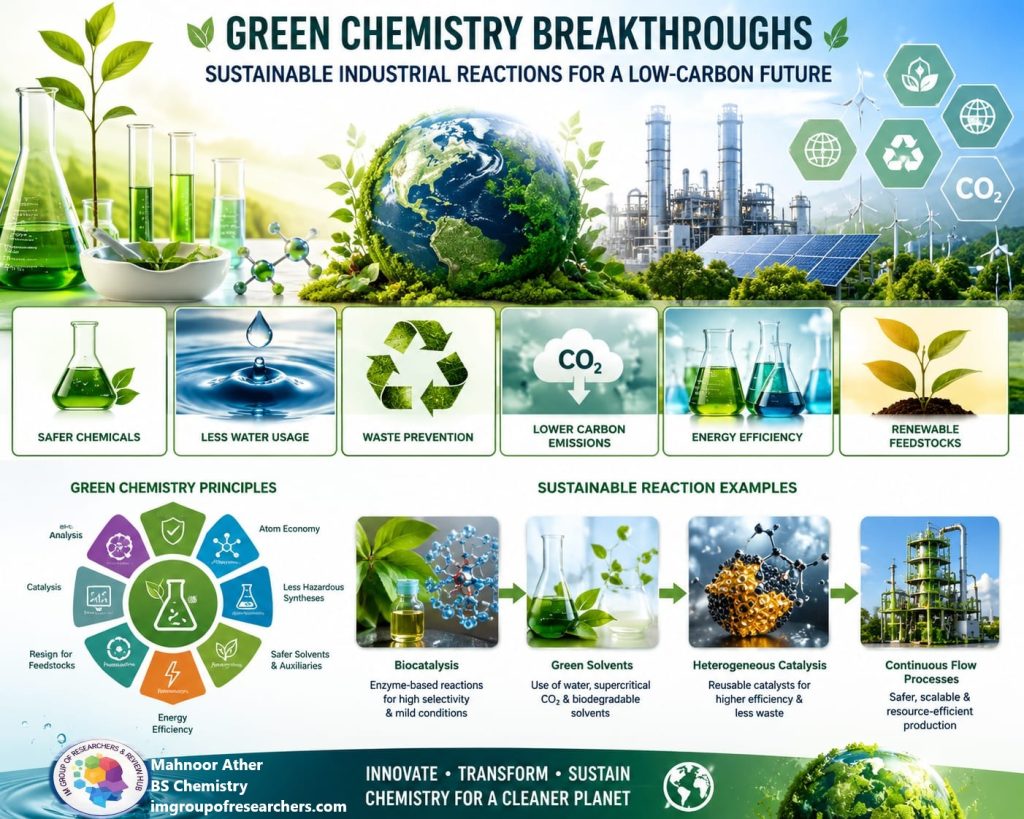
Green chemistry breakthroughs are transforming the way industries manufacture chemicals, materials, pharmaceuticals, and energy products while reducing environmental impacts. Traditional industrial processes often rely on hazardous chemicals, consume large amounts of energy, and generate significant waste and greenhouse gas emissions. As industries seek cleaner and more efficient production methods, green chemistry breakthroughs are becoming essential for building a sustainable and low-carbon future.
Green chemistry, also known as sustainable chemistry, focuses on designing chemical products and industrial reactions that minimize or eliminate hazardous substances while maximizing efficiency and resource utilization. Since its introduction by Paul Anastas in the early 1990s, green chemistry has evolved into a global scientific movement that supports cleaner manufacturing, renewable resources, and environmentally responsible innovation.
Today, green chemistry breakthroughs are driving advancements in renewable energy, pharmaceutical manufacturing, sustainable materials, carbon capture, water conservation, and industrial process optimization.
What Are Green Chemistry Breakthroughs?
Green chemistry breakthroughs refer to innovative chemical processes and technologies that reduce pollution, improve energy efficiency, minimize waste generation, and replace hazardous materials with environmentally friendly alternatives.
Unlike conventional manufacturing, green chemistry focuses on preventing pollution before it occurs rather than treating waste after production.
The primary objectives of green chemistry include:
- Reducing hazardous chemicals
- Preventing industrial waste
- Improving energy efficiency
- Using renewable raw materials
- Designing safer chemical products
- Lowering greenhouse gas emissions
- Supporting circular economy principles
These objectives make green chemistry one of the most important scientific approaches for achieving sustainable industrial development.
Why Green Chemistry Matters
The chemical industry supports countless sectors, including healthcare, agriculture, electronics, transportation, construction, and renewable energy. However, traditional chemical manufacturing is also responsible for considerable environmental pollution.
Green chemistry breakthroughs help industries:
- Reduce environmental pollution
- Lower manufacturing costs
- Improve worker safety
- Increase resource efficiency
- Reduce carbon emissions
- Support sustainable economic growth
By redesigning industrial reactions, companies can improve both environmental performance and long-term profitability.
Green Chemistry Breakthroughs in Waste Prevention
One of the fundamental principles of green chemistry is preventing waste instead of managing it after production.
Traditional manufacturing processes often utilize only 40–60% of the raw materials, while the remainder becomes waste requiring disposal.
Modern green chemistry breakthroughs focus on maximizing atom economy, allowing nearly every atom in the starting materials to become part of the final product.
Benefits include:
- Lower waste generation
- Reduced disposal costs
- Higher production efficiency
- Better resource utilization
- Reduced environmental contamination
Many modern industrial reactions now achieve atom efficiencies approaching 80–100%, significantly reducing chemical waste.
Green Chemistry Breakthroughs in Catalysis
Catalysis represents one of the most important green chemistry breakthroughs.
Catalysts accelerate chemical reactions without being consumed, allowing reactions to occur under milder conditions while requiring less energy.
Major types include:
Metal Catalysts
Metal catalysts such as copper, nickel, palladium, and platinum improve industrial reaction efficiency while reducing unwanted by-products.
Biocatalysts
Biocatalysts use enzymes or microorganisms to perform chemical reactions under mild temperatures and pressures.
Advantages include:
- Lower energy consumption
- Reduced hazardous waste
- Greater product selectivity
- Improved reaction efficiency
Many catalytic processes reduce industrial energy requirements by 20–50%.
Green Chemistry Breakthroughs in Sustainable Solvents
Conventional solvents account for a significant portion of industrial chemical waste, particularly in pharmaceutical manufacturing.
Green chemistry breakthroughs are replacing hazardous solvents with environmentally friendly alternatives.
Safer solvent options include:
- Water
- Ethanol
- Supercritical carbon dioxide
- Bio-based solvents
Supercritical carbon dioxide is particularly attractive because it dissolves many compounds without leaving toxic residues after processing.
Using sustainable solvents helps industries reduce emissions, improve workplace safety, and decrease environmental pollution.
Green Chemistry Breakthroughs for Energy-Efficient Industrial Reactions
Industrial chemical reactions often require extremely high temperatures and pressures, leading to substantial energy consumption.
Modern green chemistry breakthroughs are making industrial reactions far more energy efficient through:
- Improved catalysts
- Optimized reaction pathways
- Continuous-flow reactors
- Low-temperature reaction systems
These innovations can reduce industrial energy consumption by 30–70%, lowering both operating costs and carbon emissions.
Renewable Raw Materials in Green Chemistry
Replacing fossil-based feedstocks with renewable resources is another major advancement in green chemistry.
Renewable raw materials include:
- Plant biomass
- Agricultural residues
- Vegetable oils
- Forestry waste
- Organic waste streams
Bio-based chemicals derived from renewable resources significantly reduce dependence on petroleum while lowering greenhouse gas emissions.
For example, bioethanol produced from sugarcane or corn can reduce lifecycle greenhouse gas emissions by 40–90% compared with conventional fossil fuels.
Green Chemistry Breakthroughs in Carbon Capture and Utilization
One of the most exciting breakthroughs involves capturing carbon dioxide and converting it into valuable products instead of releasing it into the atmosphere.
Carbon Capture and Utilization (CCU) technologies can transform captured CO₂ into:
- Methanol
- Synthetic fuels
- Polymers
- Industrial chemicals
- Construction materials
Modern carbon capture systems can remove 90–95% of carbon dioxide emissions from industrial processes, supporting the transition toward a circular carbon economy.
Green Chemistry Breakthroughs in Pharmaceutical Manufacturing
The pharmaceutical industry has become a global leader in adopting green chemistry principles.
Recent improvements include:
- Reduced solvent usage
- Continuous-flow manufacturing
- Improved catalytic reactions
- Lower waste generation
- Safer production methods
Since the 1990s, many pharmaceutical companies have reduced solvent consumption by more than 50% while decreasing chemical waste by up to 70%.
These advancements improve both environmental sustainability and manufacturing efficiency.
Green Chemistry Breakthroughs in Water Conservation
Water consumption is another major challenge in chemical manufacturing.
Green chemistry breakthroughs now enable industries to recycle and reuse process water through advanced purification and treatment systems.
Benefits include:
- Reduced freshwater consumption
- Lower wastewater generation
- Improved resource efficiency
- Reduced environmental impact
Some modern facilities recycle 70–95% of their process water, with certain plants approaching near-zero liquid discharge operations.
Economic Benefits of Green Chemistry Breakthroughs
Green chemistry is not only environmentally beneficial but also economically advantageous.
Companies adopting sustainable manufacturing often experience:
- Lower raw material costs
- Reduced energy consumption
- Smaller waste disposal expenses
- Improved operational efficiency
- Better regulatory compliance
- Increased competitiveness
Studies indicate that sustainable manufacturing practices can reduce operational costs by 10–40% while improving long-term profitability.
Future Trends in Green Chemistry
The next generation of green chemistry breakthroughs will be driven by emerging technologies, including:
Artificial Intelligence
AI can optimize reaction conditions, predict catalyst performance, and accelerate the discovery of sustainable chemical processes.
Nanotechnology
Nanomaterials enable more efficient catalysts, improved separation technologies, and advanced functional materials.
Renewable Energy Integration
Renewable electricity can power cleaner industrial reactions while reducing dependence on fossil fuels.
Circular Chemical Manufacturing
Future industries will increasingly recycle chemicals, recover waste materials, and design processes that eliminate pollution altogether.
These innovations will continue transforming industrial chemistry into a cleaner, more sustainable discipline.
Conclusion
Green chemistry breakthroughs are redefining industrial manufacturing by replacing hazardous chemicals, reducing waste, improving energy efficiency, and lowering greenhouse gas emissions. Through advances in catalysis, sustainable solvents, renewable feedstocks, carbon capture, water conservation, and intelligent process design, industries can achieve cleaner production without compromising performance or profitability.
As global demand for sustainable technologies continues to grow, breakthroughs will play a central role in building a low-carbon economy. By designing safer industrial reactions at the molecular level, chemistry is helping create a future where economic growth, environmental protection, and scientific innovation progress together toward a cleaner and more sustainable planet.
Editor: Ayesha Noor