

Introduction
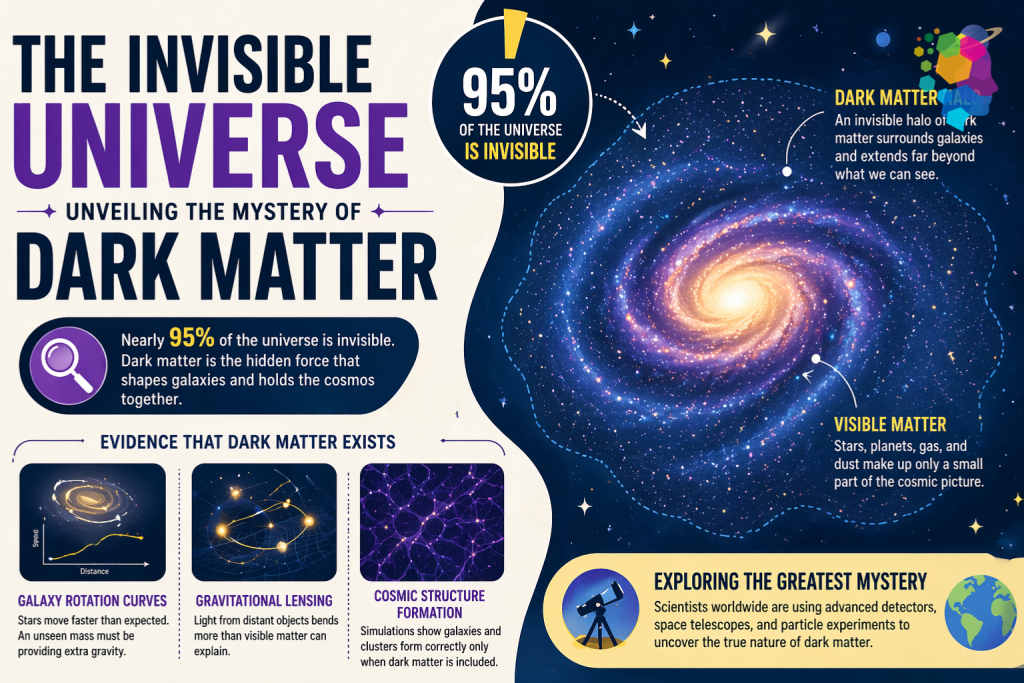
Look up at the night sky and it feels complete, stars, galaxies, and glowing nebulae painting a vivid picture of the cosmos. Yet modern astrophysics reveals a far deeper mystery. Nearly 95 percent of the universe is invisible, composed of unknown substances that neither emit nor interact with light.
At the heart of this hidden reality lies dark matter, an unseen force that silently shapes galaxies, bends light, and governs the large scale structure of the universe. Understanding it remains one of the greatest scientific challenges of our time.
What Is Dark Matter
Dark matter is a form of matter that does not emit, absorb, or reflect light, making it completely invisible to traditional telescopes. Its presence is inferred through its gravitational effects on visible matter.
For instance, stars at the edges of galaxies move far faster than expected. According to classical gravitational theory, they should drift away. Instead, they remain bound, suggesting the presence of unseen mass providing additional gravitational pull.
Evidence from the Universe
Galaxy Rotation Curves
Observations of spiral galaxies show that stars orbit at nearly constant speeds regardless of their distance from the center. This contradicts predictions based solely on visible matter.
The most accepted explanation is the presence of a dark matter halo surrounding galaxies, extending far beyond what we can observe.
Gravitational Lensing
Massive objects bend light passing near them, a phenomenon known as gravitational lensing. However, the amount of bending observed is far greater than what visible matter alone can explain.
This provides compelling evidence for hidden mass in the universe.
Cosmic Structure Formation
The large scale structure of the universe, including galaxies, clusters, and cosmic filaments, is best explained when dark matter is included in cosmological models.
Without it, the universe would not have evolved into the structure we observe today.
What Could Dark Matter Be
Despite decades of research, the true nature of dark matter remains unknown. Scientists have proposed several possible candidates.
Weakly interacting massive particles, often called WIMPs, are hypothetical particles that interact through gravity but very weakly with normal matter. Many experiments are currently searching for them.
Axions are another possibility. These are extremely light particles that could exist in vast quantities across the universe.
Dark matter cannot be explained by the Standard Model of particle physics, which describes known particles and forces. This suggests that new physics may exist beyond our current understanding.
Why Dark Matter Matters
Understanding dark matter goes far beyond solving a cosmic mystery. It plays a crucial role in the formation and evolution of galaxies, the structure and stability of the universe, and the expansion and ultimate fate of the cosmos.
In many ways, dark matter acts as the invisible framework of the universe.
The Future of Dark Matter Research
Scientists around the world are using advanced technologies to uncover the nature of dark matter. These include underground detectors, space based telescopes, and high energy particle accelerators such as those at CERN.
At the same time, new theories are emerging that challenge our understanding of space, time, and matter itself.
Conclusion
The idea that most of the universe is invisible reshapes our understanding of reality. Dark matter is not just a missing component, it is fundamental to the structure and evolution of the cosmos.
As research continues, we move closer to answering one of the most profound questions in science, what is the universe truly made of.
Editor: Ayesha Noor