

Introduction
What if your emotions were not just reactions but patterns that your brain has learned over time
Every feeling you experience from happiness to fear is controlled by networks of neurons constantly communicating inside your brain. These signals shape how you respond to the world, how you remember experiences, and even how you build habits. The exciting part is that these emotional patterns are not fixed. With the right understanding, they can be reshaped.
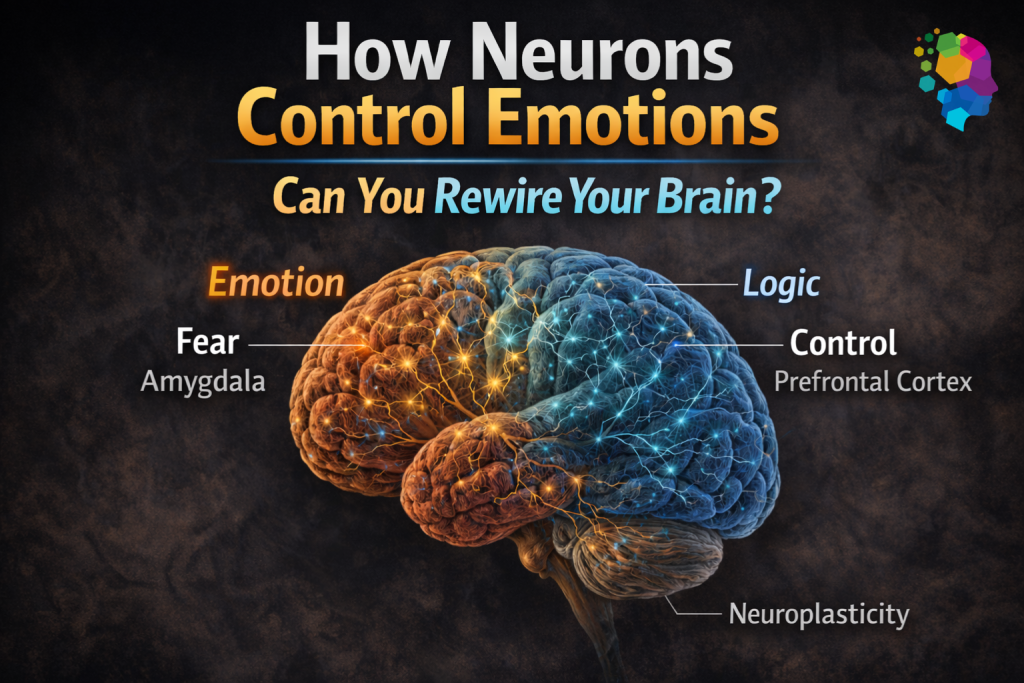
Modern neuroscience shows that the brain is adaptable. Through a process known as Neuroplasticity, your brain can reorganize itself by forming new neural connections. This means your emotions are not permanent states but dynamic processes that can evolve.
Introduction
What if your emotions were not just reactions but patterns that your brain has learned over time
Every feeling you experience from happiness to fear is controlled by networks of neurons constantly communicating inside your brain. These signals shape how you respond to the world, how you remember experiences, and even how you build habits. The exciting part is that these emotional patterns are not fixed. With the right understanding, they can be reshaped.
Modern neuroscience shows that the brain is adaptable through Neuroplasticity, a process that allows it to reorganize itself by forming new neural connections. This means your emotions are dynamic and can evolve with experience.
How Neurons Create Emotions
Emotions begin as electrical and chemical signals between neurons. These signals travel across synapses and create complex networks that define your emotional responses. The human brain contains billions of neurons connected through trillions of synapses, forming highly intricate communication systems.
Key brain regions play essential roles. The Amygdala detects threats and triggers fear responses. The Prefrontal Cortex regulates emotions and decision making. The Hippocampus links emotions with memories.
The Chemistry Behind Your Feelings
Neurons communicate using neurotransmitters that directly influence your emotional state.
- Dopamine drives motivation and pleasure
- Serotonin regulates mood and stability
- Serotonin regulates mood and stability
An imbalance in these chemicals can affect emotional health. Research from the National Institute of Mental Health shows how neurotransmitters influence mood disorders and emotional regulation.
Can You Really Rewire Your Brain
Rewiring your brain is scientifically possible.
Through neuroplasticity, repeated thoughts and behaviors strengthen certain neural pathways while weakening others. This idea is often summarized as neurons that fire together wire together, meaning repeated patterns become stronger over time.
By practicing new mental habits, you can gradually reshape emotional responses and improve resilience.
Techniques That Influence Neural Rewiring
Mindfulness and meditation reduce overactivity in emotional centers and improve control over reactions
Cognitive reframing changes how you interpret situations, altering neural pathways
Physical activity boosts neurotransmitters and strengthens brain connections
Sleep restores neural balance and supports emotional regulation
These methods are supported by global research from the World Health Organization on mental well being.
The Role of Experience in Shaping Emotions
Your brain continuously adapts based on experience. Each repeated thought strengthens neural connections, making emotional responses more automatic over time.
This is why stress can lead to anxiety patterns while positive habits build resilience. Neural networks evolve through repeated activation, reinforcing behavior and emotional memory.
Limits and Challenges of Rewiring the Brain
Although the brain is adaptable, change requires time and consistency.
Deep emotional patterns formed over years cannot be reversed instantly. Stress, trauma, and biological factors can slow the rewiring process. In some cases, professional support may be necessary.
However, even small consistent changes can gradually reshape neural pathways and improve emotional control.
The Future of Neuroscience and Emotional Control
Advances in neuroscience are opening new possibilities for understanding emotions.
Scientists are exploring AI driven mental health tools, brain computer interfaces, and targeted therapies that can influence neural circuits more precisely.
Leading research published by Nature Research highlights how rapidly this field is evolving.
Conclusion
Neurons are the foundation of every emotion you experience.
Through electrical signals and chemical interactions, your brain constantly shapes how you feel and react. While these patterns can become deeply rooted, they are not permanent.
Thanks to neuroplasticity, your brain can adapt and change. By understanding how neurons control emotions and applying consistent habits, you can gradually influence your emotional responses and build a healthier mental state.
Editor: Ayesha Noor