

Introduction
What if chemical discoveries that once took years could now happen in days.
Chemistry has always been a foundation of scientific progress, influencing areas like medicine, materials science, and energy. Traditionally, breakthroughs relied on human intuition, manual experimentation, and repeated trial and error. While effective, these methods are often slow, expensive, and limited in scope.
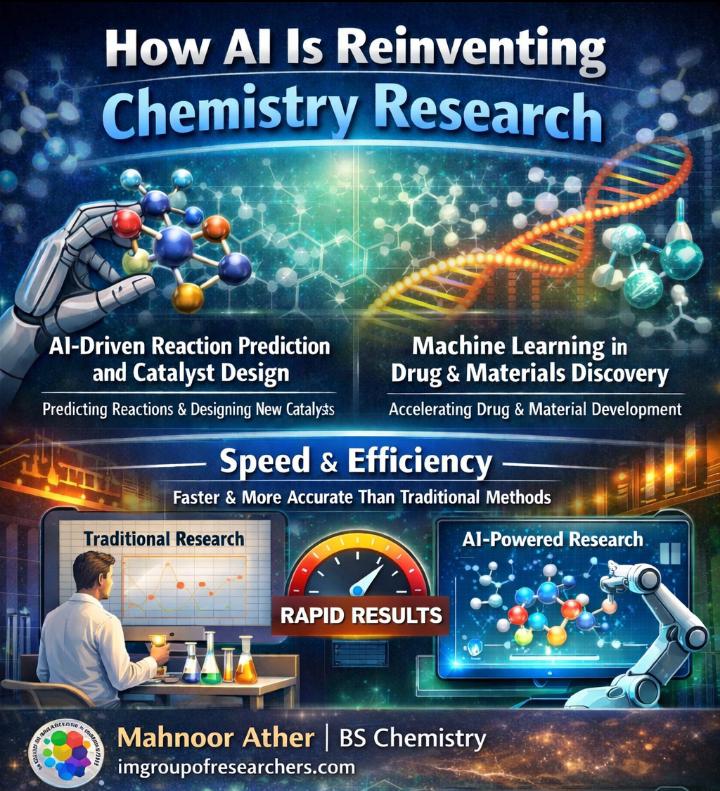
Today, artificial intelligence is reinventing chemistry research. By integrating AI into scientific workflows, researchers can predict reactions, design compounds, and automate experiments with remarkable speed and precision. This shift is not just improving efficiency but fundamentally changing how chemistry is explored and understood.
AI in Reaction Prediction and Catalyst Design
One of the most powerful applications of AI in chemistry is predicting chemical reactions and designing catalysts.
Chemical synthesis depends on identifying the right combination of reactants, catalysts, temperature, and conditions. Traditionally, this involves extensive experimentation. AI changes this by analyzing large datasets of known reactions and identifying patterns that humans might overlook.
How AI improves reaction discovery
AI systems can predict reaction outcomes, recommend optimal conditions, and suggest effective catalysts. This reduces the need for repeated experiments and allows researchers to focus on the most promising pathways.
As a result, scientists are discovering new reactions faster and improving efficiency in laboratories. Deep learning models are already capable of predicting complex organic reactions and enhancing catalyst performance.
This level of precision also connects with advancements in topics like Bioorthogonal Chemistry Explained How Chemistry Sneaks Past Biology, where reactions are controlled with minimal interference in biological systems.
For deeper scientific understanding, studies published by Nature Research shows machine learning are reshaping chemical prediction models.
Accelerating Drug Discovery and Materials Innovation
AI is significantly accelerating progress in both pharmaceuticals and materials science.
Developing a new drug typically requires years of testing and validation. AI shortens this timeline by enabling virtual screening of millions of compounds before physical testing begins.
AI in drug development
Machine learning models can predict how molecules interact with biological systems. This allows researchers to identify the most promising drug candidates early in the process and refine them for better performance and safety.
These advancements align with research directions explored in 5 Molecules That May Cure Major Diseases, where molecular-level interventions are transforming treatment strategies.
AI in materials chemistry
In materials science, AI helps predict the properties of new materials before they are synthesized. This enables the design of advanced materials for energy, electronics, and sustainability.
Researchers are already using AI to develop improved battery materials and efficient solar absorbers, concepts closely related to Beyond Lithium The Battery Materials Quietly Rewriting Energy Storage.
These innovations also support global sustainability efforts, as emphasized by the World Health Organization.
Speed and Efficiency in Modern Chemical Research
AI is dramatically improving the speed and efficiency of chemical research.
Many repetitive tasks such as data analysis, reaction optimization, and simulation can now be automated. This allows scientists to spend more time on creative thinking and innovation.
High throughput exploration
AI powered simulations can analyze complex chemical systems in a fraction of the time required by traditional methods. This enables researchers to explore vast chemical spaces and identify new possibilities quickly.
Such advancements are part of broader innovations discussed in Chemistry at the Edge of the Future 10 Discoveries That Could Change the World, where AI plays a central role in scientific transformation.
Autonomous Laboratories and Smart Experimentation
One of the most exciting developments in chemistry is the emergence of autonomous laboratories.
These labs combine AI with robotics and real time data processing to perform experiments with minimal human involvement.
Capabilities of autonomous labs
Autonomous systems can design experiments, adjust conditions based on results, and optimize reactions continuously. This leads to faster discoveries and highly reliable data.
In pharmaceutical research, autonomous labs can test multiple reaction pathways at once, significantly reducing development time. In materials science, they can rapidly identify new compounds with specific properties.
This concept is closely linked to ideas explored in Can Nanotechnology Build Molecular Robots, where intelligent systems operate at extremely small scales.
AI and Sustainable Chemistry
AI is also playing a key role in making chemistry more environmentally friendly.
By predicting efficient reactions, AI reduces waste and minimizes energy consumption. It can also help design safer chemicals and processes.
Supporting green innovation
AI enables the development of catalysts that work under milder conditions and produce fewer byproducts. It also helps in designing biodegradable materials and sustainable polymers.
These efforts align with global environmental goals and research supported by the National Institute on Aging, especially when considering long term human and environmental health.
AI driven sustainability also connects with emerging ideas in carbon capture and resource conversion, where chemistry is used to turn environmental challenges into opportunities.
Challenges in AI Driven Chemistry
Despite its advantages, AI in chemistry faces several challenges.
High quality data is essential for accurate predictions, but chemical data is often incomplete or fragmented. Additionally, AI models require validation, as they may sometimes produce results that appear correct but are chemically inaccurate.
There are also practical challenges, including the cost of building automated laboratories and maintaining advanced systems. However, as technology continues to evolve, these barriers are gradually being reduced.
The Future of AI in Chemistry
The future of chemistry is becoming increasingly intelligent and connected.
AI is expected to discover new reactions, design advanced materials, and even contribute to the development of new chemical theories. When combined with quantum chemistry and molecular simulations, AI will provide deeper insights into complex systems.
These advancements are closely related to research areas like Invisible Architects How Metal Organic Frameworks Trap the Untrappable, where intelligent design meets advanced materials science.
In the coming years, AI powered platforms may also enable global collaboration, allowing scientists to share data and accelerate discoveries across borders.
Conclusion
Artificial intelligence is transforming chemistry at every level.
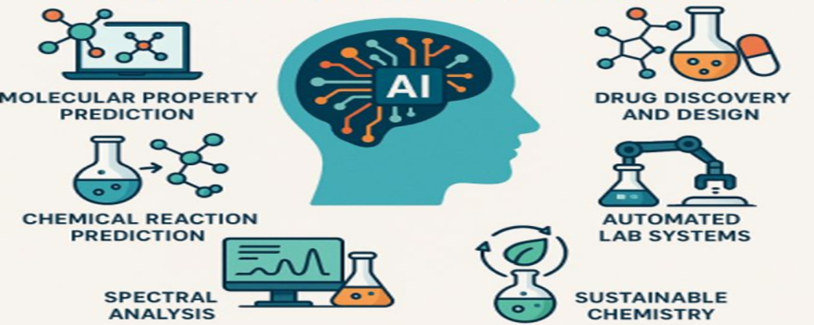
From predicting reactions and accelerating drug discovery to enabling autonomous laboratories and sustainable processes, AI is expanding both the speed and scope of scientific research.
By combining human creativity with computational power, researchers can explore new possibilities, reduce waste, and make discoveries that were once unimaginable.
As AI continues to evolve, it will become more than just a tool. It will act as a true partner in scientific discovery, shaping the future of chemistry in powerful and exciting ways.
Editor: Ayesha Noor