

Introduction to the New Era of Solar Power
Solar energy has long been seen as the key to a sustainable future. However, for decades, traditional silicon solar cells have limited how far this technology could go.
Now, everything is changing.
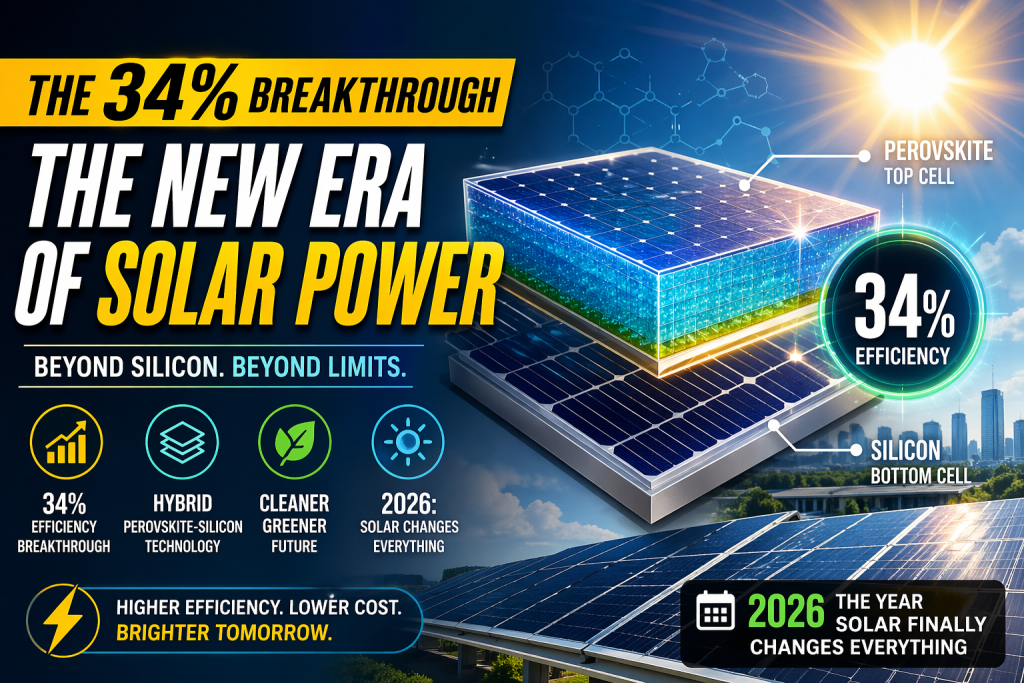
A new generation of hybrid solar cells has crossed a critical milestone, reaching efficiencies close to 34 percent. As a result, scientists and engineers are entering a new era where solar power is no longer just an alternative, but a dominant energy source.
This shift is not happening in isolation. In fact, it is part of a broader wave of innovation in advanced materials, similar to what we explored in Beyond Lithium: The Battery Materials Quietly Rewriting Energy Storage.
What Is the 34% Solar Efficiency Breakthrough
The term efficiency in solar technology refers to how much sunlight a solar panel can convert into usable electricity.
Traditional silicon panels typically operate between 18 percent and 22 percent efficiency. In contrast, new perovskite silicon tandem solar cells have achieved efficiencies approaching 34 percent under laboratory conditions.
This means:
• More electricity from the same amount of sunlight
• Reduced installation space
• Lower overall cost per unit of energy
Therefore, this breakthrough represents a major leap in renewable energy technology.
Learn more from the National Renewable Energy Laboratory
https://www.nrel.gov/pv/perovskite-solar-cells.html
Beyond Silicon: How Hybrid Solar Cells Work
The Science Behind Tandem Solar Cells
Hybrid or tandem solar cells combine two different materials to capture more of the solar spectrum.
The top layer uses perovskite materials, which absorb high energy light. Meanwhile, the bottom layer uses silicon to capture lower energy wavelengths.
As a result, more sunlight is converted into electricity instead of being lost as heat. This principle of maximizing efficiency at the molecular level is closely related to breakthroughs in nano engineering and porous materials, as discussed in Invisible Architects: How Metal Organic Frameworks Trap the Untrappable.
Why 2026 Could Be the Turning Point for Solar Energy
Rapid Commercial Scaling
Several companies and research labs are now racing to commercialize tandem solar cells. As production scales, costs are expected to drop significantly, just as we have seen in other material revolutions across clean technology.
Energy Demand and Climate Pressure
At the same time, global energy demand is rising, and climate challenges are becoming more urgent. Therefore, high efficiency solar solutions are no longer optional but necessary.
Integration With Next Generation Technologies
Hybrid solar technology is also being integrated with smart grids, AI driven systems, and advanced storage solutions. This connection becomes even clearer when you look at Beyond Lithium: The Battery Materials Quietly Rewriting Energy Storage (Insert Internal Link Here).
Applications of Hybrid Solar Cells in the Future of Energy
The impact of this breakthrough extends far beyond rooftops.
Residential and Urban Energy Systems
Buildings can generate more power using less space, making solar more accessible in dense cities.
Portable and Flexible Solar Devices
Because perovskites are lightweight and flexible, they can be used in wearable electronics and mobile energy systems.
Industrial and Grid Scale Energy
Higher efficiency means fewer panels are needed, reducing land use and infrastructure costs.
Sustainable Chemical Systems
Interestingly, hybrid solar systems are also enabling chemical innovations such as converting carbon dioxide into useful fuels, a concept closely aligned with From Pollution to Product: The New Chemistry Turning CO₂ into Cash.
Challenges Still Facing Hybrid Solar Technology
Despite its promise, this technology still faces several challenges.
Stability Issues
Perovskite materials can degrade when exposed to moisture and heat.
Manufacturing Scalability
Producing stable and durable panels at large scale is still under development.
Environmental Concerns
Some perovskites contain lead, raising concerns about sustainability and safety. However, ongoing research in green chemistry is addressing these issues, similar to approaches discussed in How Biodegradable Plastics Are Made: The Chemistry Behind Eco Friendly Polymers.
The Future of Solar Power and Global Impact
The 34 percent efficiency milestone is more than just a number. Instead, it represents a shift in how we generate and use energy.
As hybrid solar cells become commercially viable, they could:
• Reduce dependence on fossil fuels
• Lower global carbon emissions
• Make clean energy more affordable worldwide
Learn more from the International Energy Agency
https://www.iea.org/reports/solar-pv
Conclusion: Solar Power Is Entering Its Golden Age
In conclusion, solar energy is no longer limited by traditional technology. The rise of hybrid cells marks the beginning of a new era where efficiency, affordability, and scalability come together.
By 2026, solar power could move from being a growing industry to becoming the backbone of global energy systems.
The question is no longer whether solar will dominate, but how quickly it will happen.
Editor: Ayesha Noor