

Introduction
What if your fears did not begin with you
What if the stress your ancestors experienced still lives inside your biology
What if the impact of conflict does not end when the war does
As the world faces rising global tensions, displacement, and humanitarian crises, scientists are asking a deeper question
Can trauma reshape biology in ways that extend beyond a single lifetime
Epigenetic trauma research is uncovering a powerful idea that challenges how we understand inheritance. Scientists are now exploring whether trauma can leave chemical marks on DNA that pass from one generation to the next. This suggests that the body may carry echoes of experiences it never directly lived
At the center of this discovery is Epigenetics, a field that studies how gene activity can change without altering the DNA sequence itself
What Is Epigenetic Trauma
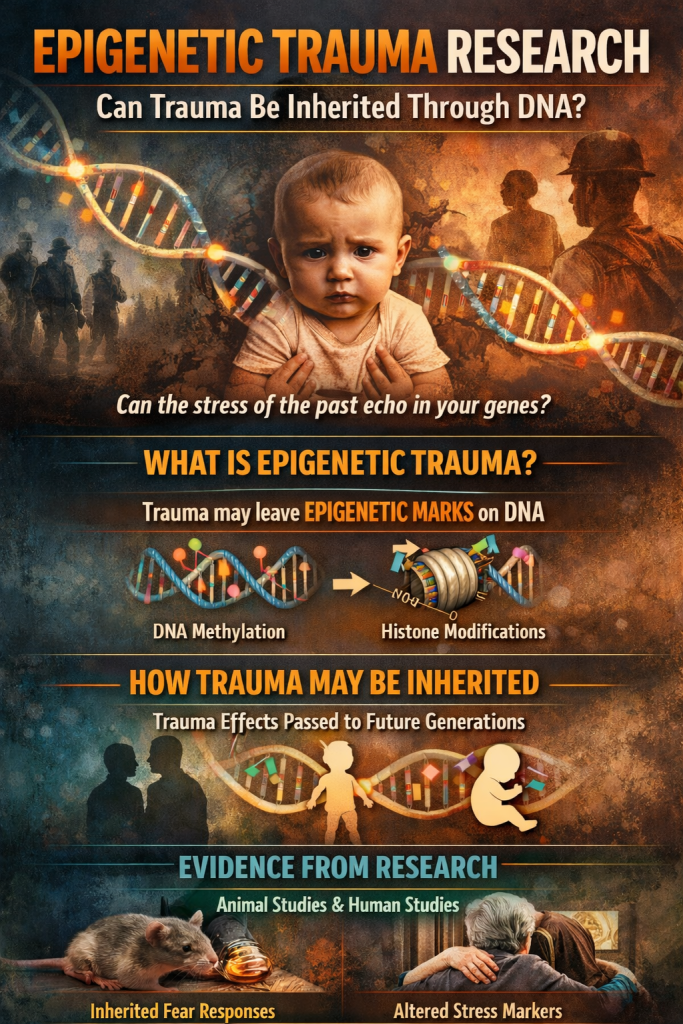
Epigenetic trauma refers to the possibility that stressful or traumatic experiences can modify how genes are expressed through chemical changes. These changes do not rewrite DNA but influence how it behaves
One of the most studied mechanisms is DNA methylation, where chemical tags attach to DNA and regulate whether certain genes are turned on or off
When trauma occurs, these chemical marks can alter stress response systems in the body. The key question researchers are asking is whether these changes can be passed down to future generations
How Trauma May Be Inherited
Scientists believe that trauma related epigenetic changes may be transmitted through reproductive cells. This means that the biological effects of stress could move from parents to children without direct exposure
Research suggests that environmental factors such as fear, starvation, or chronic stress can influence gene expression patterns. These patterns may then appear in offspring, shaping how they respond to stress and their environment
Evidence from Scientific Studies
Some of the strongest evidence comes from animal studies. In one well known experiment, mice were conditioned to associate a specific smell with danger. Over time, their offspring showed sensitivity to the same smell, even though they had never experienced the original threat
Human studies are also beginning to reveal similar patterns. Research on descendants of individuals who experienced events like the Holocaust has shown altered stress hormone levels and epigenetic markers linked to trauma
These findings suggest that biological traces of extreme stress may persist across generations, although more research is needed to fully understand the extent and mechanisms of this inheritance
The Science Behind It
Epigenetic trauma research focuses on how chemical markers influence gene activity. These markers act like switches that control whether genes related to stress, fear, and emotional regulation are active
Key processes include
DNA methylation affecting gene silencing
Histone modification altering DNA accessibility
Changes in gene expression related to stress hormones
Together, these mechanisms shape how the body reacts to future challenges
Global Conflict and Epigenetic Impact
Ongoing conflicts around the world are exposing millions of people to chronic stress, fear, and instability. These conditions are known to influence biological systems, particularly those related to stress regulation
Researchers are increasingly interested in whether populations exposed to war, displacement, and long term uncertainty may carry epigenetic changes that extend beyond a single generation
Children born to individuals who experienced extreme stress may inherit altered stress responses, even if they grow up in safer environments
This raises important questions about how today’s global crises may shape the biology of future generations
Environmental and Lifestyle Influence Beyond Trauma
Epigenetic changes are not shaped by trauma alone. Factors such as nutrition, pollution, lifestyle, and social environment also play a significant role in modifying gene expression
This means that the biological inheritance passed to future generations may reflect a combination of stress, environmental exposures, and daily habits
Understanding this broader influence highlights that while trauma can leave marks on the body, positive changes in environment and lifestyle may also help reshape these epigenetic patterns over time
Why This Changes Our Understanding of Inheritance
Traditionally, inheritance was thought to be based only on DNA sequences. Epigenetic trauma research introduces a new layer where life experiences can influence biological outcomes
This means that inheritance is not just about genes but also about how those genes are regulated based on past environments
It challenges the idea that each generation starts from a completely clean slate
Implications for Mental Health
If trauma can be inherited, it may help explain why certain stress related conditions appear across generations
This research could transform how we approach
Anxiety disorders
Depression
Post traumatic stress responses
Understanding epigenetic influences may lead to more personalized treatments that consider both genetic and environmental history
Ethical and Scientific Questions
Epigenetic trauma research raises important questions
Can inherited trauma be reversed
How much of behavior is shaped by ancestral experience
Should this knowledge influence healthcare and policy
While the science is still evolving, it opens a new perspective on responsibility, healing, and identity
The Deeper Perspective
Your DNA is not just a static code. It is a dynamic system shaped by interactions with the environment across time
Epigenetic trauma research suggests that the human body carries a biological memory that extends beyond individual experience
This does not mean destiny is fixed, but it does mean that the past may influence the present in ways we are only beginning to understand
Conclusion
Epigenetic trauma research is reshaping the boundaries of biology and psychology. The idea that trauma can leave chemical marks on DNA and potentially pass across generations challenges everything we thought about inheritance
As science continues to explore this field, one realization becomes clear
The story of your body may have begun long before you were born
Editor: Ayesha Noor