

How Scientists Are Learning to Turn Memories ON and OFF
Introduction
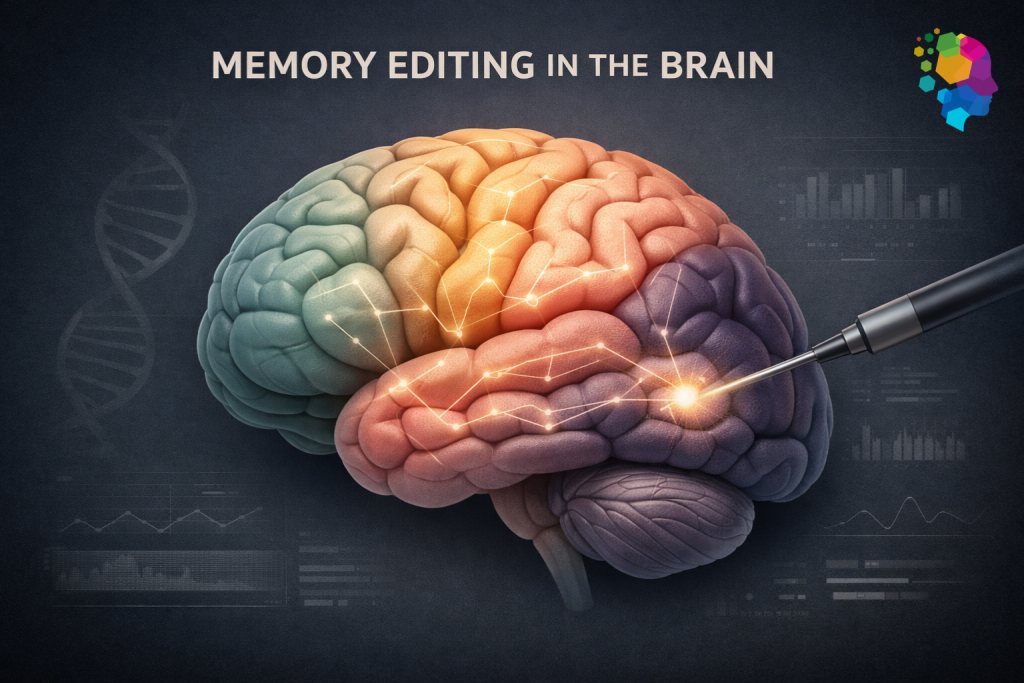
What if your memories were not fixed records of the past?
What if they could be activated, suppressed, or even rewritten?
Modern neuroscience is revealing a reality that feels closer to science fiction than biology: memory is not just stored it is actively reconstructed and, under certain conditions, controllable.
At the center of this breakthrough is a revolutionary technique called optogenetics.
What Is Optogenetics?
Optogenetics is a method that allows scientists to control specific neurons using light.
Researchers insert light-sensitive proteins such as Channelrhodopsin into brain cells. Once these proteins are in place, scientists can:
Activate neurons using light
Silence neurons with different wavelengths
Control brain circuits with extraordinary precision
Unlike older techniques, this does not affect the whole brain only specific neurons linked to a memory.
The Discovery of the “Memory Trace”
The idea that memories exist as physical traces dates back to early theories of the
Engram.
Today, scientists understand that:
A memory is not stored in one place
It exists as a network of neurons firing together
This network can be identified, tagged, and reactivated
This means memory is not a static recording it is a dynamic neural pattern.
The Experiment That Changed Everything
A groundbreaking study led by Susumu Tonegawa demonstrated something extraordinary.
Here’s what scientists did:
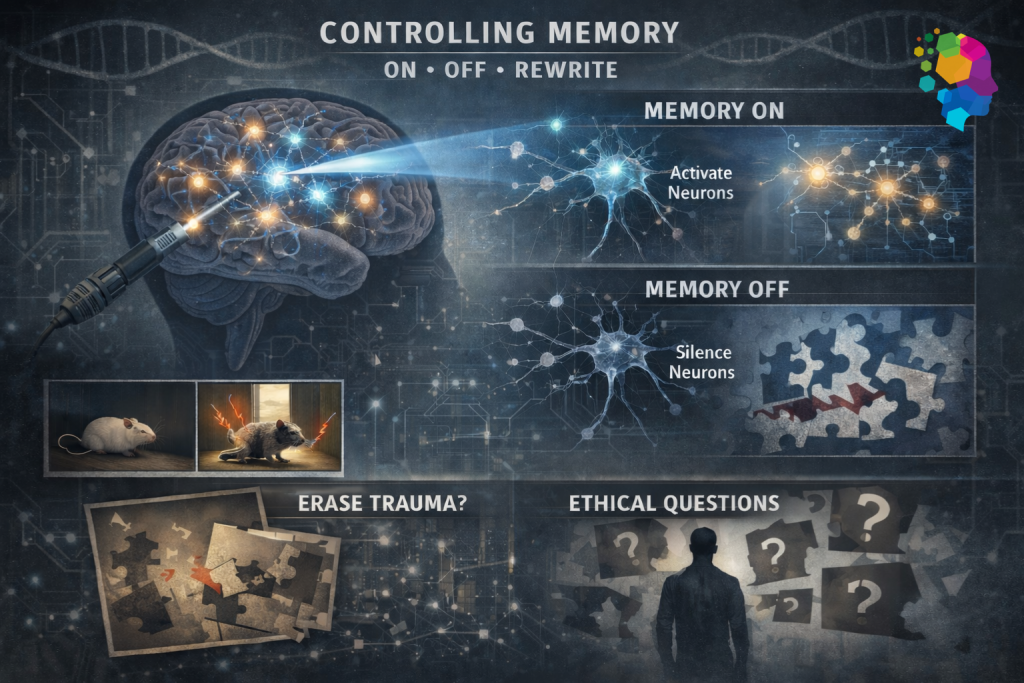
- A mouse explored a safe environment
- Researchers identified and tagged the neurons active during that experience
- Later, they activated those same neurons while delivering a mild shock in a different environment
The result:
The mouse began to fear the original safe environment.
It had formed a false memory.
Turning Memory ON
When scientists activate specific memory-related neurons:
The brain replays the experience
The subject behaves as if the memory is happening again
Context no longer matters the circuit alone triggers the response
Memory can be artificially recalled without reality
Turning Memory OFF
By suppressing those same neurons:
The memory becomes inaccessible
Emotional responses like fear disappear
Behavior linked to that memory changes
Importantly, the memory is not always erased it is often disconnected from its emotional impact.
What This Means for Trauma and Fear
This research has major implications for conditions like:
PTSD
Phobias
Anxiety disorders
Instead of simply treating symptoms, scientists may be able to:
Target the exact neural circuits causing distress
Reduce or eliminate harmful emotional responses
Rewire how the brain reacts to past experiences
The Deeper Truth About Memory
These discoveries reveal something profound:
Memory is not a perfect recording
Memory is a reconstruction process
Every time you recall something:
Your brain rebuilds the experience
That reconstruction can change
The memory itself can evolve
Ethical Questions Should We Edit Memory?
With this power comes serious ethical concerns:
Should painful memories be erased?
Could memories be manipulated without consent?
What happens to identity if memories are altered?
Because if memory defines who we are, then changing memory means:
Changing the self
The Future of Memory Science
Although most of this research is currently limited to animals, the trajectory is clear.
Scientists are moving toward:
Precision brain therapies
Advanced brain machine interfaces
Controlled memory modulation in humans
We are not fully there yet but the foundation has already been built.
Final Thought
The brain does not store reality it stores patterns.
And now for the first time in history humans are learning how to control those patterns.
Memory is no longer just something we have.
It is something we may one day edit.
Editor: Ayesha Noor